Art

$hopping $pree

Lately, we’ve been spending money right and left.  All in the name of academics, of course.


$ – We bought a geological era poster because we were reading –

Why We Went Extinct, by Tadaaki Imaizumi and Takashi Maruyama.  How did these authors take a sobering topic and make it so readable?  59 extinct animals are showcased, each species presented on a 2 page spread.  But wait!  The final section celebrates 10 species who AGAINST ALL ODDS managed to adapt and have a presence today (we have new respect for the opossums that traipse across our back yard…these guys have dealt with rather a lot in the past 65 million years).   A mountain of research went into this book.  We learned a LOT, we smiled a LOT, and I said, “this is hilarious” a LOT.
So, on each 2 page spread:
– a lengthy, highly amusing explanatory quote from the very voice (ranging from streetwise to “not the sharpest knife in the drawer”) of each animal (my son and I are sort of fans of anthropomorphizing)
– a “regret” or “key to success”
– an illustration
– a factual paragraph
– a tiny era/period chart (which is why we had to buy a poster sized chart), showing when said species bid farewell

$ – We bought a periodic table poster because we were reading – 
Marie Curie (for Kids), Her Life and Scientific Discoveries, authored  by Amy M. O’Quinn.  What a role model:  focused scientist (2 Nobel Prizes), devoted to family, brilliant contributor to the French cause in WWI (master-minded how to get mobile x-ray units to wounded troops).  Grabbing our attention:
– Marie’s husband Pierre Curie was killed when he was mowed down by a horse-drawn cart!
– Marie hid all of her intensely toxic radium in a secured lead box during WWI.  How much?  ONE HALF TEASPOON FULL  (my son and I examined my measuring spoons.  1/2 tsp.  Whoa.).
– Marie Curie passed away at age 66, her daughter Irene, also a Nobel Prize winning scientist passed away at age 58, but daughter, Eve, journalist and pianist, made it to 102.  Message received:  write, play the piano, keep a safe distance from radioactive metals, live long.
– we needed to see where polonium and radium (for which she received Nobel Prizes) were positioned on the periodic table (which is why we bought the poster).

$ – We bought a half pound of Chinese fortune cookies because we were reading – 
Top Story, 5th in an important series by Kelly Yang (engaging story lines that weave in an awareness of the meanness and (HELLO) the short-sightedness of racism).  This book finds protagonist Mia Tang attending journalism camp in San Francisco….once there,  she makes friends with someone who helps out at a fortune cookie factory (my son was not familiar with fortune cookies, so that was reason enough for the purchase).  But there is so much more to the story.  The book has a triumphant conclusion and we are looking forward to the next in the series (Chef’s Secret). 

Because my son and I were impressed by the community support in Yang’s depiction of San Francisco’s Chinatown, we read San Francisco’s Chinatown – and the tight community spirit came through on every page with text by Kathy Chin Leong and vibrant photographs by Dick Evans.  For us, most eye-opening essay:  SRO (single room occupancy) Apartments.  Our favorite essay:  Red Envelopes.

Story Problem:  It is “Strawberry Spree” time at Farmer Brown’s roadside stand.  The stand is selling strawberries of course, but also their strawberry glacé pie and strawberry jam (both of which recently earned blue ribbons at the state fair!).
Sold separately:
– the pie sells for $15
– a jar of jam sells for $6
– a small box of strawberries sells for $4
– a “Strawberry Spree” basket with a pie, a jar of jam, and a small basket of strawberries sells for $20.
Last Saturday, the roadside stand sold:
– 10 pies
– 10 jars of jam
– 30 boxes of strawberries
– 15 strawberry spree baskets
Did the roadside stand make more money from the items sold separately or from the “strawberry spree” baskets?  (answer at bottom of post)

Orchestral Music Time – 

$ – We bought a harmonica because everyone should have a chance at making music with this pocket sized marvel –
1) I was hopeless on our harmonica and 2) when I tried to hand it over to my son he reacted as if I were offering him a poisonous snake.  We settled for listening to some harmonica pros – 

Sigmund Groven:  Strawberry Fair –  this old English folk song (first published in 1891) is just the very thing to accompany our “strawberry spree” story problem.  Sweet and well played – 

Jack Harrison:  Moon River – from Henry Mancini’s motion picture score for Breakfast at Tiffany’s, winning the 1962 Academy Award for Best Original Song.  This is a lush adaptation –

Stevie Wonder:  Isn’t She Lovely – his sensation from 1976.  I had no idea that Stevie Wonder was a harmonica virtuoso.  His harmonica playing starts about a minute into the recording.  My son was vigorously tapping his toes the whole way through.  Wonder performed the song for Queen Elizabeth II at her Diamond Jubilee Concert in June of 2012 – 

Welcome to the best part of my day!
 – Jane BH
(story problem answer:  the roadside stand made more money from the “strawberry spree” basket sales)

The Call of the Wall

What if there was a blank wall?  Then all of a sudden:  Street art!  Graffiti!  Spray paint us interested.

Book:  Banksy Graffitied Walls and Wasn’t Sorry, by Fausto Gilberti. Talk about timing:  the minute my son and I finished this informative book (with its fabulously whacko illustrations) – LIKE MAGIC –  a new Banksy statue appears in London!   We are in awe of Banksy’s nerviness, we are aligned with Banksy’s message, we now have a Banksy poster up on the wall.

Book:  Hey, Wall, by Susan Verde and John Parra.  This quick reading, almost sweet book clarifies the difference between graffiti and street art.  Excellent notes from both author and illustrator at conclusion of book.

– from the sarahknightwriter.com website

Website:  Graffiti on the Berlin Wall – we read through a simply excellent essay, “How Nikita Khrushchev Turned Berlin into a Happening Art Scene” on the sarahknightwriter.com website.  (HIGHLY RECOMMEND).  Superb, organized writing (with a comprehensive definition of graffiti).  After reading, we had maps out, looking at Germany after WWII.  We spent time considering the mean-spirited wall constructed around West Berlin in 1961.  Anyway, the “western” side of the wall ended up covered in graffiti….some of it still preserved.  SO INTERESTING.

Up close and personal:  Street Art in San Pedro, California – back in 2018, one of my best friends from UCLA days, Miss LynnDee, invited me to come see what was about to happen in her hometown of San Pedro:  the community was coming together to create a 2,000 foot mosaic mural (master-minded by artist Julie Bender) on a retaining wall that faced the Pacific Ocean.  Oh boy!  A completely fun day was spent in a ceramics lab (note my tiny tile effort, obviously critical to the wall’s artistic statement).  The mural was completed in 2021.  What fun to share photos of this San Pedro treasure with my son.  He was so focused when viewing the mosaic interpretations of fish, sea birds, and boats.  He is familiar with the concept of mosaics from our study of the Vatican (see “Holy Zucchetto!” from September 2015 if ya want proof).


Because it’s not all about the call of the wall:

Our Tom Gates Marathon –  My son and I have our grin machines turned on if we are ending an evening’s study with a dip into a Tom Gates book.  Over the years, we have read Liz Pichon’s Tom Gates books here and there, but we decided to give these books a serious re-read, starting with book 1, The Brilliant World of Tom Gates, straight through to book 24 (and hopefully, book 25), no stopping.  Here is what we like about the Tom Gates books:  

the cast of characters 
(who drains us the most?  Tom’s sister Delia? Uncle Kevin? Marcus Meldrew?)
– the pickles Tom gets himself into – the oodles of doodles – the British vernacular –

So the marathon has begun.  We have finished book 1 and are half way through book 2 (Tom Gates – Excellent Excuses).

Story Problem –  The local diner is hosting a sidewalk chalk art experience for kindergarteners.  The diner will provide chalk, complimentary refreshments (their famous “not too tart” lemonade), AND the diner has contracted with multi-talented town photographer, Miss Diane, to take photos of the sidewalk art, create a poster from said photos, and print up loads of copies that will eventually be available for sale – as an impulse buy – right next to the diner cash register.

The diner has budgeted $50 for their lemonade and $75 for the chalk.
The posters will cost $10 to print up and will sell for $15.

– How many posters will need to be sold to recoup the cost of the chalk and the lemonade?
A)  25     B)  50     C)  75     D)  100

– If 40 young ’uns participate in the sidewalk art experience, and all of their moms, 4 teachers, and 15 grandparents purchase a poster, how much profit will the diner see from the event?
A)  $40     B)  $59     C)  $170     D)  $295 (answers at bottom of post)

Orchestral Music – a Banksy soundtrack!  My son and I agreed that we would LOVE to accompany Banksy on a stealthy midnight art installation.  We did not agree on background music for for sneaking around with Banksy – 

  • My son picked The Pink Panther Theme, composed by Henry Mancini for the 1963 film.  Nominated for Academy Award for best original score (but lost to Mary Poppins).  Sneaky, sneaky, sneaky.

  • I picked Anitra’s Dance, from Peer Gynt Suite No. 1, composed by Edvard Grieg in 1875.  Sneaky and sly, fast tiptoeing.  (Oooooh!  Look at the intensity of Thomas Dausgaard, the conductor.  No wonder the performance is so A+!)

  • …but we both agreed that the boldness of Banksy’s art is well matched with Aaron Copland’s Fanfare for the Common Man, composed in 1942.  This particular video, featuring Leonard Bernstein as conductor, spots Mr. Copland seated in the balcony.  (I shed tears.)

Welcome to the best part of my day!
– Jane BH
(story problem answers:  A)  25 and D) $295)

Newfangled

The past few weeks my son and I time-traveled back 100+ years and placed ourselves in a general population confronted by such newfangled shockers as – 

– the paintings of Pablo Picasso – 
– a WOMAN in the USA President’s cabinet – 
– Frank Lloyd Wright’s radical approach to home design –

While most of the newfangled ideas of this time frame enjoyed short-lived popularity (we read about hippo farming, teaching science by dance, and I think, our favorite: the coat parachute), Picasso, Perkins, and Wright were game changers –

  
Pablo Picasso (1881 – 1973).  We loved 100 Pablo Picassos – an engaging and actually fun introduction to Pablo Picasso and his many distinct painting styles, authored by Mauricio Velasquez de Leon, illustrated by Violet Lemay.  The book has a young person’s vibe to it, while maintaining respectable reference book standards.  It’s in our basket for another read through.

Frances Perkins (1880 – 1965).  The Only Woman in the Photo by Kathleen Krull, illustrated by Alexandra Bye.  We learned how the eminently qualified, workers rights advocate Frances Perkins came to be the first woman in a President’s cabinet, serving as Secretary of Labor for FDR (1933 – 1945). A graduate of Mount Holyoke College, which her grandmother Mary Lyon (chemist and educator) had founded (!), Perkins was instigator of groundbreaking workplace and fire safety laws for the state of New York.  As Secretary of Labor,  triumphs included the concept of a minimum wage and the Social Security Act.

Frank Lloyd Wright (1867 – 1959).  Thanks to Frank Lloyd Wright for Kids – His Life and Ideas, by Kathleen Thorene-Thomsen, my son and I are starting to recognize signature components of Frank Lloyd Wright houses:  nature driven, organic, long horizontal lines, geometric shapes, and at all times blending into the landscape.  (Note to self:  FLW never built house with basements because he felt that anything stored in a basement should be thrown away.)  The book also references his splendid building commissions, our favorite being the Guggenheim Museum, (the shape based on a common garden snail’s shell). Plans began in 1946, building was completed in late 1959, facing controversy every step of the way. (sigh)

Easy story problem:  Farmer Brown needs a new truck –  

Farmer Brown needs a new vehicle for, you know, farm stuff.  Before he visited local truck dealerships he made a lengthy list of “wants and dislikes”.  Frankly, some of the newfangled vehicle “improvements” make him crazy.  Among other things, he does NOT want to be distracted by information projected onto his windshield and is it too much to ask for a CD player in the cab?  Anyway, Farmer Brown has taken test drives at 6 of the 8 vehicle dealerships within a 10 mile range of his ranch.  What percentage of these dealerships have not yet had the pleasure of dealing with Farmer Brown’s list of “wants and dislikes”?

A)  6%     B)  10%     C)  20%     D)  25%     (answer at bottom of post)

Good old fashioned fiction (nothing newfangled here) – 

Hope was Here, written by Joan Bauer.  This wonderful book made us consider the possibilities of non-traditional  families, diner waitressing as an art, taking action against corrupt politicians.  We both enjoyed the book and were sort of sad to have it end.

The Further Adventures of Miss Petitfour, by Anne Michaels, illustrations by Emma Block.  If possible, this book is more fun than its predecessor, The Adventures of Miss Petitfour.  Clever way with vocabulary, clever story lines, clever cats.  Write more, Ms. Michaels.

Harriet the Spy, by Louise Fitzhugh.  We heaved a big “oh, brother!” when we learned that members of a school district in Ohio tried to ban this book in 1983, on grounds that the protagonist (Harriet) was a bad role model (spying/talking back/cursing).  Meanwhile, WE are enjoying the many layers of this book, and I am pretty sure that my son can read about spying on neighbors without actually deciding to spy on neighbors.  However, as he is non-verbal, I would sort of be pleased if my son “talked back” or “cursed”. 

Classical Music:  back to the newfangledness  we listened to music that certainly fell into the “new and NOT improved” category according to critics of the day (late 1800’s – early 1900’s).  Music that Picasso, Frances Perkins, and Frank Lloyd Wright may well have been aware of –

Jeux de Vagues (Play of the Waves) from Claude Debussy’s 3-movement composition of 1904, La Mer.  Initially met with confusion, maybe because there seems to be no introduction or conclusion?  It is as if Debussy has transported us into the middle of a mildly turbulent ocean, capturing in music the movement of  wind and water.  My son and I like listening for the comforting sounds of the harp woven in throughout this piece.

Piano Concerto No. 1 in D-flat major, movement 3. Sergei Prokofiev premiered this piece in 1911 and although there were some who could recognize its brilliance, the general reaction was, “THE IMPERTINENCE!”.  And consider this:  Prokofiev played this piece for a competition, reasoning that the jury would be unable to judge whether he was playing well or not.  My son and I haven’t really got a grasp on this brisk paced, marching, squeaking, tantruming, everything-but-the-kitchen-sink whirlwind.  For us, even 114 years after its premiere, it remains newfangled (but we are intrigued).

Les Bulles de Savon (The Soap Bubbles), from Georges Bizet’s Jeux d’Enfants suite of 1871.  This short, abrupt (soap bubbles popping?), adorable piece for “piano with four hands” sparkles with sassy, clearly discordant tones.  As discordant and sassy as this piece is, it was embraced, not criticized, by its first audiences….maybe because it was part of a suite for (discordant and sassy) children. We love this piece.

Welcome to the best part of my day!
– Jane BH
(story problem answer:  D)  25%)

Down the Rabbit Hole

This post is a bit different from my usual efforts.  We got side-tracked.  We went down the rabbit hole and this is how it happened.

First – In early August, I flew to San Francisco to spend a few days with a favorite family member (a postdoc at UCSF/we are ridiculously proud/his apartment is chaos).  Anyway, as we trekked around the hilly city we kept passing loads of friendly people decked out in tie-dyed shirts, emanating Eau de Weed, drawn to San Francisco that very weekend for the “60th anniversary of the Grateful Dead” festival.  Deadheads!  Well!  Interesting!

So then I thought, maybe I should put together a study unit on the hippie/flower child era to share with my son.

So then, to get things going, I procured a book that captured the vibes of the three day art and music festival that rocked the summer of 1969:  Woodstock, edited by Mike Evans and Paul Kingsbury.  Well organized information paired with intriguing photographs. (It is going to take us a long time to work through this book cuz a lot of the printing is done in what appears to be font size: 1 point.)  If it has to do with Woodstock, it is in this book:  the lead up, the venue choice, the sound system, the musicians, the lack of food concessions, the parking nightmare, the rain, the mud, etc.  Bottom line:  my son is in rapt attention mode when this book is opened.  So far, our favorite entries:

  • the Woodstock poster, an iconic image of the counterculture.  Graphic artist Arnold Skolnick was given the project on a Thursday and his design was due the following Monday.  He delivered.  (This prompted a mini discussion with my son about trusting your instincts when time is short. Not really sure this sunk in.)
  • the personal reflections of the performers, most of whom remember being quite nervous about performing for such a large audience (400,000 people.  That is kind of a lot).  They delivered.

So then, to enhance our immersion into the counterculture, we re-read (maybe for our 5th time, but now on high alert for the hippie nuances) Gordon Korman’s Schooled, and my son listened to (for at least the 100th time) the broadway show, Hair (1968), during nightly trampoline time.

So then, back to Woodstock:  after we pinpointed the Woodstock location on our map (upstate New York), we crossed the country to learn about the San Francisco-hippie era relationship, reading through the stunning Above & Across San Francisco book, edited by Sam Landers and Michelle Fitzgerald.  We really didn’t learn anything about the hippie era, but we were captivated by the collection of photographs showing the many best sides of San Francisco.

So then I thought, might we desire to spend a bit of time musing over the CRAZY fog that teases San Francisco?  News to us:  the fog has been named Karl.  We read Karl the Fog, written by Karl himself!  Loads of fab fog fotos accompanied by Karl’s sly way with words.

So then I thought, let’s get back to the hippie era:  since this study unit was inspired by the Grateful Dead festival, didn’t my son need to know a bit about this American rock band?  We Wikipediad up and read bits  about the Dead (and their technical catastrophes at Woodstock)/San Francisco/Jerry Garcia.  We listened and swayed back and forth to the welcoming, warm harmonies of  “Uncle John’s Band” (1969).  This piece is included on the Rock and Roll Hall of Fame’s “500 Songs that Shaped Rock and Roll”.

So then I thought, speaking of Jerry Garcia, maybe we should celebrate this unit with a scoop or two of “Cherry Garcia”, the Ben and Jerry ice cream flavor that  was developed in 1987.   Did my son love Cherry Garcia ice cream? YES.  Will Cherry Garcia be served on his upcoming birthday?  YES.

Lastly – I thought maybe we should learn something about the Ben and Jerry ice cream business, so we read The Sweetest Scoop, written by Lisa Robinson with the perfect accompanying watercolor illustrations by Stacy Innerst.  This book made us love Ben and Jerry’s even more.  Made us roll our eyes at a particular major corporation that blocked B and J ice cream from major grocery store chains for 4 years (FOR SHAME).

Yes, I would say we were officially down the rabbit hole:

San Francisco/Woodstock/Schooled/Hair
back to San Francisco/Karl the Fog/Grateful Dead

Cherry Garcia ice cream/the Ben and Jerry story

This was so much fun!
Welcome to the best part of my day,
– Jane BH

Sesquicentennial!

A sesquicentennial celebration!  Jane’s Cool School’s 150th post! 

To mark the occasion,  I scoured the previous 149 posts and came up with a general knowledge  quiz for my son, consisting of 150 questions.  He did quite well, earning an A+.   

Here is a sampling of the questions (answers at bottom of quiz).  Fret ye not, I have selected only 15 of the 150 questions:

General Knowledge Quiz – Express Lane Style

1)  A blue moon is:

a-  a second full moon in a month     
b-  a moon with a blue tinge due to gravitational pull from Venus     
c-  a full moon in Winter     
d-  a sad moon

2)  The first wheels:

a-  chariot wheels     
b-  grain grinding wheels     
c-  wheels of cheese     
d-  potters’ wheels

3)  Which of the following is NOT depicted on the Sistine Chapel ceiling:

a-  Creation     
b-  The Last Supper     
c-  Adam and Eve     
d-  Noah and the Flood

4)  “Alpha”, “Bravo”, “Charlie” are ways of communicating letters in:

a-  NATO phonetic alphabet     
b-  children’s books     
c-  Navajo Code     
d-  Morse Code

5)  The USA enjoys many unspoiled national parks due to the influence of:

a-  the Pope     
b-  John Muir     
c-  Frederic Remington     
d-  Buffalo Bill Cody

6)  What makes the Orpheus Chamber Orchestra different?

a-  no conductor     
b-  15 violinists     
c-  they play from memory, no sheet music allowed     
d-  members are all women

7)  Who does the waggle dance?

a-  people in Australia     
b-  snakes     
c-  bees     
d-  teenagers

8)  Windless weather on the high seas is referred to by sailors as:

a-  flat water     
b-  the Sargasso Sea     
c-  middle sea    
d-  the doldrums

9)  The engineer of the interior structure of the Statue of Liberty:

a-  Gustav Eiffel     
b-  Frank Lloyd Wright     
c-  Thomas Edison     
d-  the Marquis de Lafayette

10)  The Astroid Belt is found:

a-  between Mercury and Venus     
b-  between Mars and Jupiter     
c-  beyond Neptune  
d-  in any fine mens clothing store 

11)  A country build on coral:

a-  Catalina Island     
b-  Australia    
c-  Greenland     
d-  Republic of Maldives

12)  America’s first great public works project:

a-  Hoover Dam     
b-  Golden Gate Bridge     
c-  Erie Canal     
d-  Highway 66

13)  A Jannisary Band:

a-  a large rubber band used to bind logs together     
b-  a military band of the Ottoman Turks    
c-  a decorative headband     
d-  a orchestral group that plays once a year, in January

14)  The only Finnish word in the American language:

a-  sauna     
b-  loofa     
c-  antler     
d-  smorgasbord

15)  The one place on Earth that can only be used for peace and science: 

a-  the Vatican     
b-  the Bikini Atoll     
c-  Antarctica     
d-  The North Pole

Answers:

  1. a- second full moon in a month
  2. d- potters’ wheels
  3. b- The Last Supper
  4. a- NATO phonetic  alphabet
  5. b- John Muir
  6. a- no conductor
  7. c- bees
  8. d- the doldrums
  9. a- Gustav Eiffel
  10. b- between Mars and Jupiter
  11. d- Republic of Maldives
  12. c- Erie Canal
  13. b- military band of the Ottoman Turks
  14. a- sauna
  15. c- Antarctica

Meanwhile, our Stories and Studies sessions continue.  Hoo boy – our current books have provided discussion* topics that I never thought I would be having with my son:

  • oil spills in the ocean (from “The Penguin Lessons” by Tom Michell)
  • inflation in Argentina in the mid 1970’s (from “The Penguin Lessons” by Tom Michel)
  • the currency of Ecuador  (from “Let’s Look at Ecuador” by Mary Boone, and verified by Wikipedia because THIS IS JUST TOO WACKY) – the US Dollar has been the currency of Ecuador since 1990.  I will never understand how this works, so it is a good thing I am not in charge.
  • homelessness insights (from “Almost Home” by Joan Bauer)
  • the gambling addiction (from “Almost Home” by Joan Bauer)

* how do I have a discussion with my nonverbal son?  Usually, I make up a lot of questions and have my son write “yes” or “no” to each inquiry.  He likes being asked.

Classical Music Time – we considered the concept of orchestral adaptation:

My son and I are enchanted with the Los Angeles Guitar Quartet – we have listened to their recording of Luigi Boccherini’s seductive Fandango from his Guitar Quintet (1798) probably 250 times –

Topic of the evening:  could orchestral music be successfully adapted for guitar?  Could the LA Guitar Quartet deliver on pieces the were not written specifically for guitar?  Not only could they deliver, we prefer the adaptations.  We LOVE these adaptations.  YAY Los Angeles Guitar Quartet!

First, we compared John Phillip Sousa’s Black Horse Troop (a decidedly happy march, composed in 1924 for Troop A of the Cleveland National Guard, known for using only black horses) – 

Next, we compared JS Bach’s Brandenburg Concerto No. 6, movement 3 (early 1720’s).  Both performances here are excellent, but the LA Guitar Quartet has a way of making this movement into pure comfort listening – 

Welcome to the best part of my day!
 – Jane BH

C’mon in!

Here is where we study every night (my son’s bedroom).  Lots to look at.  All wall posters were selected by my son after studying about each scientist, statesman, inventor, artist, or topic – 


Here is what we have been studying –

“Frida Kahlo and Diego Rivera – Their Lives and Ideas” by Carol Sabbeth.  We recently learned that a member of our extended family studied under Diego Rivera!  Say no more!  We immediately found “Frida Kahlo and Diego Rivera”, an A+, very readable, well researched book about this independent thinking, irrepressible, never-a-dull-moment love (most of the time) match.  Takeaways:

  • Rivera was inspired by Jose Guadalupe Posada, who printed his etchings on inexpensive paper so he could sell them for pennies, making his art affordable for all.  This prompted Rivera to paint murals – his way of making art accessible for everyone.
  • Full of contradictions:  Rivera LOVED Mexico, was  a committed Communist (he assisted in hiding Leon Trotsky when he fled Russia to Mexico), but he also LOVED the big cities of the USA (spending months and months in San Francisco, Detroit, NYC).  
  • Got into big trouble for painting Vladimir Lenin into his mural in Rockefeller Center.  Got into big trouble for painting “God does not exist” into his mural for the Hotel del Prado in Mexico City.
  • Even though Kahlo and Rivera were extremely popular artists and had a devoted following, they alas, were not skilled money managers, so they had to paint, paint, paint to make ends meet.
  • Does my son like the subject matter, the strength, the rounded warmth, the empathy of Rivera’s art?  YES!  Outlook good for a Diego Rivera poster to be added to my son’s gallery.

And also –

“Earth-Friendly Buildings, Bridges and More”, by Etta Kaner.  Discussion provoking.

“In the Bag – Margaret Knight Wraps it Up”, by Monica Kulling, about the super smarty who, among her 90 inventions and 20 patents, developed a machine in 1870 to make a flat bottomed paper bag (the kind used by grocery stores, and 150 years later, still used by grocery stores).

Here is what we have been reading fiction-wise –

Hope was Here”, by Joan Bauer –  A captivating read that weaves waitressing, small town politics, a cancer diagnosis, self-reliance, and kindness into a book that we think is worth reading more than once.  We loved this book every single night.

All-of-a-Kind Family”, by Sydney Taylor –  We are enjoying 1) the author’s masterful character sketches of the 5 children and 2) comparing the differences between family life today and family life in the early 1900’s.

Farmer Brown Story Problem – C’mon in, have a cookie!  Last December, Farmer Brown sold 1,000 gingerbread man cookies at his roadside stand.  1,000!  Everyone in town just loves them!  He wants to sell even more this December.  His secret recipe requires 2 eggs to make 4 dozen gingerbread men.  How many eggs will Farmer Brown need to make at least 1,001 cookies?  

A).  12 eggs     B).  42 eggs     C).  144 eggs     D).  500 eggs

Is this more, less, or the same amount of eggs needed for 1,000 gingerbread men? (answers at bottom of post)

Sunday night studies?  C’mon in!  On Sunday nights we conclude our learning time with music that is spiritual in nature.  The top 10 pieces we have listened to dozens and dozens and dozens of times:

  • Ave Maria, Jacques Arcadelt, mid 1500’s
  • Gloria in D major, Vivaldi, early 1700’s
  • Go Down Moses, African American spiritual, mid 1800’s 
  • How Great Thou Art, Carl Boberg, 1885
  • Joshua Fit the Battle of Jericho, African American spiritual, early 1800’s
  • Let Us Cheer the Weary Traveler, Nathaniel Dett, 1926
  • Sheep May Safely Graze, Bach, 1713 
  • Tender Shepherd (Peter Pan musical), Moose Charlop (my new favorite name), 1954
  • The Dove, Respighi, 1928
  • Turn! Turn! Turn!, Pete Seeger, 1959, popularized in 1965 by The Byrds

And my son’s definite favorite three?

  • Turn! Turn! Turn! – the lyrics come straight from chapter 3 of Ecclesiastes (except for the words, “turn, turn, turn”.).  This song was a favorite staple of the hippie era –

  • How Great Thou Art – set to the music of a Swedish traditional tune.  My son loves this Alan Jackson version –

  • Joshua Fit the Battle of Jericho – what a brilliantly conceived arrangement (from the Nathaniel Dett Chorale)!  Thank heavens the song only mentions the walls tumbling down, because after the walls came-a-tumbling down, Jericho found itself in a world of hurt:  lots of mayhem and bloodshed, LOTS.  

BTW, you do NOT want to miss the next blog post (#150!!!!!).  Prepare now for THE GENERAL KNOWLEDGE QUIZ!

Welcome to the best part of my day!
– Jane BH
(story problem answers:  B).  42 eggs.  Farmer Brown will need the same amount of eggs to make 1,001 gingerbread men as he will to make 1,000.)


Mid-March Roundup

They glide through the air with the greatest of ease – We are reading “Catching Air”, a book focused on GLIDING ANIMALS (non-bird animals that seemingly fly from tree to tree).  This is our third book by Sneed B. Collard III, whose writings on lizards and bird beaks (for heavens sakes) have made us enthusiastic observers.   As usual, the material he presents in “Catching Air” makes us feel super scholarly:

  • we now know that large eyes on animals are suggestive of a nocturnal nature
  • we now know the difference between flying, gliding, and parachuting animals
  • we now know what a patagium (vocab) is and we know how to pronounce it
  • we discussed the difference between a carnivore, herbivore, and omnivore
  • we are now among those who know where the largest, second largest, and third largest islands in the world are (the largest, of course, is Greenland – where there are no gliding animals, but there are gliding animals aplenty in Papua New Guinea, the second largest island and Borneo, third largest island) 
  • last night we read about the creepiest creepiest creepiest thing:  the air gliding snakes of Borneo     

Editing Triumph:  Hans Christian Anderson – I wanted my son to understand references that originated from Anderson’s writings, like “The Emperor’s New Clothes” and “The Ugly Duckling”, so we read from a most elegant edition of his fairy tales, compiled by Noel Daniel (published in 2013).  This book is thoughtfully organized and filled with sumptuous surprises.  There is a lot of gold ink, short informative sidebars, and each fairy tale is teamed up with its own illustrator  (the likes of Maurice Sendak and Arthur Rackham).  THIS is the edition that anybody interested in Hans Christian Anderson should own. 

Quick Notes –

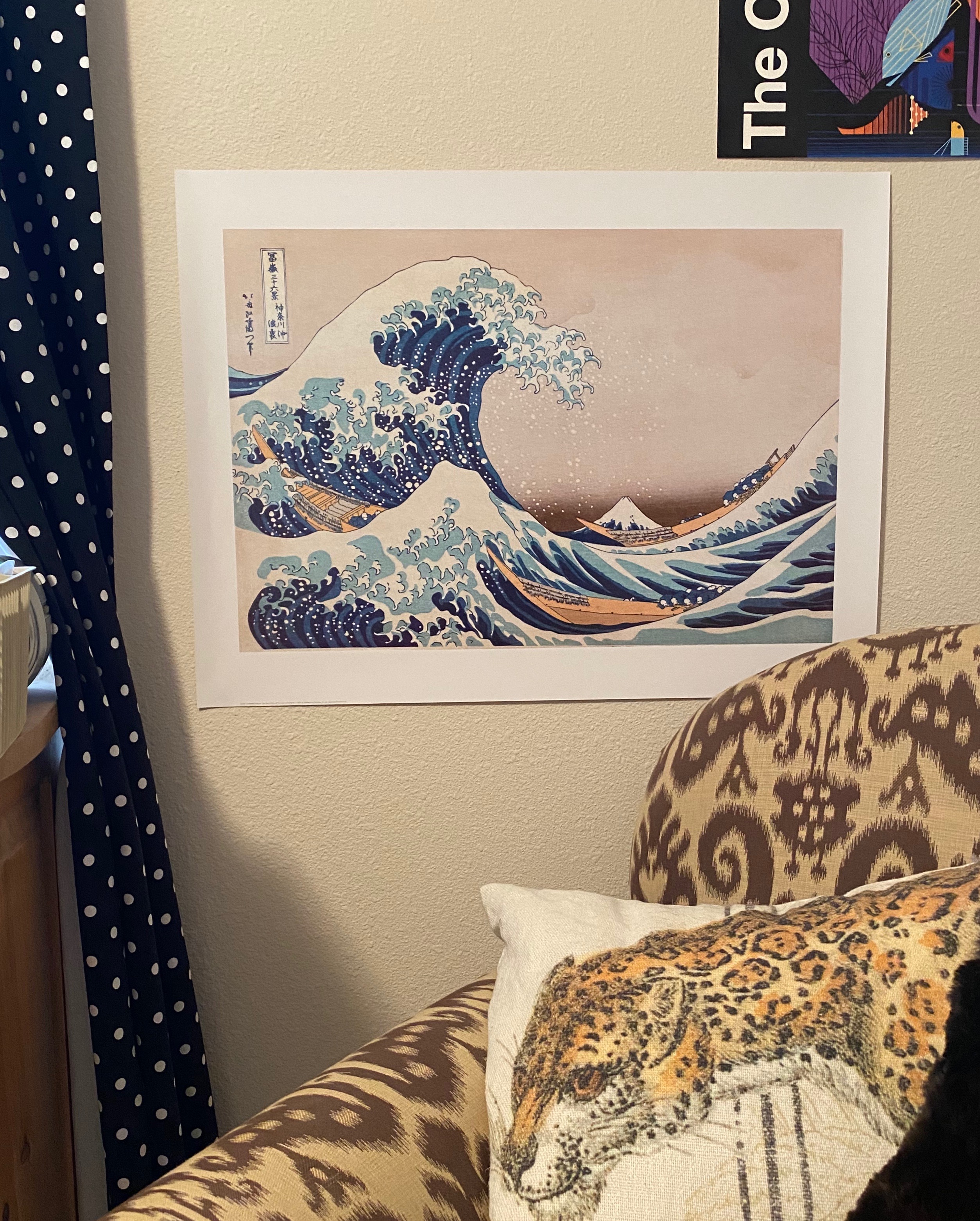
  • Hokusai:  After finishing “The Old Man Mad about Drawing” (Francois Place), learning more about Katsushika Hokusai, woodcut print master of the late 1700’s, I presented my son with 4 Hokusai poster possibilities for his room.  He selected the classic, “The Great Wave”.  Even in poster form, it is more spectacular than I had imagined.
  • Marsupials:  First of all, “marsupial” is a fun word to say.  Marsupial, marsupial, marsupial.  We finished a unit on marsupials – those mammals that nurture their newborns in mom’s front pocket – except for those marsupials whose mom’s don’t have a front pocket (which our book should have expanded upon)(editing disappointment)(sigh).
  • Compass directions:  I did a compass check with my son.  Did he know north, south, east, and west?  YES.
  • Hank the Cow Dog:  It has been years since we have read through the John R. Erickson series.  This is the ridiculousness we need to conclude each day.  We pretty much love Hank.

Complaint Department:  My son and I are studying architectural landmarks.  I am not mentioning our resource because this book could have been so much better.  I would not be giving this editor a raise anytime soon:

  • Our book provides only vague references to each landmark’s location, as if the exact whereabouts were a secret.  Seriously?  No nearby city mention?  No COUNTRY mention?  How can there not be a little map accompanying each entry?   
  • Whereas all entries are interesting, are they all really landmarks?  Are the Roman Baths of England a landmark?  Are the the buried terra-cotta army figures in China a landmark?
  • Often the book waxes on about a particular object of fascination (fabulous mosaics, a special stone, etc) associated with a particular landmark, and then does not include a photo of the object.  AAAAACK.

Nevertheless, we do have our favorite landmarks:

  • First place honors go to the hundred foot tall Christ the Redeemer of Rio de Janeiro.  Monumental simplicity.  Of interest:  funding ran low during construction, so the Vatican stepped in to assist.  Nice.
  • Second place, measuring in at 185 feet (on one side) is the relentless engineering fiasco and utterly charming Leaning Tower of Pisa.  

Story problem – a landmark at Farmer Brown’s roadside produce stand!  In the hopes of making his produce stand a tour-bus destination, Farmer Brown has commissioned a sculptor to create a 10 foot high bronze ear of corn, to be positioned near the stand.  That should get everyone’s attention!  The “artwork” will be true to actual corn proportions.  If there are 50 kernels of corn in a typical row on a corncob, each kernel must be approximately how wide in the sculpture?  (answer at bottom of post)

A)  2.5 inches     B)  5 inches     C)  7.5 inches     D)  2.5 feet

Classical Music Time – earlier in this month (MARCH), a local radio station hosted a “vote for your favorite march” opportunity.  We listen to marches every Friday night throughout the year, so my son definitely knew the three he was voting for:

  • Marche Militaire No. 1 in D major, composed as a piano four-hands piece by  Franz Schubert and first published in 1826.   Perhaps best described as a ballroom march, Marche Militaire is also effectively used in the cute-as-anything Disney cartoon of 1932, “Santa’s Workshop” (my son LOVES this cartoon – frankly, I love this cartoon).  Note:  the extremely competent pianists in this clip do take quite a bit of time to get started:

  • March of the Prague Student Legion, by Bedrich Smetana, composed in 1848.  This is a march that fills you with nationalistic pride, makes you throw your shoulders back and stand up straight.  We love the snappy pace of this particular recording.  As an added listening bonus, tucked into the middle of the march, my son and I listen for a few bars of “The Farmer in the Dell”:

  • The Imperial March (Darth Vader’s theme),  John Williams’ genius nod to aggression and menace.  In this film clip, John Williams conducts the LA Philharmonic Orchestra (complete with Jedi and Mr. Vader):

Welcome to the best part of my day!
– Jane BH
(story problem answer:  A)  2.5”)

In a Happy Place

flags nordic

If you’re happy and you know it (you must be living in one of the Nordic countries) We wanted to learn a bit about Finland, Norway, Sweden, Denmark, and Iceland when we read through the 2019 survey which ranked these Nordic countries the happiest in the world.  (FYI:  the USA placed 19th out of 156 – not too shabby)

We are using multiple resources, our globe is out, and here’s what has caught our attention: 

  • there are 30 active volcanos on Iceland
  • the only Finnish word in the American language is “sauna”
  • male AND female reindeer have antlers, and their wonky antlers are NOT symmetrical (vocab)
  • we know where to find 5 versions of the Nordic cross (all 5 countries use the Nordic cross on their national flag)
  • the Danish alphabet has three letters not found in the English alphabet
  • in 2019, the Helsinki, Finland public library was awarded Best Public Library in the World!

For those working toward a PhD in Herpetology – “Lizards” by Sneed B. Collard III is probably not the book.  For the rest of us, it IS the book:  organized, written in a casual voice, funny, funny, funny and filled with opinions, pretty good photos, and easy to grasp facts.  I tested my son on his lizard info comprehension by having him take THE LIZ QUIZ.  (A+, of course)(yay!)

Story Problems! 

From Le Fictitious Local Diner –  January is not only CHICKEN POT PIE MONTH at the diner, it is FREE IN-TOWN DELIVERY FOR CHICKEN POT PIES MONTH. Sales are skyrocketing.  Typically, the diner sells 50 pot pies a week.  But during free-delivery month, the diner has been selling 150 weekly.  Each pot pie costs $3 to produce and sells for $8.  How much more per week does the diner PROFIT in chicken pot pies during the free delivery month?
A)  $150     B)  $300     C)  $500     D)  $800  (answer at bottom of post)

From Farmer Brown’s ranch – Every January, Farmer Brown provides each of his 5 farm hands with 2 new pair of fleece lined jeans (at $50 each, including tax) and a heavy-duty waterproof jacket (at $90 each, including tax).  Was Farmer Brown able to spend less than $1,000 for the purchases this year? (answer at bottom of post)

Zigzagging from our solar system to  woodcut prints to Claude Debussy –

planetarium

– It started with “Planetarium”, Raman Prinja’s dazzling book of planets, galaxies, dark matter, etc.  My son and I have read through several excellent outer space books, so we are on the lookout for anything new:  “Planetarium” did not disappoint –   we have now been introduced to THE OORT CLOUD.  But the real story for us:  the imaginative and superbly crafted woodcut print illustrations by Chris Wormell.

– We are now in WOODCUT PRINT APPRECIATION mode:  we are re-reading “The Old Man Mad about Drawing”, about the great Japanese woodcut print master, Hokusai.  We are also working through “Making Woodblock Prints” by Chesterman and Nelson, to understand the skills and tools involved.

– THEN, while listening to the radio show, “Exploring Music with Bill McLaughlin” we learned that Claude Debussy was so intrigued by woodcut prints that he requested that Hokusai’s famed “The Great Wave” be used on the cover of his La Mer sheet music.

Our classical music selections – the focus had to be on Claude Debussy.  As polished and deeply moving as the music is, we do not often select Debussy pieces for our nightly STUDIES AND STORIES conclusion as we are usually looking for something jollier.  However, three pieces that we are familiar with (and like) – 

  • Jeux de Vagues – movement 2 from Debussy’s 1905 orchestral composition, La Mer.  My son and I envision being plopped in the middle of an ocean where the music has no beginning nor end.  That is what we hear in this intuitive piece:

  • Prelude to the Afternoon of a Faun – this 10+ minute symphonic poem, composed in 1894, is considered to be the beginning of modern music.  Here is what we think:  that flute player, who opens the piece is under ENORMOUS pressure:

  • Clair de Lune – the beloved movement 3 from Debussy’s Suite Bergamasque (for piano), of 1905.  

Welcome to the best part of my day!
– Jane BH
(story problem answers:  Diner – C.  $500, Farmer Brown – Yes)

Salient?

state-map

Salients and Peninsulas – We are a fifth of the way through our “Where is That?” states-in-the-USA activity, and my son is learning more than just the location of the states.  Two nights ago we learned about salients – and SURPRISE, we have lived in three of nine salient states:  Texas, Oklahoma, Florida, West Virginia, Connecticut, Idaho, Nebraska, Maryland, and Alaska.  We learned that SALIENT is the correct geographical term for a PANHANDLE (side learning excursion – I had to show my son a real pan handle).  We learned that a panhandle is surrounded by land, and a peninsula (where Big Peaches – star grandmother – lives) is surrounded by water.  We also considered the customary definition of salient (meaning “most important”, “most noticeable”) (vocab).  And my son also learned that panhandling (vocab) has nothing to do with pans or geography.

pans

Story Problem from Le Fictitious Local Diner – speaking of panhandles, the diner management team decided it is time to replace all frying pans.  The chefs are delighted!  8 small-sized skillets are to be ordered at a cost of $25 each, and 8 larger fry pans are to be ordered at a cost of $75 each.  How much will the diner spend for shipping (if shipping is 15% of the total order)?
A. $25      B. $80      C. $120      D. $200 (answer at bottom of post)

History is coming alive – Yay! Candace Fleming’s “Presenting Buffalo Bill – The Man who Invented the Wild West” has us on the edge of our seats.  We are currently reading about Will Cody’s pre-teen years in the Kansas territory, where his family was caught in the territory’s “slavery/no slavery” struggle (a shameful blot on the pages of American history – teams of pro-slavery thugs from Missouri terrorized homesteaders who did not want Kansas to be a slavery state).  As Will’s father was an object of death threats from the pro-slavery faction, and was often out of state, in hiding, a very young Will Cody had to provide the primary financial support for his large family.   Working for a shipping company that delivered goods to military posts in Colorado and Utah, Will had his full share of wild west adventures (stampedes, shoot-outs, starvation).  What’s going to happen next???

better-tokyo-sculpture           better-blue-brushtstroke

Roy Lichtenstein – two take-aways from Susan Goldman Rubin’s excellent book, “Whaam! The Art and Life of Roy Lichtenstein”:

1)  What is a win-win situation?  How about when a corporation commissions (vocab) artwork that will be accessible to the general public?  We love Lichtenstein’s sculpture, “Tokyo Brushstroke II” commissioned by an architectural firm in Japan, and the crazy-gigantic-five-stories high mural, “Blue Brushstroke” commissioned by The Equitable Life Assurance Society in Manhattan.  The win-win?
– thousands and thousands and thousands of people get to enjoy the artwork
– excellent PR (vocab) for the corporation
– the artist gets paid!
2)  We are never too old to try something new:  Roy Lichtenstein learned to play the saxophone in his mid 60’s! OF COURSE, we were enthusiastic about devoting an evening to a sampling of saxophone sounds:

  • Harlem Nocturne, composed by Earle Hagen and Dick Rogers in 1939, played to perfection by the Duke Ellington Orchestra. The saxophone brings the sultry:

  • The Pink Panther Theme, composed by Henri Mancini in 1963.  This is OLD footage, with Henry Mancini conducting.  The saxophone brings the relentlessly sneaky:

  • The Prologue to West Side Story, composed by Leonard Bernstein for the 1957 Broadway production. The saxophone doesn’t take center stage in this piece, but does set the tone for a collage of NYC sounds and rhythms:

Welcome to the best part of my day!
– Jane BH
(story problem answer:  C. $120)

It’s All Fun!

roy-whaam

Giant Cartoon Art – We are currently reading through “Whaam! The Art & Life of Roy Lichtenstein” by Susan Goldman Rubin.  This book is filled with examples of his pop art of the 1960’s that both shocked (“this is art?????”) and rocked a generation.  Each of Lichtenstein’s paintings was inspired by published comic book drawings of others, and I like that the author addressed the issue of copyright. My son likes looking at photographs of Lichtenstein’s art on display, with people standing near the paintings, so he can get an idea of exactly how large the paintings are.

bill-polka-dots

Buffalo Bill and his Wild West Show – Hot off the press! Candace Fleming’s “Presenting Buffalo Bill – The Man who Invented the Wild West” was just published in 2016.  We are only a few nights into this book and we are loving every minute.  Oh my! Buffalo Bill – what a man with BIG vision and what a risk (vocab) taker!  This book is part of our Native North American unit – we are impressed with the author’s excellent research and sensitivity regarding Lakota tribe members who were part of the Wild West Show (and this has provoked a short side study of the Lakota tribe).

Game ON – the other night, my son grabbed a pen, and I knew he wanted to communicate something – so I supported his wrist and here is what he wrote, “I want to play hangman.”!!!!  Really?  Well, OK!  We have been playing hangman about 2 times a week for a month or two, but I had no idea he was liking this spelling game.  I am relieved that his handwriting has improved to the point that I can read it.  Huge communication progress!

50 Days of Fun!  I am stretching the definition of “fun”, but this is sort of diverting:  we have started playing, “WHERE IS THAT?”.  I place a blank map of the USA on the desk and I ask my son to ink a dot in the middle of a particular state.  After he finds the correct state, we (hand-over-hand) color it in. Could this be a gateway activity – first the USA, then maybe the countries of South America?  Then WHO KNOWS???

And if that weren’t enough – I have added a new resource tab (look on title block) – “The Bookshelf”.  This is where I will keep a running list of the books that have worked particularly well for my son and me.

box-lunch

Box Lunches at Le Fictitious Local Diner –  Everyone knows that box lunches (vocab concept) are by definition FUN!  And here is a twist: the Local Diner’s box lunches are vegetarian, and include a bottle of kombucha that comes with it’s own teeny paper parasol.  FUN!  The lunches are apparently delicious, and the response has been enthusiastic:  during the first week 30 boxes were sold on Monday, 20 on Tuesday, 40 on Wednesday, 10 on Thursday, 40 on Friday, and 20 on Saturday!  Each box sells for $9.  If it costs the diner $4 to put the box together (including the box and the napkins, etc), what was the diner’s profit for the first week?
A. $800    B. $160    C. $1,440    D. $60 (answer at bottom of post)

Music – It was time to learn more about the SNARE DRUM – Yay percussion instruments!

snare-drum

First, we needed to see how the snare drum was constructed.  We learned that a band of narrow wires stretched across the bottom of the drum gives it that muffled rattly sound. We listened for the snare drum in:

Blue Tango, composed by LeRoy Anderson in 1951, and was ranked by Billboard as the number one song of 1952!  Sassy.

Scotland the Brave – this pipe and drum corps classic is considered to be one of three unofficial national anthems of Scotland.  BTW, in Scotland, the snare drum is called a side drum.  BTW, we are the sort of people that really like the music of bagpipes.  This footage is just so great:

Bolero, composed by Maurice Ravel, as a one-movement orchestral piece for ballet, in 1929.  From everything we have read – and can readily believe – playing the snare drum in this piece is a musician’s nightmare.  Seventeen-plus minutes of the same rhythm over and over and over and over.  But what a fine, fine performance by the Vienna Philharmonic, conducted so carefully by Gustavo Dudamel:

Welcome to the best part of my day!
– Jane BH
(Story problem answer: A. $800)