Sneed B. Collard III

The Fireproof Safe

safe third

Prologue-
Q: Did my son know what a safe was?
Q: Did my son know what “fireproof” meant?
Those resolved, Q: If my son owned a factory that produced fireproof safes, how would he mark the occasion of the sale of the 20,000th safe?  (Wait, what?)  Would he do what the Wertheim Company of Vienna did in 1869?
The story – I estimate that my son and I have listened to Joseph Strauss’s “Feuerfest Polka” about 240 times.  It is fast-moving, happy, accented with the pinging of a hammer on an anvil, and comes with an adorable story – the polka was commissioned in 1869 by Franz von Wertheim, whose firm produced fireproof safes (feuerfest means fireproof in German).  The music was in celebration of Wertheim’s 20,000th safe! My son and I spent time imagining a company today commissioning a polka for the 20,000th production of anything.  This is SO GOLD.
“Feuerfest Polka”: the story continues – Because of the hammer/anvil pinging, we’ve been referring to Strauss’s piece as the “Blacksmith Polka” for years.  But last week it occurred to me that my son might not know what a blacksmith was.  Did he?  No.  Oh, dear.  Time to find out about blacksmithing.  We chose “History of the Blacksmith in Photographs” by Bryan Crawmer, and “The Backyard Blacksmith” by Lorelei Sims.  Both exceptionally helpful.  To conclude this unit I read aloud (the quite lengthy), “The Village Blacksmith” by Longfellow.

blacksmith books

Epilogue – Because of a very short piece of music, my son now knows about blacksmithing and fireproof safes.  AND BTW, The Wertheim Company is still making safes.

All is calm – We have just finished “The Prairie Builders” a superb book by Sneed B. Collard III, for which he received the American Association for Advancement of Science Award in 2006.  It chronicles the reconstruction of an 8,000+ acre tall grass prairie in Iowa, beginning in 1992 – the site preparation, the reintroduction of native seeds, bison, elk, butterflies. The pureness, calmness of both endeavor and writing reminds us of “The Ox-Cart Man” (Donald Hall/ Barbara Cooney, Caldecott Medal 1980).  Both soothing reads make us appreciate focused, honest work.

“How Trains Work” – a comprehensive, high energy, vibrantly illustrated Lonely Planet Kids Book. Our two favorite takeaways:
– We found out exactly how a funicular works.  We have known about funiculars, but did not have a grasp on the mechanics. (See blog post of November 22, 2014, “Mounting Interest”) (the post is one of my faves)
– We were reading about suspension railways (sort of like an upside-down monorail) and came across this SHOCKINGLY AWFUL YET HILARIOUS account: in 1950, for an ill-thought-out circus publicity stunt, an elephant named Tuffi was traveling on a suspension railway in Germany.  She FREAKED OUT and jumped out of the train (40 feet above ground). LUCKILY she landed in a river and was rescued. Well! This certainly speaks to the sturdiness of that particular suspension railroad.

Reading for great pleasure – We have just started Richard Peck’s book of short stories, “Past Perfect, Present Tense” and it is so A+.  The introduction, an essay on the short story genre, should be required reading. Two points stuck with us –
(semi-direct quote)  “Stories present the metaphor of change, to prepare the readers for changes coming in their lives.  NON-READERS WILL NEVER BE READY” (I added the caps)
(semi-direct quote)  “A short story isn’t easier to write than a novel.  It has less time to plead its case.”
Last night we read the first story in the collection, “Priscilla and the Wimps”, AND LOVED IT.  In the span of 4 pages, the best short story we have ever read.  First of all, THE TITLE.  Second of all, SWEET JUSTICE! Oh my gosh, the ending!  This is re-read worthy.

Story Problem – Le Fictitious Local Diner has an app! (not really)(for story problem purposes only) – And what’s on the app?  Videos of cooking demonstrations from local celebrity/diner chef Jeanette.  The diner is paying Chef Jeanette $50 for each uploaded video and $1 for every view.  Views so far:
– “Bake your own Potato Chips with Chef Jeanette”:  20 views
– “Diner Cherry Pie with Chef Jeanette”:  15 views
– “Diner Healthy Diet Plate with Chef Jeanette”:  0 views
– “Hot Dogs in Pastry Dough with Chef Jeanette”:  25 views
– “Let’s Make Salmon Treats for your Cat with Chef Jeanette”:  500 views
At this point, how much does the diner owe Chef Jeanette?
A) $250    B) $560    C) $810    D) $1,000 (answer at bottom of post)

From our classical music time –
To honor short stories:  the very shortest piece on our iPod – Glenn Gould’s lightning fast interpretation of Bach’s Invention No. 13 in A minor (composed in the early 1700’s).  Usually this piece takes just over a minute, Gould has shaved off 15 seconds –

To honor the Regal Fritillary butterfly, reintroduced to the prairie project:  a composition for piano and two flutes, “Deux Papillons” (Two Butterflies) by Emil Kronke, composed in 1739.  Spritely performance in gorgeous cathedral setting –

And of course, to honor Franz von Wertheim’s 20,000th fireproof safe, Josef Strauss’s “Feuerfest Polka”:  this performance is pretty cute, with conductor and “local blacksmith” fighting for control of the orchestra –

Welcome to the best part of my day!
– Jane BH
(Story problem answer: C). $810)

Mid-March Roundup

They glide through the air with the greatest of ease – We are reading “Catching Air”, a book focused on GLIDING ANIMALS (non-bird animals that seemingly fly from tree to tree).  This is our third book by Sneed B. Collard III, whose writings on lizards and bird beaks (for heavens sakes) have made us enthusiastic observers.   As usual, the material he presents in “Catching Air” makes us feel super scholarly:

  • we now know that large eyes on animals are suggestive of a nocturnal nature
  • we now know the difference between flying, gliding, and parachuting animals
  • we now know what a patagium (vocab) is and we know how to pronounce it
  • we discussed the difference between a carnivore, herbivore, and omnivore
  • we are now among those who know where the largest, second largest, and third largest islands in the world are (the largest, of course, is Greenland – where there are no gliding animals, but there are gliding animals aplenty in Papua New Guinea, the second largest island and Borneo, third largest island) 
  • last night we read about the creepiest creepiest creepiest thing:  the air gliding snakes of Borneo     

Editing Triumph:  Hans Christian Anderson – I wanted my son to understand references that originated from Anderson’s writings, like “The Emperor’s New Clothes” and “The Ugly Duckling”, so we read from a most elegant edition of his fairy tales, compiled by Noel Daniel (published in 2013).  This book is thoughtfully organized and filled with sumptuous surprises.  There is a lot of gold ink, short informative sidebars, and each fairy tale is teamed up with its own illustrator  (the likes of Maurice Sendak and Arthur Rackham).  THIS is the edition that anybody interested in Hans Christian Anderson should own. 

Quick Notes –

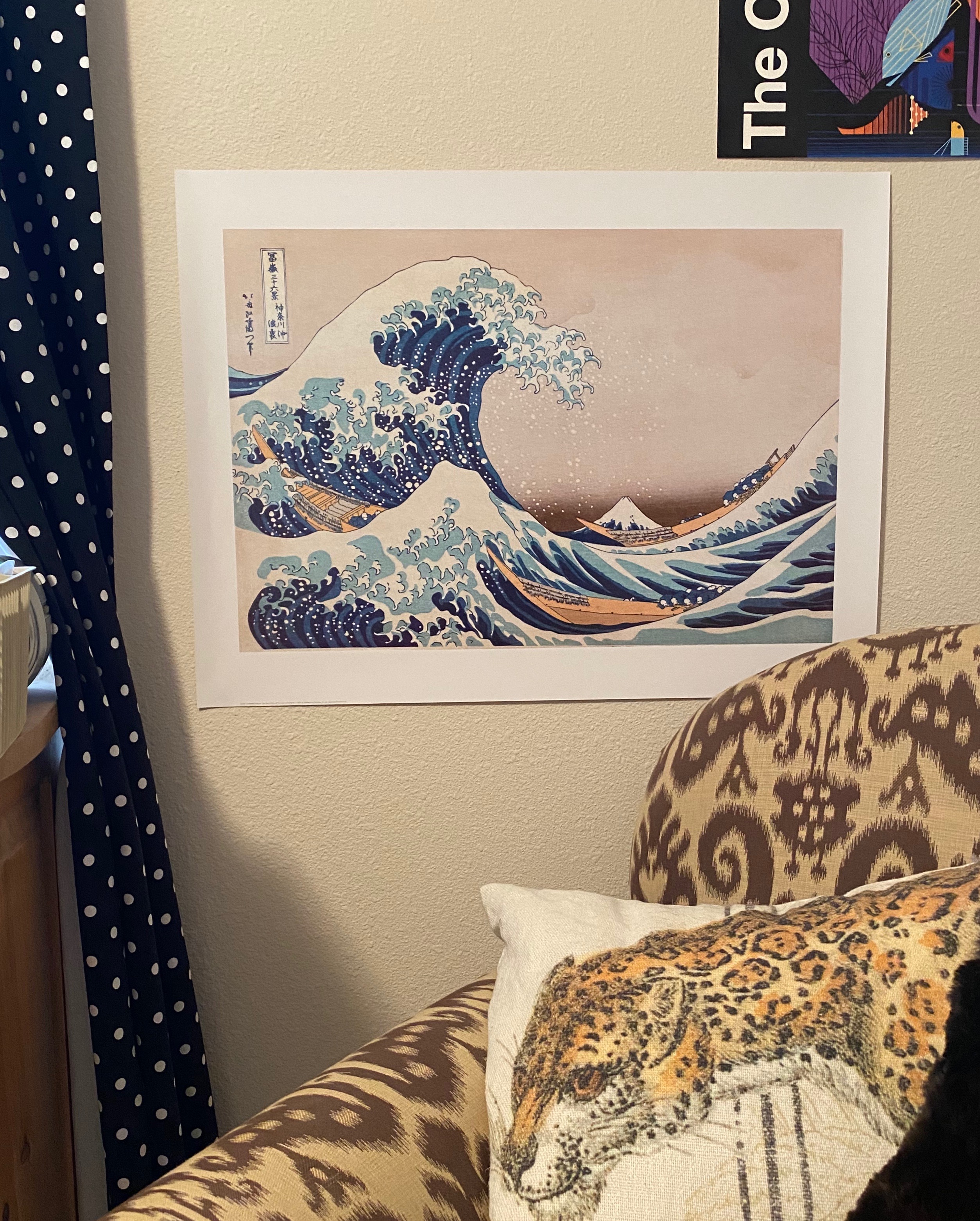
  • Hokusai:  After finishing “The Old Man Mad about Drawing” (Francois Place), learning more about Katsushika Hokusai, woodcut print master of the late 1700’s, I presented my son with 4 Hokusai poster possibilities for his room.  He selected the classic, “The Great Wave”.  Even in poster form, it is more spectacular than I had imagined.
  • Marsupials:  First of all, “marsupial” is a fun word to say.  Marsupial, marsupial, marsupial.  We finished a unit on marsupials – those mammals that nurture their newborns in mom’s front pocket – except for those marsupials whose mom’s don’t have a front pocket (which our book should have expanded upon)(editing disappointment)(sigh).
  • Compass directions:  I did a compass check with my son.  Did he know north, south, east, and west?  YES.
  • Hank the Cow Dog:  It has been years since we have read through the John R. Erickson series.  This is the ridiculousness we need to conclude each day.  We pretty much love Hank.

Complaint Department:  My son and I are studying architectural landmarks.  I am not mentioning our resource because this book could have been so much better.  I would not be giving this editor a raise anytime soon:

  • Our book provides only vague references to each landmark’s location, as if the exact whereabouts were a secret.  Seriously?  No nearby city mention?  No COUNTRY mention?  How can there not be a little map accompanying each entry?   
  • Whereas all entries are interesting, are they all really landmarks?  Are the Roman Baths of England a landmark?  Are the the buried terra-cotta army figures in China a landmark?
  • Often the book waxes on about a particular object of fascination (fabulous mosaics, a special stone, etc) associated with a particular landmark, and then does not include a photo of the object.  AAAAACK.

Nevertheless, we do have our favorite landmarks:

  • First place honors go to the hundred foot tall Christ the Redeemer of Rio de Janeiro.  Monumental simplicity.  Of interest:  funding ran low during construction, so the Vatican stepped in to assist.  Nice.
  • Second place, measuring in at 185 feet (on one side) is the relentless engineering fiasco and utterly charming Leaning Tower of Pisa.  

Story problem – a landmark at Farmer Brown’s roadside produce stand!  In the hopes of making his produce stand a tour-bus destination, Farmer Brown has commissioned a sculptor to create a 10 foot high bronze ear of corn, to be positioned near the stand.  That should get everyone’s attention!  The “artwork” will be true to actual corn proportions.  If there are 50 kernels of corn in a typical row on a corncob, each kernel must be approximately how wide in the sculpture?  (answer at bottom of post)

A)  2.5 inches     B)  5 inches     C)  7.5 inches     D)  2.5 feet

Classical Music Time – earlier in this month (MARCH), a local radio station hosted a “vote for your favorite march” opportunity.  We listen to marches every Friday night throughout the year, so my son definitely knew the three he was voting for:

  • Marche Militaire No. 1 in D major, composed as a piano four-hands piece by  Franz Schubert and first published in 1826.   Perhaps best described as a ballroom march, Marche Militaire is also effectively used in the cute-as-anything Disney cartoon of 1932, “Santa’s Workshop” (my son LOVES this cartoon – frankly, I love this cartoon).  Note:  the extremely competent pianists in this clip do take quite a bit of time to get started:

  • March of the Prague Student Legion, by Bedrich Smetana, composed in 1848.  This is a march that fills you with nationalistic pride, makes you throw your shoulders back and stand up straight.  We love the snappy pace of this particular recording.  As an added listening bonus, tucked into the middle of the march, my son and I listen for a few bars of “The Farmer in the Dell”:

  • The Imperial March (Darth Vader’s theme),  John Williams’ genius nod to aggression and menace.  In this film clip, John Williams conducts the LA Philharmonic Orchestra (complete with Jedi and Mr. Vader):

Welcome to the best part of my day!
– Jane BH
(story problem answer:  A)  2.5”)

In a Happy Place

flags nordic

If you’re happy and you know it (you must be living in one of the Nordic countries) We wanted to learn a bit about Finland, Norway, Sweden, Denmark, and Iceland when we read through the 2019 survey which ranked these Nordic countries the happiest in the world.  (FYI:  the USA placed 19th out of 156 – not too shabby)

We are using multiple resources, our globe is out, and here’s what has caught our attention: 

  • there are 30 active volcanos on Iceland
  • the only Finnish word in the American language is “sauna”
  • male AND female reindeer have antlers, and their wonky antlers are NOT symmetrical (vocab)
  • we know where to find 5 versions of the Nordic cross (all 5 countries use the Nordic cross on their national flag)
  • the Danish alphabet has three letters not found in the English alphabet
  • in 2019, the Helsinki, Finland public library was awarded Best Public Library in the World!

For those working toward a PhD in Herpetology – “Lizards” by Sneed B. Collard III is probably not the book.  For the rest of us, it IS the book:  organized, written in a casual voice, funny, funny, funny and filled with opinions, pretty good photos, and easy to grasp facts.  I tested my son on his lizard info comprehension by having him take THE LIZ QUIZ.  (A+, of course)(yay!)

Story Problems! 

From Le Fictitious Local Diner –  January is not only CHICKEN POT PIE MONTH at the diner, it is FREE IN-TOWN DELIVERY FOR CHICKEN POT PIES MONTH. Sales are skyrocketing.  Typically, the diner sells 50 pot pies a week.  But during free-delivery month, the diner has been selling 150 weekly.  Each pot pie costs $3 to produce and sells for $8.  How much more per week does the diner PROFIT in chicken pot pies during the free delivery month?
A)  $150     B)  $300     C)  $500     D)  $800  (answer at bottom of post)

From Farmer Brown’s ranch – Every January, Farmer Brown provides each of his 5 farm hands with 2 new pair of fleece lined jeans (at $50 each, including tax) and a heavy-duty waterproof jacket (at $90 each, including tax).  Was Farmer Brown able to spend less than $1,000 for the purchases this year? (answer at bottom of post)

Zigzagging from our solar system to  woodcut prints to Claude Debussy –

planetarium

– It started with “Planetarium”, Raman Prinja’s dazzling book of planets, galaxies, dark matter, etc.  My son and I have read through several excellent outer space books, so we are on the lookout for anything new:  “Planetarium” did not disappoint –   we have now been introduced to THE OORT CLOUD.  But the real story for us:  the imaginative and superbly crafted woodcut print illustrations by Chris Wormell.

– We are now in WOODCUT PRINT APPRECIATION mode:  we are re-reading “The Old Man Mad about Drawing”, about the great Japanese woodcut print master, Hokusai.  We are also working through “Making Woodblock Prints” by Chesterman and Nelson, to understand the skills and tools involved.

– THEN, while listening to the radio show, “Exploring Music with Bill McLaughlin” we learned that Claude Debussy was so intrigued by woodcut prints that he requested that Hokusai’s famed “The Great Wave” be used on the cover of his La Mer sheet music.

Our classical music selections – the focus had to be on Claude Debussy.  As polished and deeply moving as the music is, we do not often select Debussy pieces for our nightly STUDIES AND STORIES conclusion as we are usually looking for something jollier.  However, three pieces that we are familiar with (and like) – 

  • Jeux de Vagues – movement 2 from Debussy’s 1905 orchestral composition, La Mer.  My son and I envision being plopped in the middle of an ocean where the music has no beginning nor end.  That is what we hear in this intuitive piece:

  • Prelude to the Afternoon of a Faun – this 10+ minute symphonic poem, composed in 1894, is considered to be the beginning of modern music.  Here is what we think:  that flute player, who opens the piece is under ENORMOUS pressure:

  • Clair de Lune – the beloved movement 3 from Debussy’s Suite Bergamasque (for piano), of 1905.  

Welcome to the best part of my day!
– Jane BH
(story problem answers:  Diner – C.  $500, Farmer Brown – Yes)