Religion

A Tree of Good Wishes

Every year we hang antique holiday postcards all over our Christmas tree.  Real postcards from back in the day when a 1 cent stamp covered postage (early 1900’s).  Real postcards with holiday messages displaying splendid cursive penmanship.  Over the years, we’ve loved how the vintage illustrations dress up the tree, but this year my son and I decided to actually read what was written on the postcards:

The majority of the cards:  Wishing happiness! – Wishing good health! 
Wishing many good Xmas wishes! – Wishing a joyful Xmas! – The kindest of wishes! 

MOST POETIC POSTCARD MESSAGE goes to “Charity” (1908), who squeezed into the small writing space:
“Each year to ancient friendships adds a ring. As to an oak, and precious more and more. Without deservingness or help of ours.  They grow, and silent, wider-spread each year. Their unbought ring of shelter or of shade.”  (Either we are too immature to appreciate this or perhaps this is a secret message written in code, but Charity, wherever you are:  CHEERS!).  

MOST UNIQUE CHRISTMAS CARD MESSAGE was certainly from Mattie to Albert (1909):  “Received the chickens – all O.K.”.  Apparently Miss Mattie was not given to effusiveness.  (Effusiveness:  new vocabulary word for my son).

December Reading –

Mrs. Coverlet’s Magicians:   My dad first read Mary Nash’s clever Christmas themed book to my sister and me when it arrived via “The Weekly Reader Children’s Book Club” back in 1962.  I remember asking my dad to re-read the page that listed the names of the household’s kittens:  Mary Mouse, George Soup, Ernest Waffle, Sally Egg, and the baddest kitten, John Napkin.  This book struck a chord with me, so here I am decades later, reading it every single December to my son.  And we are reading the very same precious 1962 edition (although I do have 3 backups for just in case).

Dogtown:  co-authored by Katherine Applegate and Gennifer Choldenko.  This book is a charmer, written from the viewpoint of a dog who has found herself in the local dog shelter (“Dogtown”).  It eases the reader into looking beyond diversity and disability and focusing on real issues (forging friendships/finding a “forever home”).  There were tears when we read the final page (from me, not my son), and my son was glad to see the sequel, “Mouse and His Dog” under the Christmas tree.

December Reading Comprehension – My son smiles big when he sees a new Clem and Clyde reading comp worksheet.  I smile big when I am writing a new Clem and Clyde reading comp worksheet:

Story Problem from the Local Diner –

During December, the diner adds their rich, creamy, “town-famous” hot cocoa to the menu.  Each mug of chocolate deliciousness is topped off with 5 mini marshmallows.  If the diner buys 16-ounce bags of mini marshmallows, and each bag contains 700 mini marshmallows, how many bags will the diner need if they predict serving 3,000 mugs of hot chocolate this December?

a)  5 bags     b)  22 bags    c)  300 bags    d)   700 bags (answer at bottom of post)

Our 2025 Christmas Music Obsession –

Somehow, we came across John Rutter’s “Shepherd’s Pipe Carol” and became enchanted with the lavish harmonies and unexpected rhythms. We found out what a shepherd’s pipe is (lots of definitions: recorder, wooden flute, pan pipes) and we read that composer/lyricist John Rutter, was inspired by Menotti’s one act opera, Amahl and the Night Visitors (first performed in 1951) (so we read a synopsis of Amahl and the Night Visitors).  Rutter wrote this carol in 1966 when he was an undergraduate at University of Cambridge.  We just love this piece!

Finally, looking toward the new year –

Another story problem from the Local Diner:  The diner has set up a New Year’s Resolution bulletin board next to the cashier’s counter.  The board will be up all year.  Anyone can tack up a card with their New Year’s Resolution.  As soon as a goal has been reached, a giant gold star sticker will be put on the card.  

For example, Miss Olive has made a resolution to clean up her dining room, 
which has turned into a warehouse of clutter.  As soon as Miss Olive’s dining room looks again like a dining room, she gets to stick a gold star on her resolution card. –  

To further encourage success, the diner will serve up a hot fudge sundae to anyone presenting their gold starred resolution card!
– If 250 customers tack up resolutions and at the end of the year there are gold stars on 40% of the resolution cards, how many people did NOT fulfill their New Year’s Resolution?
a)  40  people  b)  60 people     c)  100 people     d)  150 people
– If a hot fudge sundae costs the diner $3, how much money will they have spent on the customers who fulfilled their New Year’s resolution?
a)  $30     b)  $120     c)  $300     d)  $750 (answer at bottom of post)

Welcome to the best part of my day!
– Jane BH
Story problem answers:  b)  22 bags of marshmallows and d)  150 people and c)  $300 

Indian Summer

Summertime studies for the likes of us – 

India, Incredible India, an A+ book by Jasbinder Bilan, content well matched with Nina Chakrabarti’s A+ graphics.  Clever premise:  a young lady, “Thara”, and Nanijee (nanijee – totally great word – translates to maternal grandmother), sort through grandmother’s treasure box, which is filled with souvenirs from every state and territory in India.  Page by page, we learned facts about each area and souvenir, then located the state/territory on the included map.  Every night, my son and I were drawn in by the exuberant illustrations positioned among splashes of vibrant colors.  We would read anything by this team.

While Mrs. Coverlet was Away, by Mary Nash.  I subject my son to this book every August because it is funny, imaginative, and champions the concept of self reliance.  Spoiler alert:  chapter 15 includes such a poetic passage, transporting us on a lazy summer’s day to the town swamp for turtle hunting.  The story gets us ready for our Mary Nash December read (Mrs. Coverlet’s Magicians). 

, by Mariana Swift.  Oh, we do like this man (1473-1543) who had the nerve to propose the heliocentric theory.  Big shocker, Copernicus was not in the good graces of the church, but did he shy away from enthusiastically explaining his observations?  NO!  Role model!  Copernicus published his groundbreaking book, “On the Revolutions of the Celestial Spheres”, at age 70.  Role model!

The Travel Book (a Lonely Planet Kids book).  We started this quirky fact book January 1st (with Canada) and finished August 1st (with Kiribati). One page every night, one country every night. (and BTW, I just took an online geography quiz and correctly identified 26 countries out of 30…before this unit I probably could have pinpointed about 9 countries).  Study unit highlights:

Welcome to our “Travel Book” Quirky Awards Ceremony:

Quirky Fashion Accessory Award, Grand Prize Winner:  Lithuania develops a signature perfume “Scent of Lithuania” (2011)
Quirky Global Citizen Award, Grand Prize Winner:  Global Seed Vault – entirely funded by Norway (officially started in 2008)
Quirky Destination Award, Grand Prize Winner:  An underwater post office! (Vanuatu)
Quirky Flag Design Award, tied for Grand Prize Winner :  A completely awesome hat (the symbol of Lesotho’s main ethnic group) is emblazoned on the Lesotho flag


Quirky Flag Design Award, tied for Grand Prize Winner:  Nauru is located just south of the equator and their flag is a model of brilliant simplicity.  See what I mean? 


Quirky Sob Story Category, Grand Prize Winner:  Awww, Nauru.  In the 1980’s, this country experienced a huge economic boom when they were able to sell  phosphate (used in fertilizers) (from scrapings of BIRD POOP).  Alas, they did such a good job of scraping the rocks of the guano, that there was no more phosphate to sell. Economy collapse. Heart breaker.  At least they still have that well designed flag.

A summer school cooking class story problem from the local diner – Chef Hank’s theme this year:  “It is all about the POTATO”.   The agenda:

Monday – twice baked potatoes
Tuesday – the secret of hash browned taters
Wednesday – Vichyssoise, co-hosted by the high school French teacher, Miss Suzette
Thursday – home-made potato chips and dips
Friday – cottage fries and the diner’s famous bar-b-que sauce

Well, who doesn’t want to improve their potato skills?  The diner kitchen has room for 15 students (and there is already a waiting list with 10 names on it).  This is a most popular class.

1)  If the class runs from 10 am until noon, how many hours will the students be in the diner’s school during the week?
2)  If the chef needs an hour of preparation before each class, for how many hours will the chef be paid at the conclusion of the week?  
3)  If the chef earns $20 an hour, how much will the chef earn for his potato week efforts?
4)  If students pay $40 tuition for the week long cooking class, will that be enough to pay the chef?
5)  If the supplies for the week run $100, will that be covered with the tuition income?
6)  If Miss Suzette is to be paid $20 an hour for 3 hours of work on the Wednesday, will that be covered by tuition? (answers at bottom of post)

Music to conclude the evening:  Impression from India

Ravi Shankar’s “Concerto for Sitar and Orchestra”, movement 3 (composed in 1971), performed by the London Symphony Orchestra, conducted by Andre Previn.  The first minute and a half of this piece is calmly exotic, then we are abruptly treated to the energetic, frenetic sound of the sitar.  What a thrill ride!  What a way to introduce my son to the sound of this complicated looking instrument!

The Beatles, “Norwegian Wood” (1965), the first piece of western pop music to use the sitar. George Harrison studied with Ravi Shankar and the unique sound of the instrument was woven into this piece in a decidedly tame (but decidedly lovely) manner.

Léo Delibes, “The Flower Duet” from his opera of 1883, Lakmé, which takes place in 19th century India.  No sitar in this at all, but oh, the harmonies in this simply dazzling duet.  I can find no evidence that Delibes ever traveled to India, so this might be a case of “write what you don’t really know”.  It is still stunning.

Welcome to the best part of my day!
 – Jane BH
(story problem answers:  1)  10 hours     2)  15 hours     3)  $300     4), 5), and 6) yes)

Chillin’ with the Ladies*

 My son and I have been spending time with the two most recognizable women in the world.

– Mother Teresa, by Navin Chawla  
This was a lengthy book (274 pages) for us, but every single page increased our awareness of Mother Teresa’s brilliant original thinking, her commitment to her calling, her powerful leadership skills.

We read in depth about the three endeavors of her Missionaries of Charity:
– a home for unwanted or orphaned children
– a home and medical facility for those with leprosy
– a home for the destitute and dying 

We have added a heart swelling quote from the book to our Sunday night spiritual moment:  while sitting with a dying patient, Mother Teresa was overheard to whisper, “You say a prayer in your religion, and I will say a prayer as I know it.  Together we will say this prayer and it will be something beautiful for God.   There is now a poster of St. Teresa of Calcutta on my son’s wall.

– The Mona Lisa Vanishes, by Nicholas Day
There is nothing concerning the theft of the Mona Lisa (from the Louvre Museum in 1911) that is not examined in this book: 

– we learned about Lisa Gherardini, who posed for the portrait 
– we learned about Leonardo da Vinci (it was thought provoking to read that Leonardo was most likely ADHD)(this would explain a lot)
– we learned about French police/detective work in the early 1900’s (just the very beginning of fingerprinting)
– we learned about security at the Louvre Museum (super lax)(then, not now)  
– and finally, a dazzling conclusion to the book:  the thief of the Mona Lisa is revealed, lies surrounding the theft are exposed, and we learned that the painting was returned with great ceremony to the Louvre just prior to the breakout of WWI.

This book is perhaps the most organized and well researched book we have ever read.  It is written in small readable chunks – perfect for us.  Inspired by this book, we now have a poster of the Mona Lisa up on my son’s wall. 

Fiction Fun –

– While Mrs. Coverlet was Away, by Mary Nash –  This classic from 1958 has been on our August reading list for several years.  I just love it…I sort of hope my son loves it too, cuz this was at least our 8th time through.   It is funny, it is clever, it champions self reliance.

Story Problem:  The Local Diner gets Fancy

The local diner has decided to add a refined touch:  from now on, all  breakfast rolls and desserts will be served atop a doily.  If the diner calculates that they serve 50 breakfast rolls daily (7 days a week) and 150 desserts daily (7 days a week), how many doilies will they need each week?
a)  70     b)  350     c)  700     d)  1,400

If the diner can purchase 1,000 doilies for $15 from “Doilies R Us”, will $100 be enough money in the diner budget to purchase a month’s worth of the needed doilies?  (answers at bottom of post)

(I am not defending the use of doilies, I am only writing a story problem)

Classical Music:  finally chillin’ with the ladies, virtuoso style –

– Setting the stage –
1913 – first woman EVER to be hired by a professional orchestra (the Queen’s Hall Orchestra in London)
1918 – first woman invited to join an American orchestra (the Detroit Symphony Orchestra)
2003 – at the very back of the pack:  the Vienna Philharmonic, under pressure from the Austrian government, finally welcomes the first female musician into the orchestra

Any orchestra should be so lucky to be chillin’ with these virtuosos:

Cello Virtuoso, Jacqueline du Pré – (1945 – 1987)  Ask anyone (who knows anything about this) to list 5 cello virtuosos, and Jacqueline du Pré’s name will be on that list.  My son and I sat rapt listening to her play “The Swan” from Camille Saint-Saëns’ 14 movement suite, “Carnival of the Animals” (composed in 1886) –

Flute Virtuoso, Jeanne Baxtresser (1947 –    ), former principal flutist for the NY Philharmonic (for 15 years!).  It was fun to listen to her almost haunting adaptation of Saint-Saëns’ “Swan” and we loved the spirited pace

Trumpet Virtuoso, Alison Balsom (1978 –    ).  Alas, we knew we weren’t going to find anyone on trumpet playing “The Swan”, but we were happy to find a recording of Handel’s  “Arrival of the Queen of Sheba” (from his 1748 oratorio, “Solomon”), showcasing Alison Balsom, whose performance is perfection.  Even though this has been one of our favorite compositions for years, we still can’t help but smirk thinking about Handel’s fussy piece portraying life in Jerusalem about 1,000 BC  –

Welcome to the best part of my day,
– Jane BH
(story problem answers:  d)  1,400 doilies a week, and “yes”, $100 is enough to pay for a month’s worth of doilies)
*The title of this page came from a “Get Fuzzy” (Darby Conley) cartoon from years and years ago.  The phrase is still making me and one of my other kids laugh every time we think about it.

32 and counting!

How many books do we read in a year?  We have no idea.  So, this past January my son and I decided this would be the year to track the number of books.  Reporting midway through 2024:  32 books on the tally sheet.  Currently in the stories and studies book basket:

Studies – 

Arctic Tern Migration, Susan H. Gray.  In the autumn, these global traveling birds take 3 months to fly from the Arctic to the Antarctic.  In springtime, they head back to the Arctic – this trip taking less than two months due to wind currents.  We have layers and layers of “how do they do this and why do they do this?” questions.

Birdology, Sy Montgomery.  Favorite chapters:  “Chickens” (because each and every one is wacky) and “Pigeons”  (author Montgomery takes the reader to a pigeon racing club and we learn the specifics – we love it when a book opens a whole new world for us).

Mother Teresa, Navin Chawla.  This particular book – based upon extensive interviews with those who influenced (or were influenced by) Mother Teresa –  is the only authorized biography of Saint Teresa of Calcutta (as per her canonization by the Catholic Church in 2016).  It is THE book.  We were riveted by the work of this brilliant visionary leader.  How could one person, with no income, starting with 1 room and 2 postulants, turn this into a multi-national effort (hundreds of homes for the destitute, dying, leprosy affected, poorest of the poor) with a support system of 4,000 enthusiastic, committed nuns? 

Can I Recycle This?, Jennie Romer.  This is not our first recycling book, but this one leaves the other one (which was patronizing and jammed with platitudes) in the dust.  This author is interesting and specific.  We learned what goes on at a recycling center.  We learned what cannot (at this point) be recycled:  plastic forks and knives, straws, restaurant “to-go” cartons that have been sprayed with a plastic coating, eyeglasses, coat hangers, plastic baggies, potato chip bags.  We are sort of feeling bad about all the potato chip bags we go through.

Footnotes from the Most Fascinating Museums, Bob Eckstein.  Each entry includes a short list of facts about the museum, charming illustrations, and a few personal reflections from museum goers/employees (this is the best part!).  I was happy to see one of my favorite, NAY, perhaps my favorite museum, included in the book:  The Museum of Bad Art (Boston).  Also, we learned that there are museums/museum grounds that host 200,000 bees (Clark Art Institute), and 1,000 dolls (Wenham Museum House).  We were touched to the soul by the “National Museum of African American History and Culture” and Baltimore’s “American Visionary Art Museum”.  We learned that a WOMAN (Betty Willis) designed the iconic “Welcome to Fabulous Las Vegas” sign (from The Neon Museum).  I learned of this book from James Breakwell’s hilarious Instagram site.  Many thanks!  This is the perfect type of book for us!

Stories – 

The Teacher’s Funeral – Author Richard Peck takes us to the one room country school house of the early 1900’s.  The surprisingly effective teacher is a high school student, sister of two of her 8 pupils (who do not want to be in school at all).  And then, just as we are settling into her spelling bees and geography lessons WHAT THE H-E-DOUBLE-TOOTHPICKS??? –  the author takes us along to a neighborly gathering to observe the butchering of a pig.  Oh dear oh dear oh dear.  Do I skip over this part or do I come to terms with this part of long ago rural life?  I mean seriously, to be invited to a pig slaughter? Honored with the responsibility of handling the shotgun that would kill said pig?  Then the book goes right back to being its pleasant self (romance, school yard antics, teacher certification worries, the town poet mystery).  We do love Richard Peck’s books and have read loads of them.  This pig business was a jarring surprise.

The Trials of Hercules Beal, Gary D. Schmidt.  An excellent use of our reading time.  Yes, it is highly entertaining.  Yes, its writing style nudges close to poetic.  Yes,  we are learning about the mythical trials of the Roman god Hercules and how they parallel the life of current student, Hercules Beal.  But we are also given front row seats to the best of  thoughtful and focused teaching skills.  On so many levels, a superb book.

Schooled, Gordon Korman.  This is probably our 4th time through this book.  There is a clash and then a melding of 1960’s hippie style culture with a present day 8th grade social environment.  So well written, fun to read.   

Story Problem from Farmer Brown’s Roadside Stand – The 4 full time employees at Farmer Brown’s roadside stand will now be identified by the wearing of heavy duty green canvas aprons.  Each employee looks so professional now.  The aprons cost $15 and this includes “Farmer Brown’s Roadside Stand” embroidery work.  Farmer Brown decided to order 10 aprons.  Good thing he did.  The week after the aprons were ordered, the price shot up to $25 per apron.  How much money did Farmer Brown save by ordering before the price skyrocketed?

a)  $10     b)  $100     c)  $250     d)  $1,000 (answer at bottom of post)

Counting on Classical Music – 

The Cuckoo, from Ottorino Respighi’s suite, “The Birds” (1928).  Here is a tough assignment:  tally up the number of two-note cuckoo motifs in this 4 minute composition.  Sometimes the motif is produced by a  single instrument, sometimes full orchestra, sometimes the notes are high, sometimes low, sometimes the motif stands alone, sometimes it is mixed into a collage of sounds.  Like I said, tough.  Our tally sheet totals are different every time we try this. 

 Bolero, Maurice Ravel (also 1928!) – ya gotta feel sorry for the percussionist who ends up playing snare drum for this 15-plus minute piece.  It is calculated that the snare drum is struck 5,144 times.  The worst part is that the musician has to play the same short rhythm over and over and over and over.  We would go bonkers.  That being said, we cannot resist anything that is conducted by Gustavo Dudamel. 

3,000 and counting! – According to the Guinness Book of World Records, the most prolific classical composer (with over 3,000 compositions) was Georg Philipp Telemann (1681-1767).  We are not sure we found the final composition (our goal), but his Overture-Suite in G minor was written during his final year.  We listened to the short second movement (the “Gavotte en Rondeau”), a marvelously fussy piece – clearly baroque – that moves right along.

 Welcome to the best part of my day,
Jane BH
(story problem answer:  b)  $100)

C’mon in!

Here is where we study every night (my son’s bedroom).  Lots to look at.  All wall posters were selected by my son after studying about each scientist, statesman, inventor, artist, or topic – 


Here is what we have been studying –

“Frida Kahlo and Diego Rivera – Their Lives and Ideas” by Carol Sabbeth.  We recently learned that a member of our extended family studied under Diego Rivera!  Say no more!  We immediately found “Frida Kahlo and Diego Rivera”, an A+, very readable, well researched book about this independent thinking, irrepressible, never-a-dull-moment love (most of the time) match.  Takeaways:

  • Rivera was inspired by Jose Guadalupe Posada, who printed his etchings on inexpensive paper so he could sell them for pennies, making his art affordable for all.  This prompted Rivera to paint murals – his way of making art accessible for everyone.
  • Full of contradictions:  Rivera LOVED Mexico, was  a committed Communist (he assisted in hiding Leon Trotsky when he fled Russia to Mexico), but he also LOVED the big cities of the USA (spending months and months in San Francisco, Detroit, NYC).  
  • Got into big trouble for painting Vladimir Lenin into his mural in Rockefeller Center.  Got into big trouble for painting “God does not exist” into his mural for the Hotel del Prado in Mexico City.
  • Even though Kahlo and Rivera were extremely popular artists and had a devoted following, they alas, were not skilled money managers, so they had to paint, paint, paint to make ends meet.
  • Does my son like the subject matter, the strength, the rounded warmth, the empathy of Rivera’s art?  YES!  Outlook good for a Diego Rivera poster to be added to my son’s gallery.

And also –

“Earth-Friendly Buildings, Bridges and More”, by Etta Kaner.  Discussion provoking.

“In the Bag – Margaret Knight Wraps it Up”, by Monica Kulling, about the super smarty who, among her 90 inventions and 20 patents, developed a machine in 1870 to make a flat bottomed paper bag (the kind used by grocery stores, and 150 years later, still used by grocery stores).

Here is what we have been reading fiction-wise –

Hope was Here”, by Joan Bauer –  A captivating read that weaves waitressing, small town politics, a cancer diagnosis, self-reliance, and kindness into a book that we think is worth reading more than once.  We loved this book every single night.

All-of-a-Kind Family”, by Sydney Taylor –  We are enjoying 1) the author’s masterful character sketches of the 5 children and 2) comparing the differences between family life today and family life in the early 1900’s.

Farmer Brown Story Problem – C’mon in, have a cookie!  Last December, Farmer Brown sold 1,000 gingerbread man cookies at his roadside stand.  1,000!  Everyone in town just loves them!  He wants to sell even more this December.  His secret recipe requires 2 eggs to make 4 dozen gingerbread men.  How many eggs will Farmer Brown need to make at least 1,001 cookies?  

A).  12 eggs     B).  42 eggs     C).  144 eggs     D).  500 eggs

Is this more, less, or the same amount of eggs needed for 1,000 gingerbread men? (answers at bottom of post)

Sunday night studies?  C’mon in!  On Sunday nights we conclude our learning time with music that is spiritual in nature.  The top 10 pieces we have listened to dozens and dozens and dozens of times:

  • Ave Maria, Jacques Arcadelt, mid 1500’s
  • Gloria in D major, Vivaldi, early 1700’s
  • Go Down Moses, African American spiritual, mid 1800’s 
  • How Great Thou Art, Carl Boberg, 1885
  • Joshua Fit the Battle of Jericho, African American spiritual, early 1800’s
  • Let Us Cheer the Weary Traveler, Nathaniel Dett, 1926
  • Sheep May Safely Graze, Bach, 1713 
  • Tender Shepherd (Peter Pan musical), Moose Charlop (my new favorite name), 1954
  • The Dove, Respighi, 1928
  • Turn! Turn! Turn!, Pete Seeger, 1959, popularized in 1965 by The Byrds

And my son’s definite favorite three?

  • Turn! Turn! Turn! – the lyrics come straight from chapter 3 of Ecclesiastes (except for the words, “turn, turn, turn”.).  This song was a favorite staple of the hippie era –

  • How Great Thou Art – set to the music of a Swedish traditional tune.  My son loves this Alan Jackson version –

  • Joshua Fit the Battle of Jericho – what a brilliantly conceived arrangement (from the Nathaniel Dett Chorale)!  Thank heavens the song only mentions the walls tumbling down, because after the walls came-a-tumbling down, Jericho found itself in a world of hurt:  lots of mayhem and bloodshed, LOTS.  

BTW, you do NOT want to miss the next blog post (#150!!!!!).  Prepare now for THE GENERAL KNOWLEDGE QUIZ!

Welcome to the best part of my day!
– Jane BH
(story problem answers:  B).  42 eggs.  Farmer Brown will need the same amount of eggs to make 1,001 gingerbread men as he will to make 1,000.)


December Template

December Staples –

If it is December we are smiling our way through Mary Nash’s “Mrs. Coverlet’s Magicians”.  What about this book makes us eager to read it for the 15th time?

funny ✓  original plot   champions self-reliance   holiday spirit  ✓

Or we might be enjoying “The Life and Adventures of Santa Claus”, by Julie Lane.  This is our third time through this old fashioned December read. The author has skillfully woven plausible reasons for Santa’s sled, Christmas stockings, Santa’s red suit, etc into the story. 

The best book we’ve read in 2020 – Katherine Applegate’s award-winning “Home of the Brave”:  Kek, a refugee (we discussed differences between immigrant and refugee) from The Sudan (found it on globe, briefly read of its inner turmoil/armed conflict and despaired) has a new home with his aunt and cousin in America.  Every word in this book has been so carefully selected; it is easy to read, calmly poetic, heart-wrenchingly deep, and even funny.  It is about kindness and appreciation.  I was pretty much choked up by the end of every single short chapter.  This is a book that makes us be better people. 

Walruses for the win – We have just finished a unit on pinnipeds (fin footed), using “Scary Creatures:  Pinnipeds” by John Malam as a resource.  We now have the basics on seals, sea lions, and walruses, but seriously, there wasn’t too much that was tremendously interesting except this:

Guess how many clams an adult male walrus can eat at one meal?  6,000.  As in SIX THOUSAND.  How is it that there are any clams left?  My son and I decided that from now on when we see somebody gobbling up way more than their share we are not going to refer to them as a pig or hog, but rather as a walrus.

“American Trailblazers” by Lisa Trusiani – This book presents compelling introductions to 50 Americans who have shaped US history.  Some, my son was familiar with –  Example:  Paul Robeson.  My son loves Robeson’s recording of “Old Man River” from the musical “Showboat”, but we had no idea that Robeson was majorly intellectually gifted with a first-rate education (Rutgers University valedictorian in 1919, Columbia Law School graduate in 1923).

Some were new names to my son – Example:  Alexander Calder.  We learned that Sandy Calder (of the fabulous ultra modern mobiles) came from a line of professional sculptors.  His grandfather, Alexander Milne Calder constructed the bronze statue of William Penn that stands atop the Philadelphia City Hall.  His father,  Alexander Stirling Calder created a sculpture of George Washington that is part of the Washington Square Arch in New York City.  We had to see photos:

Story Problem Time – Jingling all the way at the Local Diner – Somebody, probably the diner cashier, Miss Fran, decided it would add a lot of holiday cheer if 5 large jingle bells were attached to every chair in the diner.  Chairs pushed in, chairs pulled out:  jingle, jingle, jingle.  

  • If there are usually 32 chairs in the diner, but due to the pandemic, 3/4 of the chairs had to be placed into storage, how many chairs would be adorned with bells?
  • If each bell costs 50 cents, how much would it cost to jingle up the chairs remaining in the diner? (answers at bottom of post)

December Listening – Handbell Choirs! What says HOLIDAYS ARE IN THE AIR more than the ting ting tinging of a handbell choir? –

First, a very cute performance of “Up on the Housetop” by the Raleigh Ringers –  

Next, LeRoy Anderson’s “Sleigh Ride” – a perfect match with a handbell choir (all that jingling), and the usual shenanigans provided by the Raleigh Ringers – 

And finally, “Patapan” – a superb performance by the Hong Kong Youth Handbell Ensemble.  Adorable ending –  

Welcome to the best part of my day!
– Jane BH
(story problem answers:  8 chairs, $20)


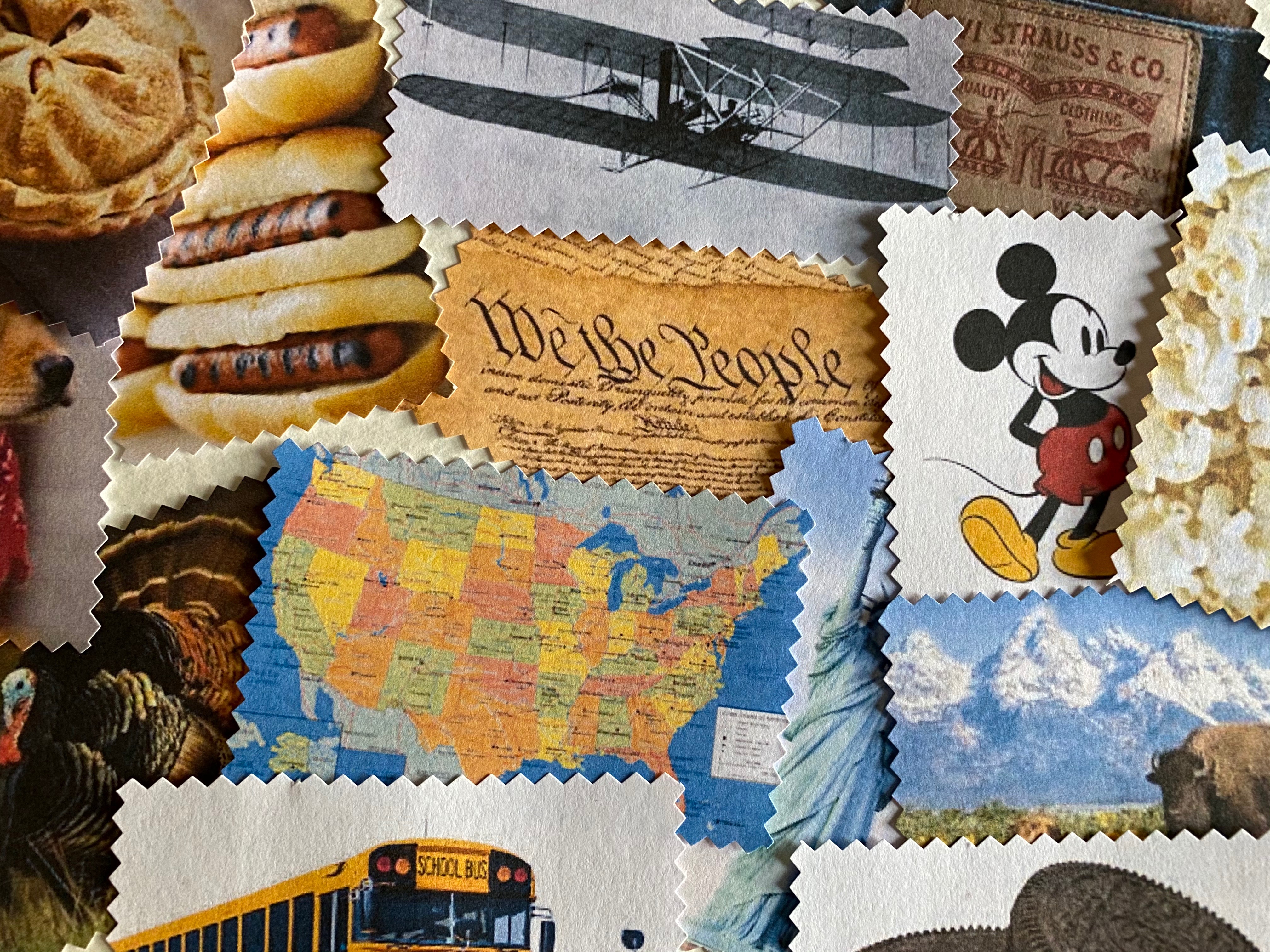
American Collage

Our focus, these past few weeks, has been directed toward several aspects of the American experience –

Part of the American Collage “The Smithsonian’s History of America in 101 Objects”, by Richard Kurin.  (We began by learning a bit about the Smithsonian Institution’s 19 museums and 9 research centers sites – mostly located in Washington DC).  So far, our favorite objects in the book’s collection:   

Columbus piombo    washington uniform

  • The well known portrait of Christopher Columbus that may not be a representation of the man at all – it was painted in 1519, more than 10 years after his death 
  • George Washington’s ultra elegant uniform (designed by George Washington!) 
  • The Bible that Thomas Jefferson edited for himself (leaving out parts he did not believe in)(discussion provoking)

It is going to take us months to work through this book.  We’re glad.

Part of the American Collage – “The Amish of Lancaster County” by Donald B. Kraybill.  Easy to read, up to date (published in 2019), with lovely, plentiful photographs.  Emphasized:  COMMUNITY and the hard working, self-sufficiency, graceful, modest, and religion-centered values of the Amish.  Of great fascination to us was the Amish education system:

amish school

  • all grades are taught in a one-room school 
  • science is not taught in school (we discussed)
  • there is no school after age 14 (we discussed)
  • teachers are not certified, college educated, or even high school graduates (we discussed)

Part of the American Collage – “The Blue Angels”, by Keillor and Wheeler.  Descriptive writing and heart-stopping photographs showcase the precision daredevil abilities of the Navy pilots demonstration team, thrilling everyone since 1946.  Most exciting chapter:  THE MANEUVERS! “The Delta Breakout”! “Loop Breaks”! “Six Plane Cross”!  “The Fleur-de-Lis”!  I asked my son if he would like to fly in a Blue Angel formation and the answer was a YES.  Count me out.  Also, you can count out any Amish community members from soaring with the  Blue Angels as they are (1) forbidden from joining the military and (2) forbidden from riding in airplanes of any sort.  CHANGE OF TOPIC: the first female Blue Angel joined the team in 2014 (we discussed).

Part of the American Collage – “The Incredible Band of John Philip Sousa”, by Paul Edmund Bierley.  We have never come across a book with its subject so thoroughly documented.  This book catalogs every tour, concert, concert program, musical instrument, and musician of the Sousa Band’s 40 year run.  Take aways, so far –

  • In 1889, Sousa sold the publishing rights to “The Washington Post March” for –  OH DEAR IT HURTS TO EVEN TYPE THIS – $35  
  • Sousa composed over 130 marches.  Most famous: “The Stars and Stripes Forever”, composed in 1896 and declared “Official National March of the USA” by an act of the US Congress in 1987
  • Between 1892 through 1931, the band presented just under 16,000 concerts, zigzagging all over the world.  SIXTEEN THOUSAND.
  • Sousa’s Band was a concert band, marching only eight times during the course of 40 years

Part of the American Collage – “Appleseed, The Life and Legacy of John Chapman”, by Joshua Blair.  We’ve learned:

  • Johnny Appleseed (John Chapman) was a real person (1774 – 1845), not a made up legend (although he did travel barefoot, wearing the darnedest clothes, just like the legends proclaim)
  • how he procured the apple seeds (from cider factories!)
  • how and where he set up apple nurseries and the importance of these nurseries
  • of his ability to trusted by westward moving pioneer settlers as well as native Americans
  • how he utterly embodied the spirit of the Swedenborgian religion; the apple tree planting being his ministry
  • in case you are still reading – I painted the “Johnny Appleseed Song” on our kitchen wall (pictured above) in 2003 to celebrate my father’s 82nd birthday because he loved this sung as grace before dinner

apple pie

“As American as Apple Pie” story problem – Of course, Le Fictitious Local Diner sponsors an apple pie baking contest each July 4th.  Last year 40 people entered the contest and there was a three-way tie for best pie:

  • Dr. Susan’s “Doctored-up Super Cinnamon Apple Pie”
  • Tennis Pro Tom’s “What’s Not To Love-Love Apple Lemon Tart”
  • Miss Maddy’s “I-Want-More Burnt Sugar Apple Extravaganza Pie”  

1)  If each pie used an average of 6 apples, how many apples were used to make up all the pies entered into the contest?

2)  If each pie maker practiced on 3 pies before baking their entry pie, how many apples were used to make up all pies (practice and entry pies)?

3)  If the pie bakers bought their apples from Farmer Brown’s fruit stand, did the stand sell more or less than 1,000 apples for the event? 

4)  If the three winning pies were placed on the diner menu for the month of July, and 10 of each were served over the course of the month, how many apples were used to make the menu pies?   (answers at bottom of post)

Look what we made:  our American experience collage (my son’s first collage)

Part of the American Collage – Classical Music:

Amy Beach’s “Fireflies” from “Four Sketches, opus 15”, 1892.  (Amy Beach is noted as being the first female American composer.)  “Fireflies” may just be our favorite summertime classical music selection.  We have probably listened to it 100 times, each time reminding us of firefly magic during sultry summer nights when we lived in Georgia.  The piece sparkles –

Florence Price’s “Silk Hat and Walking Cane” from her “Dances in the Canebrakes”, 1953.   (Florence Price is noted as being the first female African-American composer.)  This delightful short piece provided an opportunity to chat with my son about this well-structured composition’s thematic set-up:  We listened for themes  A – B – A (developed) – C – and finally back to A –  

Charles Ives’ “Country Band March”, composed in 1903.  This is a true musical collage in which Ives has jaggedly juxtaposed fragments from more than 12 recognizable American marches and folk melodies.  When we listen to this, my son and I pretend we are making our way through a crowded carnival midway with American music blaring at us from all sides – 

Welcome to the best part of my day!
– Jane BH
(story problem answers:  1)  240 apples,  2)  960 apples,  3)  less, 4) 180 apples)

New Year, New Books

2019

(Christmas gift – thank you Jimmy)  On the basis of a single book, “Women in Science”, my son and I welcome to our academic library ANY book book written by Rachel Ignotofsky.  WOW.  Ms. Ignotofsky certainly meets her goal of creating educational works of art;  this  dazzling book is intelligently organized and jammed with the kind of information we want to know about.  So far, we have been enticed into learning about the contributions of women astronomers, chemists, mathematicians, entomologists, paleontologists, engineers, electricians, geneticists, and geologists.  This book is such a keeper.

timeline book

(Christmas gift – thank you Aunt Janet)  The Smithsonian “Timelines of Everything” book offers up approximately 150 timelines, each commanding a giant two-page spread.  The focus of each timeline is narrow and we always find something worth discussing further.  For instance:

  • agriculture – we spent some time musing over the fact that sheep were raised for milk and food beginning around 7,000 BCE, but wool was not woven into into fabric until 4,000 BCE (Whoa. A 3,000 year time gap).
  • the wheel – the first wheels were potters’ wheels (we did not guess this – and we do know all about potters’ wheels from our study of ceramic artist George E. Ohr).  
  • the written word – we marveled over the Rosetta Stone.
  • games – we now know that when we play tic-tac-toe we are playing one of mankind’s oldest games (first century BCE) (seriously, the 3 Wise Men could have known how to play tic-tac-toe).
  • religions – I had no idea that this would lead to a discussion of REINCARNATION.  But, duh, OF COURSE.  If one hasn’t heard of reincarnation one would want to spend a bit of time grasping the concept.

styx malone

Fiction Fun – “The Season of Styx Malone”, by Kekla Magoon. Styx is full throttle coolness and confidence.  Do we trust him?  We just don’t know.  This keeps us leaning forward as we read chapter after chapter.  Please don’t disappoint us Styx!

running dog

A super short, super easy Farmer Brown story problem – Often people visiting the ranch bring their dogs, so Farmer Brown’s farmhands have fenced in two dog runs for visiting canines.  Which dog run will give the animals more square footage:  the 6’x25’ run or the 5’x30’ run?  (answer at bottom of post)

conductor match

Classical Quiz – I wanted to check to see if my son was retaining info about the great musicians we have been listening to, so he matched up virtuosos with their instrument.  A few conductors were tossed into the mix to make things tricky.  FYI:  my son scored 100%.

music notes

That sounds familiar –  It is no secret that composers often borrow musical ideas from other composers.  (Usually they give credit, sometimes they get into BIG trouble).  Anyway,  I happen to like tracing routes of melodies through the centuries, so my lucky son gets to enjoy listening to my melody match-ups.  Quick examples:

  • Jacque Arcadelt’s Ave Maria melody of the mid 1500’s can be found in both Camille Saint-Saens’ 1886 Organ Symphony and the Finlandia Hymn from Jean Sibelius’ 1899 symphonic poem, Finlandia.
  • Luigi Denza’s Finiculi Funicula (1880) is front and center in Richard Strauss’s  Aus Italian (1886) and in Nicolai Rimsky-Korsakov’s Neapolitan Song (1907).
  • Brahms’ Symphony 3, movement 3 (1883) provides the melody line for  Carlos Santana’s Love of My Life (1999).

And this leads us to Bach and Rock – 

lute

Last week we listened to Bourrée in E minor from JS Bach’s Lute Suite No. 1, composed around 1710.  Nice, short, memorable melody (and my son learned that a guitar may be substituted for a lute).  A jewel of a performance by Kevin Low – and check out the loose  guitar strings:  

Then we listened to rock-group-from-the-60’s/70’s Jethro Tull’s recording of “Bouree”.  Such a lively interpretation of the Bach suite movement, but it is clear that lead musician, Ian Anderson, had not much experience playing the flute.  We read a few interviews and found out that Anderson was a self-taught flutist, admitting that he had no idea what he was doing.  So we say BRAVO to his CAN DO attitude.  

We concluded by listening to a 2005 recording of Ian Anderson playing the same piece, “Bouree”, with orchestral support.  Anderson did well with the 35 year practice period!  YAY. 

Also, we learned that the real Jethro Tull (inspiration for the rock group’s name) was a noted British agriculture pioneer (1674-1741).

jethro tull

Welcome to the best part of my day!
-Jane BH
(Story problem answer:  both dog run designs have the same square footage – 150 square feet)

Sunday School

gutenberg stamp

The Good Book – Last week my son and I read through Graphic Library’s “Johann Gutenberg and the Printing Press”.  Excellent!  Just enough information about Bibles and print reproduction methods of the 1400s.  My son was engaged with every single comic-book-style page, so I am looking at other topics covered by Graphic Library.

New information for us:
– we learned that before 1455 (pre-Gutenberg’s printing press), monks who worked on Bibles had to use sunlight to illuminate their work stations; candles were not used in the manuscript shop because of the fire threat
– we learned that the path from the idea of movable type to the actual printing of a Bible was a LONG path:  more than 25 years of continual work – the letters, the ink, the press, the relentless search for financial backing
– we learned that Gutenberg stored his metal letters in cases. The capital letters in the “UPPER CASE” and the smaller letters in the “LOWER CASE”.  Thus, the terms!
– 200 Gutenberg Bibles were printed and 48 remain (we talked about the current $$$ value, oh my gosh)

gutenberg patents

Also studying“Popular Patents – America’s first Inventions from the Airplane to the Zipper” by Travis Brown.  This book is so well researched and so interesting, including patent number details (we sort of skip all of that), and chronological order of “what came before what” in regards to each patented invention.  So far we have read about barbed wire and the bottle cap, and we are coming to realize that:  1)  the type of person that invents, does so over and over and over – the inventors we’ve read about hold MANY patents, and 2), as we learned this from our study of Thomas Edison, successful inventors protect their ideas with a patent.  Poor Gutenberg, how he could have used patent protection.

Story Problems for Sun Days – It is so hot this summer at Farmer Brown’s:

fan

Farmer Brown’s cool farm hands: Farmer Brown knows that a cool farm hand is a productive farm hand, so he is installing 6 new fans in the farm hands’ bunkhouse.  He is planning to purchase 4 traditional type large fans for $48 each and 2 state-of-the-art Dyson pedestal fans for $450 each. Farmer Brown’s accountant says this is certainly a business expense and needs to know the total spent.  Without calculating on paper or with calculator, what is most likely the total of the 6 fans?
A: $4,800      B: $948      C: $1,092      D: $2,000    (answer at bottom of post)

corn maze

Farmer Brown’s corn maze:  Farmer Brown decided to join the corn maze craze.  His angle: the state’s smallest maze (for those that freak out at the thought of becoming lost amid the acreage of a typical corn maze)!  Farmer Brown’s maze is going to be 15 feet by 15 feet.  At the end of the maze, Farmer Brown will serve up complimentary corn on the cob.  The attraction will be open July and August.  If an entrance fee of $3 is charged, and on an average 200 people go through the maze each month, and Farmer Brown spends 50 cents for each ear of corn/butter/salt and pepper, how much money will Farmer Brown net by the end of August? (answer at bottom of post)

angel with harp

Music for a Sunday night – Sunday nights are church-type music nights for us, so what better than the sound of a harp to put us in mind of angels?  The three ultra-soothing pieces we listened to last Sunday night were all composed in the 1700s.

First, George Frederick Handel’s “Harp Concerto in B flat Major”, movement 1, written in 1736. This movement is beautifully presented by an orchestra in Istanbul, Turkey (sorry, I couldn’t decipher any more information, it was effort enough to figure out the city) (harpists’ ruffled dresses = adorable):

Second, “Harp Concerto in A Major”, movement 3, composed in the late 1700s (best we could do in terms of a date) by (here comes awesome name of the month):  Carl Ditters von Dittersdorf.  Such a FUN name to say.  Every single time.  This particular video features a VERY young and most talented harpist:

Finally, Mozart’s “Concerto for Flute and Harp”, movement 2, composed in 1778.  This is such a gorgeous yearning melody, presented by a most accomplished student orchestra in Russia and featuring another very young harpist:

Welcome to the best part of my day!
Jane BH
(story problem answer – Farmer Brown’s cool farm hands – C: $1,092)
(story problem answer – Farmer Brown’s corn maze – $1,000)

Riveting!

levi strauss pants

Our current history unit is riveting – or more precisely, it’s about rivets.  We are reading about the blue jeans empire of Levi Strauss & Company, (“Images of America – Levi Strauss & Co.” by historian Lynn Downey).  We’ve learned that Levi Strauss, of San Francisco, teamed with tailor, Jacob Davis, in 1873 to manufacture an extra-hard-wearing work pant – the key to their immense success was their patented rivets-on-the-corners-of-the-pockets design.  But this unit is giving us an opportunity to learn more than just about the jeans: we’ve talked about why Levi Strauss was said to have haled from Bavaria (not Germany) (actually we learned about this from our previous study on Otto von Bismarck), we’ve learned about the devastating San Francisco earthquake of 1906, we’ve learned what “dry goods” are, we’ve looked at print advertising of the early 1900’s AND we’ve learned about rivets.  Another great study unit!

greetings from India postcard      indiana postcard 2

TRAVEL BARGAIN!  13,000 extra miles for $4.00!  I often purchase our books via the “used book associate sellers” on Amazon. (It is amazing how many books I have purchased for 1 penny, plus shipping.)  I usually look to see where the seller is located so I can gauge how long it might take to receive the book.  Last week I ordered a series of “Tom Gates” books from what I thought was a seller in Indiana.  What a surprise to find out that I ordered the series from a seller in INDIA!!!  Crazily, the shipping cost for 7 books was a mere $4.00 and I received the order within a week.  A+ on all levels!  Before we cracked open the first book, we got out the globe, located both Indiana and India, had a small laugh over the 13,000 mile distance, then we traced the route the books may have taken from India to reach us in Texas.

andes mints after eight mints

A mintylicious story problem from Le Fictitious Local Diner – the diner has plans to serve up after-dinner mints with the check at the end of every meal.  The question is, which mints?  The busboys are voting for “Andes Mints” (primarily because one of the busboys is named “Andy”, and wouldn’t that be a riot?).  The waitresses think “After Eight” mints are much classier.  The diner’s accountant told the staff that it is the thought that counts and strongly suggested they purchase the most cost efficient (cheapest) (vocab) mint.  So:
After Eight Mints – each box contains 25 mints.  A package of 6 boxes sells for $22.
Andes Mints – 5 pounds of Andes Mints can be purchased for $34. There are 70 mints in each pound.

A.  How much does a single mint of each type cost (we learned about “rounding up”)?
B.  The diner is going with the least expensive mint.  If  700 hundred dinners are served per week, and each will conclude with a mint, how much will the diner be spending on mints per month? (we are not including tax or shipping costs)(answers at bottom of post)

lute player

“The Lute Player” by Caravaggio, with sheet music by Jacques Arcadelt.  Whoa.

Three Hymns from One – As I have mentioned previously, my son and I listen to music of an ecclesiastical nature on Sunday nights.  This past Sunday night we followed the path of a hymn written in the mid-1500s by Jacques Arcadelt.

First, Arcadelt’s “Ave Maria“.  We are not sure who is singing here, but the acoustics of the Joy Burns Plaza are insanely effective.  A LOT of sound from 4 vocalists:

Next, the finale to Camille Saint-Saens’ “Symphony No. 3 in C minor” (the “Organ Symphony”), composed in 1886. Of this symphony, Saint-Saens wrote “I gave everything to it I was able to give. What I have here accomplished, I will never achieve again.” Doesn’t this make you desperate to have a listen?  Of course, we sort of always like to hear any piece played on a gigantic pipe organ.  We clearly hear Arcadelt’s hymn in this piece:

Finally, we listened to Jean Sibelius’ “Finlandia Hymn”, a small part of his 9-minute “Finlandia” composition.  Again, we hear the influence of Arcadelt’s “Ave Maria”.  “Finlandia” was written in 1899, and words to the hymn portion in 1941.  My son and I are suckers for flashmobs – a train station in Finland is the setting for this wonderful event:

We also wanted to hear the entire “Finlandia” composition.  This recording came from the opening performance of the new music hall in Helsinki, 2011.  The hymn starts about 5 minutes 30 seconds into the piece (alert:  the piece is rather menacing in the beginning – the message is clearly “Don’t Mess with Finland”).  Stirring:

Welcome to the best part of my day.
– Jane BH
Story problem answers:
A. each Andes mint costs approximately 10 cents, each After Eight mint costs approximately 15 cents
B. $272