Nature

The Two-for-One Special

TWO QUIZZES!  That’s right, not just ONE, but TWO quizzes to test my son’s comprehension of current study endeavors (significant landmarks/animal investigations/the Netherlands).  Yay!  He scored 100%.  (answers at bottom of post)

The General Knowledge Quiz: 

1.  Who designed and oversaw construction of Mount Rushmore?
a)  Gustav Eiffel     b)  Frank Lloyd Wright     c)  Alexander Calder,  d)  Gutzon Borglum

2.  The arms (wicks) of windmills turn –
a)  clockwise     b)  counterclockwise  c)  either way depending upon wind direction

3.  Regarding the windmill communication system:  the resting placement of the windmill arms (wicks) can signal – 
a)  good news/bad news/windmill is broken/windmill is resting     b)  there is no such thing as a windmill communication system

4.  The number of bicycles recovered from the Amsterdam canals annually –
a)  100     b)  1,000     c)  10,000

5.  The reason San Francisco’s Golden Gate Bridge is painted orange –
a)   to stand out in the fog     b)  at the time of installation (1937), orange was the California governor’s wife’s favorite color     c)  it was the most affordable paint color that was closest to “gold”

6.  The Great Wall of China was built over the span of –
a)  2,000 years     b)  1,000 years     c)  50 years

7.  Today, the largest ships using the Panama Canal, pay tolls of up to – 
a)   $1 million      b)  $75,000     c)  $1,000
(Here is something fun: In 1928, writer and adventurer Richard Halliburton paid a toll of 36 cents to swim through the canal.)

8.  The largest mammal in South America –
a)  the giant anteater     b)  the capybara     c)  the tapir     d)  the brown throated sloth

9.  Birds have – 
a)  hollow bones     b)  gelatinous semi-soft bones     c)  titanium bones

10.  The only bird that can fly backwards –
a)  the hummingbird     b)  the owl     c)  the bluebird of happiness

The Great Lengths Quiz:  

1.  The length of the Golden Gate Bridge – 
a)  8 miles     b)  4.2 miles      c)   3.5 miles     d)  1.7 miles     

2.  The length of the Panama Canal
a)   50 miles     b)  45 miles     c)  25 miles     d)  10 miles

3.  From furthest point west to furthest point east, which is longer:  mainland United States or the Mediterranean Sea?  (hint:  one is 2,600 miles, the other is 2,400 miles)
a)   Mainland USA     b)  the Mediterranean Sea

4.  All things considered (because this is not one continuous structure), how long is the Great Wall of China?
a)  13,000 miles     b)  9,500 miles     c)  2,100 miles     d)  400 miles

5.  What is the approximate distance between Earth and the moon?
a)  500,000 miles     b)  240,000 miles     c)  10,000 miles     d)  250 miles

After all that test taking:   FUN FICTION READING – 

For a look at history:  Here Lies the Librarian, Richard Peck – a continually amusing peek into rural American life in the 1920’s:  home-made automobiles, romance, dirt roads, bad neighbors, and terrible-to-superb local library management.  

For provoking discussion:  Millicent Min – Girl Genius, Lisa Yee – Brilliant Millicent is 11, and taking a college level poetry class.  Written as a summer journal, short diary entries inform us that Millicent’s mom is forcing her join a volleyball team, Millicent finally has her first friend, Millicent is tutoring somebody who’s lack of academic commitment is driving her crazy.  We are sympathizing with this protagonist who has such a rocky time socializing.  Awwwww.

For relaxing/laughing/smiling:  Tom Gates: Five Star Stories,  Liz Pichon.  This is book number 21 in the series and we’ve read them all – the quality of the hilarious writing, the hilarious predicaments, the hilarious illustrations has not wavered.   At this point, the cast of characters feel like part of our family. Ms. Pichon:  KEEP WRITING!


Story Problem: 2-for-the-price-of-1” at the local diner – Tuesday nights at the local diner are a bit slow, so an enticing “Tuesday Night Only” promotion is offered:  two manager’s specials (chicken pot pie and apple crisp) for the price of one.  If it’s not Tuesday, the price of this dinner is $15 per single order.  Last Tuesday 60 patrons ordered the manager’s special.  How much money did the special bring in?  If the manager’s special costs the diner $5 per order, how much profit did the diner realize? (answers at bottom of post)

Classical Music – How about a THREE-for-ONE special?  We listened to three completely different composition styles of Luigi Boccherini, cello virtuoso and composer (1743 – 1805).  Boccherini’s early years were spent as a  court musician in Vienna.  At age 27, Boccherini relocated, becoming a court musician for the Spanish royal family in Madrid (and remained in Spain for the rest of his life).  We wanted to hear 1) a Viennese-style piece, 2) a work influenced by the music of Madrid and 3) one of his cello-focused compositions.

The Minuet (movement 3) from Boccherini’s String Quintet in E major, composed in 1771 – this fussy, hummable, very “classical music” melody is instantly recognizable as it has been used in loads of films, TV shows, and video games –

The Fandango, from Boccherini’s Guitar Quintet No. 4 in D major, composed in 1798, shows the influence of the guitar music he was introduced to in Spain.  I do not think my son and I have listened to this less than 350 times; it was interesting the first time we heard it, it remains interesting.  We love this performance by the L.A. Guitar Quartet –

Cello Showcased – we know we should be extolling Boccherini’s well respected “Cello Concerto in B flat major”, and we did take a listen.  The concerto certainly flaunts a cellist’s skills.  However, what we love is Boccherini’s String Quintet No. 6 (also known as “Night Music of the Streets of Madrid”).  Movement 5, the Passa Calle, in which the cello carries the piece, is warm, full of local flavor, and we really cannot listen without swaying to the tempo –

Welcome to the best part of my day,
– Jane BH

General Knowledge Quiz Answers:

  1. d)  Gutzon Borglum
  2. b)  counterclockwise
  3. a)  good news, etc.
  4. c)  10,000 bikes
  5. a)  to stand out in the fog
  6. a)  2,000 years
  7. a)  $1 million
  8. c)  the tapir
  9. a)  hollow bones
  10. a)  the hummingbird

Great Lengths Quiz Answers:

  1. d)  1.7 miles
  2. a)  50 miles
  3. a)  mainland USA
  4. a)  13,000 miles
  5. b)  240,000 miles

(Story Problem Answers:  $450, $150)

January Jabber

Here is something we didn’t know: the number of books we read a year.  So, the plan for 2024: TRACKING OUR READING –  How many books will my son and I read this year?  How many will we start?  How many will we finish?  How many are good enough to make it into the re-read basket? 

Speaking of reading (from our Farmer Brown story problem collection) – Farmer Brown has a library in his farmhands’ bunkhouse.  The library has 200 books, some on ranch animal care, some on tending crops, some are rip-roaring tales of the old west.  Farmer Brown noticed that 20 of the books have never been read (mostly books on personal hygiene and healthy snacks).  

– What percentage of books have been read by the farmhands?
a)    10%     b)     20%     c)     75%     d)     90%

– There are 60 wild west fiction books that have been read over and over by the farmhands.  These books comprise what percentage of the bunkhouse library? (answers at bottom of post)
a)  15%     b)  30%     c)  45%     d)  60%

Our Current Sy Montgomery Books – Sy Montgomery is an author whose writing appeals to us.  Her journal-style books take us around the world as we join her in following the work of dedicated animal researchers (and we especially love her “researcher bios”) –

 – The Hyena Scientist”:   For this study, Sy Montgomery journeys to Kenya to join a team of scientists focused on and fascinated by hyenas.  For us, the most intriguing takeaway:  hyenas gather in tightly knit clans (and there are CLAN WARS) with an extremely structured hierarchy, and the females RULE.  Do not mess with the matriarch.

Amazon Adventure – How Tiny Fish are Saving the World’s Largest Rain Forest”:  Cardinal Tetras, bitty sized fish from the Rio Negro (a tributary of the Amazon River, near Barcelos, Brazil) are sought after by home aquarium owners all over the world, and Montgomery spells out why this fish gathering/transporting industry is ecologically important.  OK, OK, but here is the best part of this book:  learning about Barcelos’ FESTIVAL OF ORNAMENTAL FISH!  Oh my gosh, THE FESTIVAL!  Citizens of this teeny town spend months preparing parade floats, stitching flamboyant costumes, and rehearsing for grand “cast-of-a-thousand” performances in the town stadium.  The festival is also a competition:  town citizens are either on the Cardinal team or the Discus (another small aquarium fish) team.  Teams are judged on costumes and performance AND how politely team members watch their rival’s performance! Yes!  Etiquette always!  The Festival of Ornamental Fish is so on the bucket list.

January Jeopardy – We are quiz show ready!  A sampling  of quirky info from our latest batch of books –

1.  The hippo is the most dangerous animal in Africa.  (from “The Hyena Scientist”,  Sy Montgomery)
2. The didgeridoo is the oldest musical instrument in the world.  (from “A Time to Celebrate”, a Lonely Planet Kids book)
3.  Some of the Olympic swimming medalists from the 1948, 1952 and 1956 games started their aquatic training in Maui’s sugar plantation irrigation ditches.  (from “Sakamoto’s Swim Club”, Julie Abery)
4.  Omaha, Nebraska was the home town of dancing sensations Fred Astaire and sister Adele. (from “Footwork – The Story of Freed and Adele Astaire”, Roxane Orvill)
5.  Crescent-shaped, sword-shaped, and star-shaped are three different types of sand dunes found in Algeria’s Sahara Desert.  (from “Algeria, Enchantment of the World”, Martin Hintz)
6.  According to botanists, there are 8 different types of vegetables (leaf, bulb, flower bud, root, tuber, stem, fruit, and seed veggiesit grieves me that my son does not acknowledge 7 types of vegetables). (from “The Vegetables We Eat”, by Gail Gibbons) (answers at bottom of post)

Music + Academics = A+

  • Philip Glass’s “Negro River”, from his 9 movement “Aquas da Amazonia” (composed for a ballet in the late 1990’s), transports us to the site of our “Amazon Adventure” reading experience.   We hear rhythms and echoes of the river – birds, bugs, frogs, water bubbles, an intruder (a snake?) –   

  • Who wouldn’t want to hear the music of the didgeridoo, the oldest instrument in the world!  The didgeridoo (traditionally made of eucalyptus) in this video clip is certainly elegant.  For us, the drone sound it produces takes us by surprise every single time – 

  • And how about some background music for Farmer Brown’s farmhands as they read through the novels of the American west?  We are really liking Virgil Thomson’s “Cattle” movement from his suite that accompanied the 1936 documentary, “The Plow that Broke the Plains”. This short piece is a comforting patchwork of old west melodies –  

Welcome to the best part of my day,
– Jane BH
(story problem answers:  d)  90% have been read, b)  wild west fiction comprises 30% of the library)
Left over from last post:  our San Francisco family member finally sent us a photo from aboard a cable car: 

What took us so long?

What took us so long to discover books by science journalist/author/Sibert medalist Sy Montgomery?  

– We lovedCondor Comeback” because who doesn’t love a success story?  

1982:  Only 22 California condors (huge, majestic members of the vulture family) remain on planet Earth.  That is it.  22.
2019:  450 California condors and the numbers are growing!

This book introduced us to Dr. Estelle Sandhaus, director of conservation science at the zoo in Santa Barbara, California.  From Dr. Sandhaus we learned why condors were on the endangered list since 1967:
– the ingesting of microtrash
– poisoning from lead bullets found in carrion that condors feast upon 
Sandhaus and Montgomery reveal the work required to phase out lead bullets, educate about microtrash, supervise condor breeding, conduct health checks for every condor, and oversee the  “captivity-to-flying-free” protocol.  

– We loved “Chasing Cheetahs”, another success story!  The book focuses upon Laurie Marker and the Cheetah Conservation Fund in Namibia.  Challenge:  cheetah numbers in Namibia were dwindling fast because farmers were killing the cheetahs who were killing their livestock.  The CCF Solution:  education, Kangal dogs and goats (and the cheetah population has risen dramatically).  (Seriously, my summary is simplistic.  I do a disservice to Laurie Marker and Sy Montgomery.  Apologies.  The point is that Laurie Marker and her team have brilliant, common sense ideas and admirable follow through and Sy Montgomery conveyed this to us in a way my son could understand).  

– We really loved “The Great White Shark Scientist”, introducing us to Greg Skomal, shark biologist with the Massachusetts Division of Marine Fisheries.  A basic theme of the book is that sharks are not as dangerous as portrayed by the media.  Example:
In 1996 – the number of Americans injured by sharks:  13 
In 1996 – the number of Americans injured by toilets:  43,000  
Also, we learned that sharks like to eat seals.  So, question:  is it smart to swim around seals?
Saving the best for last:  Sy Montgomery suggests following sharks who have been fitted with a tracking device at ocearch.org (look for “Shark Tracker”).  My son and I are having more fun checking in on the sharks nightly, watching them cruise up and down the east coast of the US.  The tagged sharks have been named and our favorites are Penny, Frosty, and Maple. 

– But we REALLY  loved “The Book of Turtles”.  Worth the price of the book: 1)  Matt Patterson’s superb life-like illustrations.  WHOA.  and 2)  the section on CELEBRITY TURTLES!   Our favorite entry:  the story of two Galapagos tortoises at the Klagenfurt Zoo (Austria), Poldi and Bibi, who had lived happily together for 115 YEARS until one day Bibi  decided that she had “had it up to here” with Poldi. She hissed at him, she bit off part of his shell.  Dear, me!  Zookeepers tried to bring them back together with romantic dinners, but to no success.  The two are now permanently separated.  It is the stuff of Greek tragedies.

What else we are learning –
1)  how to use a Chinese abacus     2)  state birds (we are puzzled that 7 states need to claim the Northern Cardinal as “their” bird.  Was there not choice enough among the remaining 1,100 bird species in the United States?)     3)  history of the circus

Story Problem:  Sack Lunch Sides” at The Local Diner!  To celebrate the start of the school year, the diner is offering a “sack lunch sides” workshop. For $15, junior chefs will learn how to make home-made chips, home-made pickles, and home-made brownies. 

– If 20 students signed up for the class and 18 actually attended, what percentage of students forgot to show up?  
a)  2%     b)  10%     c)  20%     d)  22%
– If 9 of the attendees did not like the “home-made pickles” (yikes!  recipe fail!) what percentage of the junior chefs liked the pickles?  
a)  2%     b)  9%     c)  33%     d)  50%
– And finally, if it cost the diner $8 to provide for each of the 18 students, what was the total profit the diner realized?
a)  $36    b)  $126     c)  $180     d)  $270  (answers at bottom of post)

Classical music to enhance the opera-worthy Poldi and Bibi story – 

– Bibi can no longer abide Poldi, and she has a long, long list of things he does that drive her to madness.  We teamed this scenario with Beethoven’s melodramatic “Rage over a Lost Penny” (composed around 1795).  My son and I are glad not to be at the receiving end of this tirade – 

The Zookeepers set up a dinner of romance to encourage Poldi and Bibi to patch things up.  Music to set the scene?  What better than Carlos Gardel’s très dramatique tango “Por una Cabeza” (composed 1935).  If this doesn’t get things moving in the right direction, nothing will.  Alas, it fails –

– A broken-hearted Poldi slowly trudges away from the love of his life – Nothing less than “Gymnopedie No. 1”, Erik Satie’s slow tempo soul crusher (composed 1888) can capture Poldi’s despair.  Did 115 years of companionship mean nothing? 

Welcome to the best part of my day!
– Jane BH
(story problem answers:  b)  10%,  d)  50%,  b)  $126)

Study Break

Such an unfun set-up:  first the studies, then the study break.

The Greenland Focus – My son and I have proclaimed 2023 as the year we are going to learn about Greenland (the one large land mass we hadn’t “visited” during 2022).  We started with the Wikipedia entry (Greenland: largest island in the world, part of the Kingdom of Denmark, 70% of its energy comes from water power (renewable).  YAY!),  and then read, “Escape Greenland” by Ellen Prager.  This is not our usual type of fiction reading (it is a bit on the high tension/good guys vs. bad guys side)(we are more on the low tension-looking to be enchanted side).  Nonetheless, it successfully brought the location, terrain and climate of Greenland to our attention.

“Icebergs & Glaciers” by Seymour Simon.  A good accompaniment to “Escape Greenland”.  We needed to see photographs of glaciers and icebergs.  We needed grasp their definitions.  (This is hardly the end of our Greenland focus.)

Next Stop, Australia, via “The Great Barrier Reef” by Helen Scales and Lisk Feng.  You can now ask us about:

  • coral bleaching, John “Charlie” Vernon (Godfather of Coral), and the wicked, wicked Crown-of-Thorns Starfish  
  • the future of Green Sea Turtles (this is a species, not a description).  The facts: 
        • the temperature in the nest of baby sea turtle eggs determines the sex of the turtle.  WHAT???? My son and I took a few moments to puzzle over this.  
        • if the nest temperature is lower than 81 degrees, the turtles will be males.  If the temp is above 87 degrees, the turtles will be female.  In-between temps produce a mix.
        • at present, only 1% of green turtles hatching in the Great Barrier Reef are male.    My son and I discussed whether this is optimal.  

  • we read a bit about the world-famous whale, Migaloo (an albino humpback whale), who makes an annual appearance in the reef area (actually, scientists think Migaloo might have perished in the recent past)(RIP Migaloo).  We wanted to know more about Migaloo, so we read “Migaloo, The White Whale”, by Mark Wilson, which provoked us to take a listen to recorded humpback whale sounds. V soothing –

}}-}}}}}}}}}}{{{{{{{{{-{{

Bugs leading the way – how did scientists come up with the idea for:


  • the changing color (green to gold) of the “10” on the 10 dollar bill?  The Blue Morpho Butterfly
  • efficient use of electricity in light bulbs?  Fireflies
  • better solar panels?  The Isabella Tiger Moth
  • more comfortable medical needles?  Mosquitos (whoa: something nice about mosquitoes)

How do we know all this stuff?  “FANDEX Kids “Bugs”.  Anyone following our strict regimen, focusing upon 2 bugs a night would also know:

  • that the queen of some species of termites can live up to 50 years.  Yeeks.
  • the oldest known spider in the world was a female trapdoor spider.  She lived for 43 years!  We can only assume she was studied in a science lab, because she was heartlessly named, “Number 16”.

Yes, we are still on the bird thing we are half way through “What It’s Like to Be a Bird”, written/stunningly illustrated by David Allen Sibley.  We thank Ann P. (influential master teacher who mentored me through my student teaching days decades and decades ago) for suggesting this elegant book.  So far, our favorite 2-page spread:  Wild Turkeys 

  • turkeys were domesticated in Mexico over 2,000 years ago
  • in the 1500’s, they were brought from Mexico to Spain with returning explorers (conquistadors most likely, who are on our permanent bad list)
  • within 20 years, turkeys were the rage throughout Europe (the Pilgrims even brought them back to the Americas onboard the Mayflower)  
  • and TA-DA!!!  Somehow, some Europeans did not get the memo that these birds were from Mexico; it was widely believed they originated from the middle east, specifically, TURKEY.  Thus the name!  File this away for a Thanksgiving Day conversation starter.  We loved this entire segment and read it aloud 3 times.  Thank you again, Ann P.!

And BTW, we now have Sibley’s “Birds of Texas” poster up on the wall.  Very cool.

FINALLY, the study break!  Snack Time Story Problem   The local diner has purchased a popcorn cart with the intention of renting it out for birthday parties and local youth sporting events.  The festive cart was purchased for $300 and will be available for rental at $75 per day.  The diner can supply popcorn and popcorn bags (200 portions for $50).  For fancy affairs, clients may wish to hire Chef Iris to serve up the popcorn at an additional cost of $100 per day.

– How many times will the popcorn cart need to be rented to recover the $300? 
A.  4 rentals     B. 14 rentals     C.  24 rentals  D.  1,000 rentals 

– How much will a client spend if they require the cart for two days, 600 popcorn servings, and Chef Iris to tend cart?
A.  $300     B.  $400     C.  $500     D.  $1,000  (answers at bottom of post)

Classical Music Time – let us suppose that the popcorn cart client would love some carefree, cheerful background music.  Maybe Chef Iris would suggest –

  • Leroy Anderson’s very first work, “Jazz Pizzicato”, 1938.  We can almost hear the popcorn popping –

  • Beethoven’s “Five Pieces for a Mechanical Clock”, Number 3, composed around 1799.  Sweet carnival-type music that could provoke twirling around the closest popcorn cart.  (from what I’ve read, I’m thinking this may have appalled Beethoven)  –  

  • Shostakovich, “Ballet Suite No. 4”, movement 2  (“The Song of Great Rivers”), composed in 1953.  Fresh, lighthearted, an almost merry-go-round feel.  Signature popcorn cart music –

Welcome to the best part of my day!
– Jane BH
(story problem answers:  A. 4 rentals, and C. $500)

Bird Nerds

Us?  Bird nerds?  You must have us confused with real ornithological enthusiasts.  It is true that we have our bird-watching binoculars at the ready and since May, 2022 (when we read our first bird watching book – Mike O’Connor’s hilarious and informative “Why Don’t Woodpeckers Get Headaches”) we have served up pounds & pounds & pounds of sunflower seeds, but other than that we have only accumulated:

  • 5 bird reference books
  • 3 bird posters
  • 3 bird baths
  • 1 bird feeder
  • 1 nesting box

Us?  Bird nerds?  I am not sure we aspire to nerd status, but birdwatching has turned out to be a lot more fun than we could have imagined pre-May 2022.

We comment upon our bird feeder visitors – 
We probably know about 2% of what bird people know about birds, so our amateur observations may understandably provoke criticism:

Mr. and Mrs. Cardinal:  our resident senior citizens (through the binoculars, they look pretty shabby, poor things, but they are a class act).  Very dignified, they perch for a moment, take a sunflower seed, fly off.  We give them an “A”.

The Chickadees:  we think of these cuties as the “little sports cars” of our backyard birds.  Compact and swift, they perch for a moment, take a sunflower seed, fly off.  We give them an “A”.

Our Tufted Titmouse:  this soft looking, dear bird seems to keep himself to himself.  He perches for a moment, takes a sunflower seed, flies off.  We give him an “A”.

Our Mourning Dove:  we haven’t seen this handsome bird perch on the feeder –  he seems content to dine on seeds that have fallen to the ground.  This bird is quiet, sweet, appears thoughtful, and we have to give him an “A”.

And finally, THE FINCHES:  house finches, purple finches, American goldfinches.  These birds hog the feeder and spit seeds all over the place.  They are like the non-productive workers that hang around the office water cooler.  They are like the relatives you wish you didn’t have to invite to the wedding reception.  We give these birds a “C-”, and that is a gift.

Rome Antics”, by David Macaulay – how clever is this book? 

  • the pun-intended title and a homing pigeon tie page one to the final page  
  • the exquisite illustrations of the architecture of Rome, presented pigeon-style (upside down/sideways/twirly-whirly)  

My son and I enthusiastically read this book 3 times in a row to appreciate Macaulay’s efforts.  A+ all over the place.

Big Birds – Speaking of birds, we did get out the measuring tape to see for ourselves the wingspan of some REALLY LARGE birds.  Example:  the Laysan Albatross – 82”.  Whoa.

Current Re-Read – “The Penguin Lessons”, by Tom Michell – so much to learn from this captivating non-fiction book – lots about penguins, lots about Argentina in the 1970’s (hoo boy, talk about inflation).  Well worth the re-read.

We’re not just about birds:

Fandex Kids “Ocean” – this Fandex-Kids card deck is surprisingly good.  An enticing variety of sea life presented with skilled humorous writing.  Our favorite entries:  ocean depth zones (new vocabulary “pelagic”, rhymes with “magic”), the coelacanth, giant kelp, giant squid (measuring tape out again to envision this 40 foot wonder), the graceful decorator crab.  If we were employed as Fandex editors we would replace the cartoony illustrations with photographs.  Other than that, fun resource with a most helpful glossary.

Story Problem:  Farmer Brown upgrades the bunk house It is time for Farmer Brown to replace all the bedding in the ranch hands’ bunk house.  For each bed, new sheets (at $75 per set), new blankets (at $100 each) and a new quilt (at $100 each) will be purchased.  If there are 8 ranch hands and Farmer Brown wants  2 sets of sheets, 2 blankets, and 2 quilts for each bed, will Farmer Brown spend more or less than $4,000 to replace the bedding? (answer at bottom of post)

’22  in Review – our academic goal for 2022 was to find the location on the globe of everything we studied.  In all, we “visited” 44 countries.  The only large landmass we missed was Greenland, so this is ASSIGNMENT ONE for 2023.

Classical Music is for the Birds – 

The Aviary, from “Carnival of the Animals” by Camille Saint-Saens.  The suite was composed in 1886, but not published until after Saint-Saens’ death (1921).  He thought his reputation as a serious composer would be tarnished by this “too frivolous” work (of course he was wrong).  A jewel of a performance by the Pittsburgh Symphony Orchestra, conducted by Andre Previn –

The Dove (La Colomba), Ottorino Respighi.  Perfect way to honor our mourning dove.  Respighi based this 1928 composition on the music of 17th century lute virtuoso Jacques de Gallot.  We can hear the dove cooing throughout and we love the magical flute and harp ending –

Bird Feeder Banquet Music –   How about “Tafelmusik” (literally “table music”, composed  specifically to provide light background music while people AND MAYBE BIRDS were banqueting)?  We chose an absolutely delightful piece by Georg Philipp Telemann (his Quartet in G major, movement 4, composed in 1733)(and BTW, Telemann wrote lots of tafelmusik).  We can hear the birds darting to and from the bird feeder throughout the movement –

Welcome to the best part of my day,
Jane BH
(Story problem answer:  Farmer Brown will spend more than $4,000.  He will, in fact, spend $4,400 plus tax)

…and the categories are –

-FAST FOOD FESTIVAL-
-WINGING IT-
-POWER PLAYS-
-BRAVEST OF THE BRAVE-
-BIODIVERSITY UNIVERSITY-
-THE NEW DEAL GOES NORTH-

I know it looks like my son and I are gearing up to secure spots on a TV game show;  our current stack of books is crammed with so many unrelated topics and we are jammed with facts, ready for trivia question number one – 

FAST FOOD FESTIVAL – We are ready for questions about the history of mega-popular American foods (pizza, hot dogs, french fries and the like) after reading “There’s No Ham in Hamburgers”, by Kim Bachman.  Now we know:

  • a surprising number of the foods Americans consume like mad were brought to public exposure at the 1904 Louisiana Purchase Exposition AKA the 1904 St. Louis World’s Fair:  hamburgers, yellow mustard, cotton candy, puffed rice cereal, and Dr. Pepper.
  • Mr. Potato Head was the first toy to have a TV commercial (this kooky bit of info found in the potato chapter).
  • WWI American soldiers were the first to enjoy peanut butter and jelly sandwiches (high in protein and no refrigeration needed).  The US Army bought the ENTIRE first batch of Welch’s grape jelly for the cause.  And speaking of peanut butter, I am sure EVERYONE wants to know that Skippy filed for a patent for hydrogenated peanut butter the very same WEEK that my son’s grandfather was born (April 1921) AND in the very same city in which he was born (Alameda, California).  Whoo hoo!  Chills!  Making history personal!

WINGING IT – We are ready for questions about North American birds after reading Mike O’Connor’s second book, “Why Do Bluebirds Hate Me?”.  Same format (question and sidesplitting/informative answer) as his first book, “Why Don’t Woodpeckers Get Headaches”.  Per suggestion from first book, we teamed our nightly reading with the Kaufman Focus Guide, “Birds of North America”.  Thanks to a repetition of themes, we now know:

  • birds want sunflower seeds, not “special birdseed mix” 
  • seeds need to be fresh
  • birds need a birdbath:  we now have a birdbath!!!! Tiny, but AWESOME, handcrafted of river stone by an artisan in New Hampshire (danceswithstone.com)
  • there is a correlation between backyard bird sightings and bird migration
  • we can be a kinder people, thanks to a superb essay on bird feeder hospitality

Final note – O’Connor’s way with words made me laugh so hard, that with most of the Q&A’s, I had to stop reading aloud until I could gain composure. What is better than that?

POWER PLAY – “Solar Story – How One Community Lives Alongside the World’s Biggest Solar Plant”, Allan Drummond.  Easy to read, endearing illustrations, enlightening.  We are ready for questions about solar plants and sustainability AND we get to mark another country on our global map:  Morocco.  We now know that the world’s largest concentrated solar power plant is located in Ouarzazate, Morocco (in the blindingly sunshiny Sahara Desert).  We augmented our reading with the Wikipedia article on this Ouarzazate Solar Power Station, and we saw it with our own eyes via a Google Earth view. 

BRAVEST OF THE BRAVE – “Resist!”, subtitled “Peaceful Acts that Changed our World”, an A+ resource by Diane Stanley (all of her books are A+).  We are ready for questions about the gutsiest people who have acted boldly, guided by an inner sense of what is right.   Some we have already studied (like Harriet Tubman and Mohandas Gandhi), some we have never heard of (like Irena Sendler and Ai Weiwei).  Each 2-page mini bio has grabbed ahold of our hearts (and I am pretty much weeping at the end of each profile). 

BIODIVERSITY UNIVERSITY – We are ready to answer questions about the most biodiverse place on Earth because we have just finished “Amazon River”, a well-edited introduction to the world’s largest river basin, by Sangma Francis, brilliant artwork by Romolo D’Hipolito.  We now know a bit about the geography, indigenous people, current dangers, and the ridiculously enormous variety of plant (like 16,000 species of trees) and animal wildlife (like 2.5 million species of insects).  Our final take-away:  we would like to see “in person” a pink river dolphin, and we would not like to see “in person” a green anaconda (but we sort of would – from at least a 17 foot distance).

THE NEW DEAL GOES NORTH –  We are ready for questions about an aspect of FDR’s New Deal program:  during the Great Depression of the 1930’s, the Matanuska Colony was established to give displaced Midwestern farmers a new start in the Alaska territory.  This is the basis of Carole Estby Dagg’s well researched and continually interesting YA historical novel, “Sweet Home Alaska” – a family from Wisconsin becomes part of this new community.  Good reading every single night.

Story Problem at the Local Diner   What doesn’t Chef James do well?  He has recently revealed that he is a nationally ranked chess player, so diner management has asked him to preside over a week long (Monday-Friday) chess camp for middle schoolers in August.  The camp will be held mornings in the diner and will include a hearty breakfast to activate brain cells.  20 students have signed up.  The participants are to be charged $75 for the week.  Chef James will received $50 for each morning of chess instruction.  The daily breakfast for each camper is priced at $8.00.  

– How much profit will the diner realize at the end of the week?

a)  $250     b)  $450     c)  $1,050     d)  $1,500

– If the diner pays $250 for a large outdoor banner to advertise the chess camp, will they still make a profit? (answers at bottom of post)

Something new:  keyboarding skills!  I was so inspired by this year’s (2022) graduation speech by Rollins College valedictorian, Elizabeth Bonkers (easy to find her delivery on YouTube).  She, like my son, has autism and is non-verbal.  Her speech was achieved through a text-to-speech program and was the worthiest of graduation addresses.  What a wake-up call!  Could my son learn keyboarding skills? We had tried this years ago with no success, but I decided to try again and now, THE ANSWER IS YES!  He is focused and interested!  We begin with keyboarding practice (finding vowels, the letters of his name, the space bar) and then for the best part: my son gets to text his brother and sister (one in NY, one in Seattle) and they both text right back.  Talk about effective positive reinforcement.

Classical Music Time –  Our brains are crammed and jammed with facts and this is not the time for challenging music selections.  Here are the top three super-soothers that my son selects over and over for night time listening –

Song to the Moon, from Antonín Dvořák’s opera, Rusalka (1901). This is sort of  the Czech version of the little mermaid story; this particular piece has a water nymph asking the moon to tell the prince of her love. This recording showcasing violin virtuoso, Joshua Bell, is the one we have listened to about 300 times – 

 Oven Fresh Day, from Grant Kirkhope’s BAFTA (which we learned was the British Academy of Film and Television Arts) nominee score for the Xbox 360 game, “Viva Piñata”, composed in 2006.   A lovely, wistful melody, recorded by the Prague Philharmonic – 

The Barcarolle, from Act 3 of Jacques Offenbach’s final opera, “The Tales of Hoffman” (1880).   Although referred to as “The Barcarolle”, the real title of the work is “Belle Nuit, ô Nuit d’Amour” (“Beautiful Night, Oh Night of Love”) (FYI, a barcarolle is the song of a Venetian gondolier) . There is no reason for any other orchestra to record this, as this smooth-as-glass, masterful performance by the Berlin Philharmonic cannot be improved upon – 

Welcome to the best part of my day!
 – Jane BH
(Story problem answers:  b)  $450, and yes)

Hey, Rhododend!

Hey, rhododend! Courage, little friend. Ev’rything’ll end rhododandy. Hurry! It’s lovely up here!

My son and I are experiencing the satisfaction of growing plants from seeds, and I have been humming the GO TO gardener cheerleading tune, “Hurry! It’s Lovely Up Here”, from the 1965 Lane/Lerner Broadway musical, “On A Clear Day You Can See Forever”.  How this came to be – 

First, back in December, my son started a microscopic volunteer job at the most wonderful local nursery.  Mr. Paul, the manager, as well as every single employee we have encountered, has been accommodating, tolerant, and welcoming.  So, when we arrive for the once-a-week “job”, my son literally bursts from the car and yanks on his garden gloves, revved up to walk through the magic land of plants and get to work.  At completion of the day’s task, we purchase a seed packet (so far:  radishes, sunflowers, thyme, cucumbers, peppers, turnips) for planting that very afternoon. 

Then, we learned so much from Riz Reyes’ “Grow”, a superbly organized book offering a four-page spread for each of 15 different types of plants (plants that my son can understand, like mushrooms, bamboo, maple trees, daffodils), enhanced by the vibrant illustrations of Sara Boccaccini Meadows.  This A+ book has inspired us to plant tomatoes, pumpkins, and carrots from seeds.  (And speaking of “A+”, this book was written by a former high school student of my best college room-mate, (top flight language arts teacher) Miss Jeanette – who has made it into a few of my story problems).  We are already on our second read through. We just love every page of this book AND his Instagram page:  rhrhorticulture. Finally, a few months ago I paid a visit to the very best kind of new relative (a half-sister!), whose backyard produces such an abundance of fruits/citrus/vegetables that I knew, right then, that I wanted my son to be able to witness the slow motion miracle of all sorts of plant growing cycles.

Change of topic, but still in the backyard –  “Why Don’t Woodpeckers Get Headaches”, by Mike O’Connor, of the “Bird Watchers General Store” in Orleans, Massachusetts.  First of all, this is the work of a skilled and knowledgeable writer and almost more importantly, THIS BOOK IS NON-STOP HILARIOUS.  It is comprised of letters of inquiry to Mr. O’Connor, whose responses make me shriek with laughter, and are filled with information we had never considered (how can we be responsible citizens if we don’t have a birdbath in our back yard?????)(we are SO getting a birdbath).  Learning while we are laughing is THE BEST. More outdoor stuff – We have just finished “The Northern Lights – Celestial Performances of the Aurora Borealis”, dazzler photos by Daryl Pederson and Calvin Hall and relevant accompanying essay by Ned Rozell – prompting us to discuss the commitment a photographer would need to spend endless nights in the freezing cold environs of the North Pole, just waiting and waiting and waiting to capture aurora phenomena.  (Of course, we learned what causes the aurora:  solar winds jousting with the earth’s electromagnetic field.  Sort of FREAKY STUFF.)  We augmented our study (Wikipedia) by learning that  “aurora borealis” means  “northern lights”.  Is there a similar phenomena by the South Pole?  Yes, the “aurora australis” (australis meaning “south”, not a reference to Australia).  Damn, we know a lot.

Story problem from the nursery – a project my son is currently working on (at his volunteer job) involves moving pavers (that have been stacked on a falling-apart wood palate) to a brand new palate.  Over the course of the past few weeks he has moved: week 1 – 25 pavers week 2 – 30 pavers week 3 – 30 pavers week 4 – 33 pavers Question:  If the pavers sell for $3 each, and Farmer Brown needs 50% of the pavers on the new palate to create flooring for his new birdbath sanctuary, how much cash will he need to retrieve from his secret safe (not including tax)? a)  $60     b)  $177     c)  $300     d)  $354  (answer at bottom of post)

And more outdoor stuff  – We’ve just finished the Gordon Korman YA book, “Unplugged”, which takes place in the great outdoors (a remote camp in Arkansas) and involves a ban on electronics, a vegetable-forward diet, quirky new friends AND a sinister, illegal alligator enterprise. This is the most advanced mystery/adventure book I have tackled with my son.  He liked it!  As per usual with a Gordon Korman work:  excellent book, excellent message.

Classical Music Time: celebrating the growing season – “Spring”, movement I – from Vivaldi’s “Four Seasons”, composed around 1720.  About 30 seconds into this spirited performance we can hear jillions of insects buzzing like crazy in the meadow.  We love this part!

“Spring Song” from Mendelssohn’s “Songs without Words”, book 5 (of 8 books), composed around 1844.  My son is familiar with the main theme of this composition because it has been used more than once in cartoons (case in point, Disney’s 1937 “Clock Cleaners” – about 6 minutes into the cartoon) – 

And of course, “Hurry! It’s Lovely Up Here” – Adorably sung in this video clip by Audra McDonald – my fave lines (about the “rhododend”) are stuck right in the middle of the song – 

Welcome to the best part of my day! – Jane BH (Story problem answer:  b)  $177)

Making the Grade

Straight A’s  for everything in our July book basket – 

A+:  A History of Pictures” – by David Hockney and Martin Gayford.  It is really called “A History of Pictures for Children” and we are perplexed:  this stunner of a book is for EVERYBODY.  It is thought-filled and thought-provoking, tempting us to take a fresh look at cave paintings, Egyptian wall paintings, mirrors, shadows, Disney cartoons, pencil marks, brush strokes, perspective, collage, and the influences of photography, movies, and computers. The 4 page timeline of inventions that pertain to drawing and painting is worth the cost of the book alone.  This book is in line for a re-read.

A+: One Real American, The Life of Ely S. Parker” – by Joseph Bruchac.  A superb book about the Seneca sachem (chief) and Civil War general.  Easy to read, filled with information that was new to us (go ahead, ask us about the Iroquois League, ask us about Red Jacket, ask us about Ely S. Parker), extremely well edited and documented, and a timeline is included at the back of the book.  My son and I are impressed by both Ely S. Parker and author Joseph Bruchac.

A+:  “What Linnaeus Saw” by Karen Magnuson Beil.  In my last post, “Our Hour”, I mentioned that we had read about artist/nature observer Maria Merian, who was cited so very many times by Carl Linnaeus.  So, we HAD to read about Carl Linnaeus (1707 -1778), whose quest was to systemize, classify, and name every animal, plant, and mineral.   The book is a weency bit repetitive, but the author is forgiven – Linnaeus’s path to the goal was neither short nor direct.

A+: Three Keys” – My son got a feel for the term “refugee” in “Home of the Brave” by Katherine Applegate (the finest book we read in 2020).  He is now beginning to understand the plight of the immigrant via Kelly Yang’s book “Three Keys”.  This is about friendship, open mindedness, hard work, and having the confidence to speak out for what is right.  We really liked the prequel, “Front Desk” and we will definitely be reading “Room to Dream” when it comes out in September.  Kelly Yang:  A+!

Other study topics from the July book basket

  • The Everglades   “Everglades National Park” by Grace Hansen.  This book is written for the younger reader, but it does come across with the basic facts and the photos (including a nice photo of President Harry Truman dedicating the park) are large and representative. 
  • Geometry   “Everything You Need to Ace GEOMETRY in One Big Fat Notebook” by Workman Publishing.  Oooooh, I do not like this book because any venture into math that doesn’t involve a story problem leaves me dizzy.  BUT, my son really likes it.  DARN.  So we sally forth learning about congruency, chords, transversals, etc.  With each page, I feel like my head is diving deeper into a swirling fog, so I just read the words aloud and marvel that my son is entranced.  I give myself a C-.  
  • Geography – “Bird’s Eye View – The Natural World” by John Farndon/Paul Boston.  Very pretty book, soothing illustrations, AND we both learned a new word!  We LOVE being smacked in the face with a new word!  We have never come across the word MEANDER used as a noun.  A meander is a bend in a river or a road.  It takes so little to make us gleeful.

The Local Diner plans for August (story problem) –  The diner is installing a pop-up snow-cone hut on the diner’s back deck for the month of August.  It will be manned by a high school summer-time employee, who will work 5 hours a day for $12 an hour.  There will be 3 flavors of snow cones:  cherry, mint, and watermelon, and a commercial snow cone machine has been purchased for $250.  The diner is making the syrups and providing the ice.  So the questions are:

  1. How much will the diner pay a week for a high school snow cone artisan?  
  2. If the diner sells a snow cone for $2.00, how many will have to be sold to recoup the money spent of the snow cone machine?
  3. Will the diner spend more on the snow cone machine or employing the high school worker (for the month of August)? (answers at bottom of post)

Classical music:  A+ Musicians  

It was VIRTUOSO NIGHT last night.  My son made the selections (the writing chaos on the side of the page is my son indicating “Yes” or “No” for each of my suggestions) –

On the flute:  James Galway – We both love James Galway and we both love Tambourin, a short, happy piece for flute composed by Francois-Joseph Gossec in 1794, for his opera, “Le Triomphe de la Republique”.  For some reason, midway through the video there is a blank screen for about 40 seconds, but NO WORRIES, the spritely music continues – 

On the violin:  Itzhak Perlman   We have compared Itzhak Perlman’s performance to other violin virtuosos and no one touches the finesse he puts into this performance of Mendelssohn’s Violin Concerto in E minor, the finale (composed in 1844).  BTW, my son and I refer to this as the Cat and Mouse movement – 

On the piano:  Simone Dinnerstein   We consider ourselves members of the Simone Dinnerstein fan club.  Her discs are part of our music line-up as we drive to In-N-Out Burger twice a week. We LOVE her way with a Bach invention – 

Welcome to the best part of my day!
– Jane BH
(story problem answers:  1)  $420,  2)  125 snow cones,  3)  the diner will spend more for the high school worker)

Our Hour

Class is in session for one hour every single night and my son and I LOVE this time together.  We are focused, fascinated, and leaning forward to learn more.  Here is how we divided up our studies and stories hours this past week:

Before Carl Linnaeus, before Charles Darwin, before John James Audubon:  MARIA MERIAN  (1647-1717), artist/nature observer.  We learned all about Merian in the Sibert Medal 2019 book, “The Girl Who Drew Butterflies”  (Joyce Sidman).  Merian’s meticulous work documenting caterpillars/butterflies/host plants was cited 130 times by Carl Linnaeus in his major opus, “Systema Naturae”.  Maria Merian was the first to bring scholarly attention to the caterpillar-to-butterfly connection.  More, of note:

  • We rolled our eyes:  As a female in her native Germany, Maria Merian was forbidden to study at college, and yet her groundbreaking work was criticized because she was a “self-taught amateur”.  
  • We cheered:  Tsar Peter the Great bought 300 of her original watercolors to start Russia’s first art museum.  My son selected one of her works in poster form for his room:

History Time:  

“The World Jesus Knew – A Curious Kid’s Guide to Life in the First Century”, by Marc Olson/illustrated by Jemima Maybank.  A scholarly work, accented with sly humor.  Here is what caught our attention:

  • Palestine was under the rule of the Roman Empire during the time of Jesus.  This was actually a BIG deal – Roman rule infiltrated all aspects of life
  • Because fisherman were in the water so often, they often fished WITH NO CLOTHES ON
  • The Sanhedrin, what was it and how powerful was it?

Learning-about-Careers Time:  

“Vet Academy” (Martin/Keoghan) – My son’s cousin Kelly is a vet (and as far as we are concerned, THE BEST VET), so we thought we should learn more about her world: 

  • My son and I mused over three vet specializations and what each would mean in terms of life-style:  small pets (vet treats animals at local veterinary clinic), farm animals (vet drives all over creation to check on “patients”), or zoo animals (vet essentially lives at the zoo).  
  • Our favorite page of the book was in the zoo animal section:  we learned to distinguish between cheetahs, leopards, and jaguars by examining their spots.  We keep getting smarter.   

Language Arts Time:  

PREMOOSC – YENIDS – HEVETOBEN – TWESARE – YECCLER – PRITOMANEL

After spending really a lot of time putting together months and months of puzzles, I bought a “Jumble Junior”  book.  Perfect.  

Math Time:  

A Farmer Brown Story Problem – Even though Farmer Brown has a perfectly good rooster to awaken his 8 farmhands, he has been under pressure to purchase an alarm clock for each worker.  Farmer Brown is letting them choose between a digital (vocab) clock ($12) or a vintage analog (vocab) clock ($15).  Three fourths of the farmhands want a digital clock, the rest have ordered the analog.  Total shipping will be $10.  Farmer Brown has budgeted $100 for new clocks, will this cover the costs?  (answer at bottom of post)

Reading for Fun Time:  

Three words:  Hank the Cowdog.  Years ago we read through the gigantic series and we are now revisiting our favorites.  Two weeks ago we read, “The Mopwater Files”.  Last week it was “The Disappearance of Drover”, this week, “The Incredible Priceless Corncob”.  Hank time is Texas-sized smile time.

Arts and Crafts Time:

French curve – We were swerving and curving after I found an envelope of plastic French curve templates that had belonged to my father (an engineer).  Why shouldn’t my son know about Ludwig Burmester’s (a German mathematician) French curves?

Music Appreciation Time:  last night we listened to music for CLOCK-WATCHERS: 

– Haydn’s Symphony No. 101 “The Clock” (movement 2, the “tick-tock movement”) composed in 1794.  Performed competently (and adorably) by the Kawartha (Ontario, CA) Youth Orchestra –

–  Zoltan Kodaly’s “Viennese Music Clock” from his Hungarian folk opera “Háry János” (1926).  A spirited performance, complete with dancing clock, by the Israel Philharmonic Orchestra –

– LeRoy Anderson’s “Syncopated Clock”.  This piece was composed in 1945, while Anderson was serving in the US Army, as Chief of Scandinavian Desk of Military Intelligence (proving that he could do two things at once).  I sort of think that Leroy  Anderson (a brilliant man with a huge sense of humor) would have approved of this kookie performance by the St. Luke’s Bottle Band (and I totally want one of those feathered green hats).  This ensemble is having WAY TOO MUCH FUN –

Welcome to the best part of my day!
– Jane BH
(Unscrambled words:  COMPOSER, DISNEY, BEETHOVEN, SWEATER, RECYCLE, TRAMPOLINE)
(Story Problem answer:  NO)


Mid-March Roundup

They glide through the air with the greatest of ease – We are reading “Catching Air”, a book focused on GLIDING ANIMALS (non-bird animals that seemingly fly from tree to tree).  This is our third book by Sneed B. Collard III, whose writings on lizards and bird beaks (for heavens sakes) have made us enthusiastic observers.   As usual, the material he presents in “Catching Air” makes us feel super scholarly:

  • we now know that large eyes on animals are suggestive of a nocturnal nature
  • we now know the difference between flying, gliding, and parachuting animals
  • we now know what a patagium (vocab) is and we know how to pronounce it
  • we discussed the difference between a carnivore, herbivore, and omnivore
  • we are now among those who know where the largest, second largest, and third largest islands in the world are (the largest, of course, is Greenland – where there are no gliding animals, but there are gliding animals aplenty in Papua New Guinea, the second largest island and Borneo, third largest island) 
  • last night we read about the creepiest creepiest creepiest thing:  the air gliding snakes of Borneo     

Editing Triumph:  Hans Christian Anderson – I wanted my son to understand references that originated from Anderson’s writings, like “The Emperor’s New Clothes” and “The Ugly Duckling”, so we read from a most elegant edition of his fairy tales, compiled by Noel Daniel (published in 2013).  This book is thoughtfully organized and filled with sumptuous surprises.  There is a lot of gold ink, short informative sidebars, and each fairy tale is teamed up with its own illustrator  (the likes of Maurice Sendak and Arthur Rackham).  THIS is the edition that anybody interested in Hans Christian Anderson should own. 

Quick Notes –

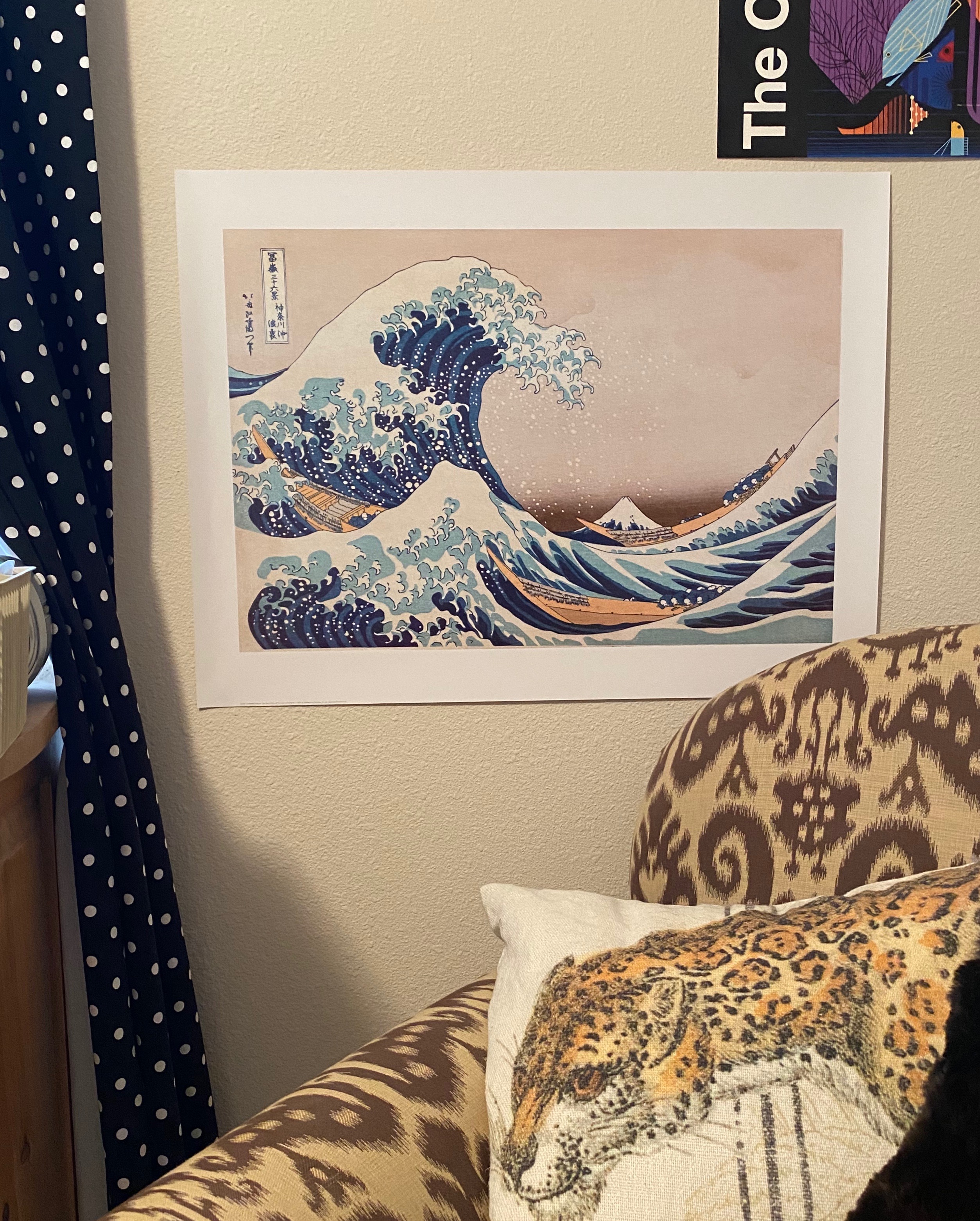
  • Hokusai:  After finishing “The Old Man Mad about Drawing” (Francois Place), learning more about Katsushika Hokusai, woodcut print master of the late 1700’s, I presented my son with 4 Hokusai poster possibilities for his room.  He selected the classic, “The Great Wave”.  Even in poster form, it is more spectacular than I had imagined.
  • Marsupials:  First of all, “marsupial” is a fun word to say.  Marsupial, marsupial, marsupial.  We finished a unit on marsupials – those mammals that nurture their newborns in mom’s front pocket – except for those marsupials whose mom’s don’t have a front pocket (which our book should have expanded upon)(editing disappointment)(sigh).
  • Compass directions:  I did a compass check with my son.  Did he know north, south, east, and west?  YES.
  • Hank the Cow Dog:  It has been years since we have read through the John R. Erickson series.  This is the ridiculousness we need to conclude each day.  We pretty much love Hank.

Complaint Department:  My son and I are studying architectural landmarks.  I am not mentioning our resource because this book could have been so much better.  I would not be giving this editor a raise anytime soon:

  • Our book provides only vague references to each landmark’s location, as if the exact whereabouts were a secret.  Seriously?  No nearby city mention?  No COUNTRY mention?  How can there not be a little map accompanying each entry?   
  • Whereas all entries are interesting, are they all really landmarks?  Are the Roman Baths of England a landmark?  Are the the buried terra-cotta army figures in China a landmark?
  • Often the book waxes on about a particular object of fascination (fabulous mosaics, a special stone, etc) associated with a particular landmark, and then does not include a photo of the object.  AAAAACK.

Nevertheless, we do have our favorite landmarks:

  • First place honors go to the hundred foot tall Christ the Redeemer of Rio de Janeiro.  Monumental simplicity.  Of interest:  funding ran low during construction, so the Vatican stepped in to assist.  Nice.
  • Second place, measuring in at 185 feet (on one side) is the relentless engineering fiasco and utterly charming Leaning Tower of Pisa.  

Story problem – a landmark at Farmer Brown’s roadside produce stand!  In the hopes of making his produce stand a tour-bus destination, Farmer Brown has commissioned a sculptor to create a 10 foot high bronze ear of corn, to be positioned near the stand.  That should get everyone’s attention!  The “artwork” will be true to actual corn proportions.  If there are 50 kernels of corn in a typical row on a corncob, each kernel must be approximately how wide in the sculpture?  (answer at bottom of post)

A)  2.5 inches     B)  5 inches     C)  7.5 inches     D)  2.5 feet

Classical Music Time – earlier in this month (MARCH), a local radio station hosted a “vote for your favorite march” opportunity.  We listen to marches every Friday night throughout the year, so my son definitely knew the three he was voting for:

  • Marche Militaire No. 1 in D major, composed as a piano four-hands piece by  Franz Schubert and first published in 1826.   Perhaps best described as a ballroom march, Marche Militaire is also effectively used in the cute-as-anything Disney cartoon of 1932, “Santa’s Workshop” (my son LOVES this cartoon – frankly, I love this cartoon).  Note:  the extremely competent pianists in this clip do take quite a bit of time to get started:

  • March of the Prague Student Legion, by Bedrich Smetana, composed in 1848.  This is a march that fills you with nationalistic pride, makes you throw your shoulders back and stand up straight.  We love the snappy pace of this particular recording.  As an added listening bonus, tucked into the middle of the march, my son and I listen for a few bars of “The Farmer in the Dell”:

  • The Imperial March (Darth Vader’s theme),  John Williams’ genius nod to aggression and menace.  In this film clip, John Williams conducts the LA Philharmonic Orchestra (complete with Jedi and Mr. Vader):

Welcome to the best part of my day!
– Jane BH
(story problem answer:  A)  2.5”)