Camille Saint-Saens

Chillin’ with the Ladies*

 My son and I have been spending time with the two most recognizable women in the world.

– Mother Teresa, by Navin Chawla  
This was a lengthy book (274 pages) for us, but every single page increased our awareness of Mother Teresa’s brilliant original thinking, her commitment to her calling, her powerful leadership skills.

We read in depth about the three endeavors of her Missionaries of Charity:
– a home for unwanted or orphaned children
– a home and medical facility for those with leprosy
– a home for the destitute and dying 

We have added a heart swelling quote from the book to our Sunday night spiritual moment:  while sitting with a dying patient, Mother Teresa was overheard to whisper, “You say a prayer in your religion, and I will say a prayer as I know it.  Together we will say this prayer and it will be something beautiful for God.   There is now a poster of St. Teresa of Calcutta on my son’s wall.

– The Mona Lisa Vanishes, by Nicholas Day
There is nothing concerning the theft of the Mona Lisa (from the Louvre Museum in 1911) that is not examined in this book: 

– we learned about Lisa Gherardini, who posed for the portrait 
– we learned about Leonardo da Vinci (it was thought provoking to read that Leonardo was most likely ADHD)(this would explain a lot)
– we learned about French police/detective work in the early 1900’s (just the very beginning of fingerprinting)
– we learned about security at the Louvre Museum (super lax)(then, not now)  
– and finally, a dazzling conclusion to the book:  the thief of the Mona Lisa is revealed, lies surrounding the theft are exposed, and we learned that the painting was returned with great ceremony to the Louvre just prior to the breakout of WWI.

This book is perhaps the most organized and well researched book we have ever read.  It is written in small readable chunks – perfect for us.  Inspired by this book, we now have a poster of the Mona Lisa up on my son’s wall. 

Fiction Fun –

– While Mrs. Coverlet was Away, by Mary Nash –  This classic from 1958 has been on our August reading list for several years.  I just love it…I sort of hope my son loves it too, cuz this was at least our 8th time through.   It is funny, it is clever, it champions self reliance.

Story Problem:  The Local Diner gets Fancy

The local diner has decided to add a refined touch:  from now on, all  breakfast rolls and desserts will be served atop a doily.  If the diner calculates that they serve 50 breakfast rolls daily (7 days a week) and 150 desserts daily (7 days a week), how many doilies will they need each week?
a)  70     b)  350     c)  700     d)  1,400

If the diner can purchase 1,000 doilies for $15 from “Doilies R Us”, will $100 be enough money in the diner budget to purchase a month’s worth of the needed doilies?  (answers at bottom of post)

(I am not defending the use of doilies, I am only writing a story problem)

Classical Music:  finally chillin’ with the ladies, virtuoso style –

– Setting the stage –
1913 – first woman EVER to be hired by a professional orchestra (the Queen’s Hall Orchestra in London)
1918 – first woman invited to join an American orchestra (the Detroit Symphony Orchestra)
2003 – at the very back of the pack:  the Vienna Philharmonic, under pressure from the Austrian government, finally welcomes the first female musician into the orchestra

Any orchestra should be so lucky to be chillin’ with these virtuosos:

Cello Virtuoso, Jacqueline du Pré – (1945 – 1987)  Ask anyone (who knows anything about this) to list 5 cello virtuosos, and Jacqueline du Pré’s name will be on that list.  My son and I sat rapt listening to her play “The Swan” from Camille Saint-Saëns’ 14 movement suite, “Carnival of the Animals” (composed in 1886) –

Flute Virtuoso, Jeanne Baxtresser (1947 –    ), former principal flutist for the NY Philharmonic (for 15 years!).  It was fun to listen to her almost haunting adaptation of Saint-Saëns’ “Swan” and we loved the spirited pace

Trumpet Virtuoso, Alison Balsom (1978 –    ).  Alas, we knew we weren’t going to find anyone on trumpet playing “The Swan”, but we were happy to find a recording of Handel’s  “Arrival of the Queen of Sheba” (from his 1748 oratorio, “Solomon”), showcasing Alison Balsom, whose performance is perfection.  Even though this has been one of our favorite compositions for years, we still can’t help but smirk thinking about Handel’s fussy piece portraying life in Jerusalem about 1,000 BC  –

Welcome to the best part of my day,
– Jane BH
(story problem answers:  d)  1,400 doilies a week, and “yes”, $100 is enough to pay for a month’s worth of doilies)
*The title of this page came from a “Get Fuzzy” (Darby Conley) cartoon from years and years ago.  The phrase is still making me and one of my other kids laugh every time we think about it.

Side Dishes

Regarding our Stories & Studies program  If books are the “main course”, we need side dishes to complete the nightly academic banquet.  This is the fun part for me – making up the story problems, word scrambles, iPad keyboard practice words, and most fun of all, creating the reading comprehension sheets.

Reading Comprehension –
Our reading comprehension efforts amount to this:  in complete silence, my son reads a few paragraphs dealing with the antics of two best friends, Clem and Clyde, and answers questions so I can assess if he understood what he read.  So far, it is a big smiles occasion when I present a new “Clem and Clyde”  and my son has worked through 25 reading comp sheets.  Did I hear someone inquire about the page titles?  OK:

Clem and Clyde get Jobs!
Clem and Clyde get New Shoes
Clem and Clyde and the Dandy Potato!*
Clem and Clyde Win an Award!
Clem and Clyde and the Pizza Poet
Clem and Clyde and the Purring Promenade
Clem and Clyde Learn to Juggle!
Clem and Clyde get New Backpacks
Clem and Clyde Paint their Bedrooms
Clem and Clyde Drive Tractors!*
Clem and Clyde and Honest Abe
Clem and Clyde and the Dream Destination
Clem and Clyde:  Trampoline Testers!
Clem and Clyde at Home on Candy Cane Lane
Clem and Clyde make New Years Resolutions
Clem and Clyde buy a Snowman
Clem and Clyde try Sugar Snap Peas
Clem and Clyde take Square Dancing Lessons!
Clem and Clyde get Haircuts
Clem and Clyde get Saturday Jobs
Clem and Clyde Paint Murals
Clem and Clyde and the Band-Aid Stand
Clem and Clyde Host a Spaghetti Dinner
Clem and Clyde Help Out at the Library
Clem and Clyde Make the Worst Lemonade

*samples:

iPad Keyboard Competence –
My son still needs to get comfortable with letter positions on a keyboard.   Repetition is obviously the key, but here is what would happen if I said “press the “a”, press the “a”, press the “a”, now press the “b”, press the “b”, press the “b””:  NOTHING.  So, I prepare groups of rhyming words (one group per night) (enough is enough) (this seems to be SLOWLY working:  without assistance, my son can now locate and press letters “A” through “I”).   Rhyming clusters like these:

wink – blink – sink – pink – rink – think (repeatedly pressing the “i-n-k” letters)
bark – park – hark – lark – shark – mark (repeatedly pressing the “a-r-k” letters)

Word Scrambles – 
My son LOVES (and is lightning fast at) unscrambling words.  If nothing else, this is good for  handwriting practice.  Not that anyone needs an example, but:

THARRSOCE (orchestra)
SLYMOPIC (Olympics)

Story Problems
I like story problems and I like writing them.  When I was a youngster, story problems were the only way that I could understand the point of math. Our story problems bring to life the Local Diner or Farmer Brown’s Ranch and Roadside Stand.

~The local diner has decided to bottle and sell their popular spicy buttermilk salad dressing.  Local high school art students are competing to design the bottle’s label.   The prize is three-pronged: 1) a case of 24 bottles of the spicy buttermilk salad dressing, 2) photo of winning designer in local newspaper, 3) the photo enlarged to poster size and displayed near the diner cash register (we are talking HOME TOWN FAME).  

– If each bottle will sell in the diner for $5.00, how much is the prize worth? 
a)  $24     b)  $120     c)  $500     d)  $524

– If the “sell by” date of each bottle is 6 months after bottling, and a family typically goes through 2 bottles of salad dressing a month, how many bottles from the case of 24 should the prize winner give away to neighbors?
a)  9     b)  12     c)  18     d)  20 (answers at bottom of post)

~Farmer Brown has recently purchased 5 new umbrellas for the outdoor picnic area adjacent to his roadside produce stand.  Good grief, each umbrella cost $500!  Farmer Brown is selling his popular “cinnamon stick apple pies” for $20 each to raise money to pay for the umbrellas.  If the profit from each pie sold is $15, will Farmer Brown have to sell more or less than 150 apple pies? (answer at bottom of post)

Parlez-vous de musique classique?  For the duration of the Paris Olympics, we have listened to the work of French composers (Saint-Saëns, Ravel, Faure, Satie, Offenbach, Delibes, Bizet, Debussy) every single night.   Getting us into the Parisian spirit – 

(BTW, this is how my son selects music every night)

Offenbach – The Can-Can from Jacque Offenbach’s comic opera of 1874, “Orpheus in the Underworld”.  This is the lively version my son and I have listened to many, many, many times –

Bizet – The Carillon (tower bells) from “L’Arlesienne, Suite No. 1”, composed in 1872.  Bizet composed 27 pieces  of incidental music for Alphonse Daudet’s drama (“L’Arlesienne”).  In this performance, we like how the conductor moves this piece right along.  The usual tempo is a bit slower.

Debussy – Clair de Lune, inspired by Paul Verlaine’s poem (1869),  Clair de Lune is the 3rd movement of Debussy’s “Suite Bergamasque” composition for piano of 1890.  This video footage complete with Lang Lang’s achingly slow, thought-filled performance, is filled with current scenes of Paris.  Perfect! 

Welcome to the best part of my day!
– Jane BH
(story problem answers:  b)  $120, b)  12 bottles to neighbors, and “more” (Farmer Brown needs to sell 167 apple pies)

Bird Nerds

Us?  Bird nerds?  You must have us confused with real ornithological enthusiasts.  It is true that we have our bird-watching binoculars at the ready and since May, 2022 (when we read our first bird watching book – Mike O’Connor’s hilarious and informative “Why Don’t Woodpeckers Get Headaches”) we have served up pounds & pounds & pounds of sunflower seeds, but other than that we have only accumulated:

  • 5 bird reference books
  • 3 bird posters
  • 3 bird baths
  • 1 bird feeder
  • 1 nesting box

Us?  Bird nerds?  I am not sure we aspire to nerd status, but birdwatching has turned out to be a lot more fun than we could have imagined pre-May 2022.

We comment upon our bird feeder visitors – 
We probably know about 2% of what bird people know about birds, so our amateur observations may understandably provoke criticism:

Mr. and Mrs. Cardinal:  our resident senior citizens (through the binoculars, they look pretty shabby, poor things, but they are a class act).  Very dignified, they perch for a moment, take a sunflower seed, fly off.  We give them an “A”.

The Chickadees:  we think of these cuties as the “little sports cars” of our backyard birds.  Compact and swift, they perch for a moment, take a sunflower seed, fly off.  We give them an “A”.

Our Tufted Titmouse:  this soft looking, dear bird seems to keep himself to himself.  He perches for a moment, takes a sunflower seed, flies off.  We give him an “A”.

Our Mourning Dove:  we haven’t seen this handsome bird perch on the feeder –  he seems content to dine on seeds that have fallen to the ground.  This bird is quiet, sweet, appears thoughtful, and we have to give him an “A”.

And finally, THE FINCHES:  house finches, purple finches, American goldfinches.  These birds hog the feeder and spit seeds all over the place.  They are like the non-productive workers that hang around the office water cooler.  They are like the relatives you wish you didn’t have to invite to the wedding reception.  We give these birds a “C-”, and that is a gift.

Rome Antics”, by David Macaulay – how clever is this book? 

  • the pun-intended title and a homing pigeon tie page one to the final page  
  • the exquisite illustrations of the architecture of Rome, presented pigeon-style (upside down/sideways/twirly-whirly)  

My son and I enthusiastically read this book 3 times in a row to appreciate Macaulay’s efforts.  A+ all over the place.

Big Birds – Speaking of birds, we did get out the measuring tape to see for ourselves the wingspan of some REALLY LARGE birds.  Example:  the Laysan Albatross – 82”.  Whoa.

Current Re-Read – “The Penguin Lessons”, by Tom Michell – so much to learn from this captivating non-fiction book – lots about penguins, lots about Argentina in the 1970’s (hoo boy, talk about inflation).  Well worth the re-read.

We’re not just about birds:

Fandex Kids “Ocean” – this Fandex-Kids card deck is surprisingly good.  An enticing variety of sea life presented with skilled humorous writing.  Our favorite entries:  ocean depth zones (new vocabulary “pelagic”, rhymes with “magic”), the coelacanth, giant kelp, giant squid (measuring tape out again to envision this 40 foot wonder), the graceful decorator crab.  If we were employed as Fandex editors we would replace the cartoony illustrations with photographs.  Other than that, fun resource with a most helpful glossary.

Story Problem:  Farmer Brown upgrades the bunk house It is time for Farmer Brown to replace all the bedding in the ranch hands’ bunk house.  For each bed, new sheets (at $75 per set), new blankets (at $100 each) and a new quilt (at $100 each) will be purchased.  If there are 8 ranch hands and Farmer Brown wants  2 sets of sheets, 2 blankets, and 2 quilts for each bed, will Farmer Brown spend more or less than $4,000 to replace the bedding? (answer at bottom of post)

’22  in Review – our academic goal for 2022 was to find the location on the globe of everything we studied.  In all, we “visited” 44 countries.  The only large landmass we missed was Greenland, so this is ASSIGNMENT ONE for 2023.

Classical Music is for the Birds – 

The Aviary, from “Carnival of the Animals” by Camille Saint-Saens.  The suite was composed in 1886, but not published until after Saint-Saens’ death (1921).  He thought his reputation as a serious composer would be tarnished by this “too frivolous” work (of course he was wrong).  A jewel of a performance by the Pittsburgh Symphony Orchestra, conducted by Andre Previn –

The Dove (La Colomba), Ottorino Respighi.  Perfect way to honor our mourning dove.  Respighi based this 1928 composition on the music of 17th century lute virtuoso Jacques de Gallot.  We can hear the dove cooing throughout and we love the magical flute and harp ending –

Bird Feeder Banquet Music –   How about “Tafelmusik” (literally “table music”, composed  specifically to provide light background music while people AND MAYBE BIRDS were banqueting)?  We chose an absolutely delightful piece by Georg Philipp Telemann (his Quartet in G major, movement 4, composed in 1733)(and BTW, Telemann wrote lots of tafelmusik).  We can hear the birds darting to and from the bird feeder throughout the movement –

Welcome to the best part of my day,
Jane BH
(Story problem answer:  Farmer Brown will spend more than $4,000.  He will, in fact, spend $4,400 plus tax)

The Octopus Shocker

He writes!  He illustrates! – For the past few weeks my son and I have become entranced with  Owen Davey books.   Informative, clever, teamed with sophisticated graphics in a perfection of colors.  Our type of book.  We’ve just finished – 

  • “Mad about Monkeys” – We needed to get a better grip on our knowledge of primates (as in the fact that chimpanzees, gorillas, orangutans, gibbons are NOT types of monkeys) (we had sort of thought they were)(we were wrong).  Also, we now have a passing knowledge of “old world” and “new world” monkeys.  
  • “Obsessive about Octopuses” – 1)  this book is so A+, 2) the correct plural of octopus is octopuses, NOT octopi, 3) we stopped short when we read about the common blanket octopus: the female stretches to 6 feet in length and the male (ARE YOU REALLY READY FOR THIS?) measures in at 1 inch. A live male blanket octopus was sighted for the first time in 2002 (Wikipedia) OH MY GOSH and 4)  THE SHOCKER!!!!!  Most of the 300 species of octopus live ONLY A FEW MONTHS!  I have been asking all my friends how long a typical octopus lives and guesses have ranged from 16 years to 50 years.  Dear dear magical, nimble, problem-solving octopuses –  taken at so young an age.
  • Next on the reading list, “Fanatical about Frogs”.

Deforestation – My son and I read a lot of books about endangered animals, so we know that loss of habitat is a primary cause.  We have come across the term, “deforestation”  many times, so deforestation was on our minds when we read from the excellent “How Ships Work” (a Lonely Planet Kids book) that – 

  • around 2,000 trees were used to build a Spanish galleon in the 1500’s (and we know there was more than one galleon).
  • 6,000 trees were needed to construct British flagship HMS Victory in 1765. 

 Deforestation is not a new trend.

“Everest” by Sangma Francis and Lisk Feng – all topics Everest are covered in this well written, well designed book:  Sherpas, the sacredness of the mountain, climbing clothes, the development of oxygen masks, trash on the mountain, routes to the summit, inspirational climbers AND my son and I are still musing over the fact that Mount Everest grows 1/3 inch a year.

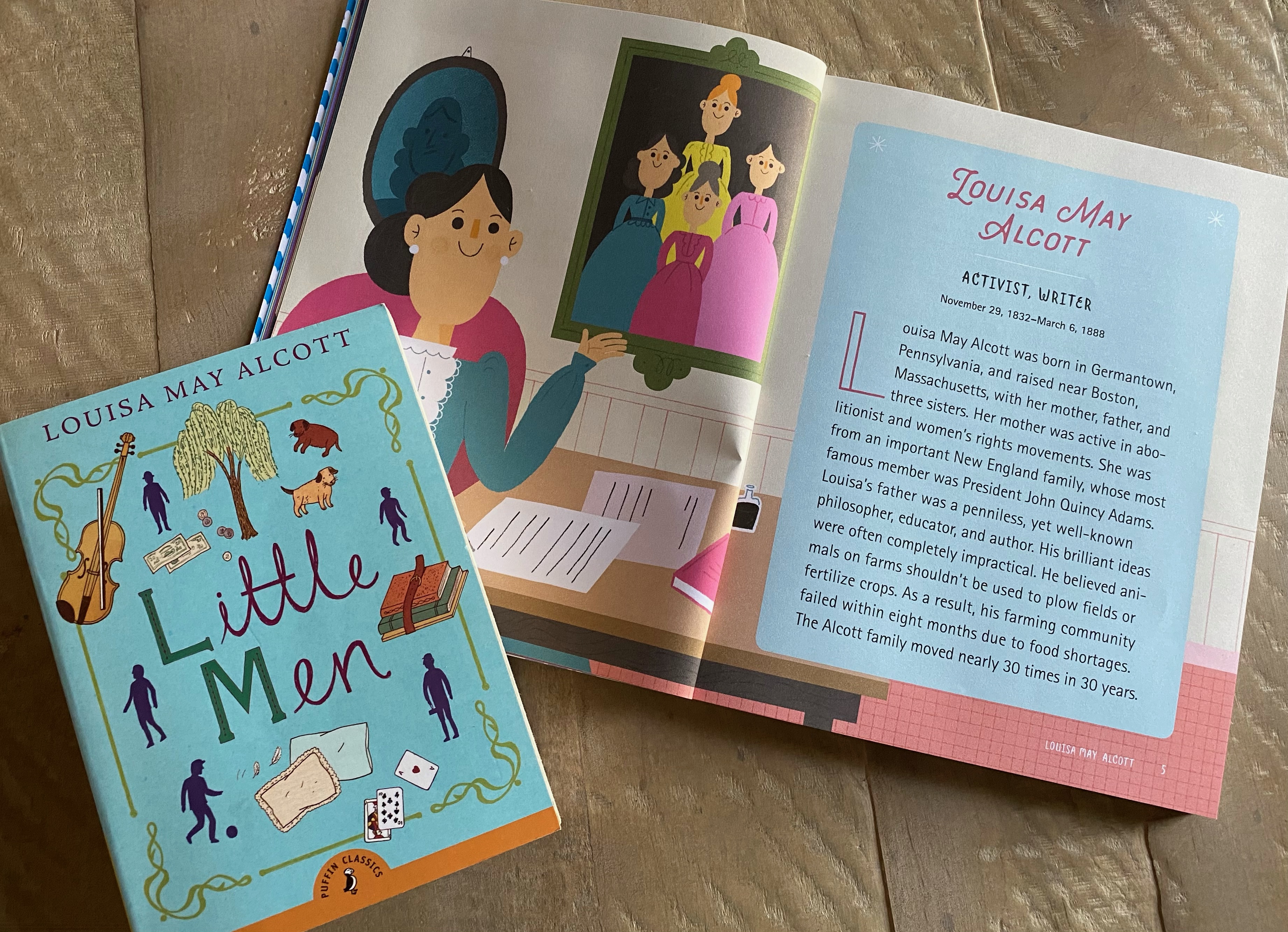
“Little Men”, by Louisa May Alcott – I have read “Little Women” several times and I was eager to share my first reading of “Little Men” with my son.  1)  Jeepers, this is relentlessly moral story.  2) This is a difficult read what with the vernacular of the 1870’s and the loads of characters, some with multiple nicknames. I read aloud one paragraph and then take the same amount of time to untangle what I’ve just read for my son.  Sigh.  We have augmented “Little Men” by reading a short bio of Louisa May Alcott from “American Trailblazers” by Lisa Trusiani.

Time for a change in tone!  Story Problem – Farmer Brown Runs for Town Mayor!  –  Yes, Farmer Brown is running for town mayor and his chances for winning look good!  His campaign manager has all sorts of campaign ideas to get Farmer Brown’s name before the public:

  • 50 big yard signs spread around town, with the slogan, “Farmer Brown can make our town grow!” ($4 for each sign and $25 each for Farmer Brown’s two nephews to place the signs)
  • 1000 campaign buttons (“Farmer Brown can make our town grow!”) for $250
  • A running ad (boldly proclaiming that “Farmer Brown can make our town grow!”) in the local newspaper for $75
  • A banner spanning the width of Main Street boldly proclaiming, “Farmer Brown can make our town grow!” for $75
  • 1,000 grocery sacks at Farmer Brown’s road-side stand with “Farmer Brown can make our town grow!” imprinted for $150

Farmer Brown has budgeted $750 for campaign PR.  Can he afford all the ideas ?  (answer at bottom of post)

Classical Music for Octopuses – we were still thinking about the brief lives of the octopuses.  If the current crop of octopuses is going to enjoy classical music, the pieces had better be short.  May we suggest – 

  • Violin virtuoso Fritz Kreisler’s “Schön Rosmarin” (Beautiful Rosmarin), composed in 1905.  Just under two minutes. We listened for iconic Kreisler embellishments while easily envisioning an octopus swaying with the tides –
  • “Solfeggietto”, by CPE Bach, composed in 1766. One minute sixteen seconds. This fast, frantic piece is certainly the “go to” background music for an octopus needing to escape predators –
  • “The Aquarium” from Carnival of the Animals (1886), by Camille Saint-Saëns.  Two minutes, four seconds. Reflective, yearning, chilling, mysterious; it seems as if the octopus was the muse for this piece –

Welcome to the best part of my day!
– Jane BH
(story problem answer:  NO!)

New Year, New Books

2019

(Christmas gift – thank you Jimmy)  On the basis of a single book, “Women in Science”, my son and I welcome to our academic library ANY book book written by Rachel Ignotofsky.  WOW.  Ms. Ignotofsky certainly meets her goal of creating educational works of art;  this  dazzling book is intelligently organized and jammed with the kind of information we want to know about.  So far, we have been enticed into learning about the contributions of women astronomers, chemists, mathematicians, entomologists, paleontologists, engineers, electricians, geneticists, and geologists.  This book is such a keeper.

timeline book

(Christmas gift – thank you Aunt Janet)  The Smithsonian “Timelines of Everything” book offers up approximately 150 timelines, each commanding a giant two-page spread.  The focus of each timeline is narrow and we always find something worth discussing further.  For instance:

  • agriculture – we spent some time musing over the fact that sheep were raised for milk and food beginning around 7,000 BCE, but wool was not woven into into fabric until 4,000 BCE (Whoa. A 3,000 year time gap).
  • the wheel – the first wheels were potters’ wheels (we did not guess this – and we do know all about potters’ wheels from our study of ceramic artist George E. Ohr).  
  • the written word – we marveled over the Rosetta Stone.
  • games – we now know that when we play tic-tac-toe we are playing one of mankind’s oldest games (first century BCE) (seriously, the 3 Wise Men could have known how to play tic-tac-toe).
  • religions – I had no idea that this would lead to a discussion of REINCARNATION.  But, duh, OF COURSE.  If one hasn’t heard of reincarnation one would want to spend a bit of time grasping the concept.

styx malone

Fiction Fun – “The Season of Styx Malone”, by Kekla Magoon. Styx is full throttle coolness and confidence.  Do we trust him?  We just don’t know.  This keeps us leaning forward as we read chapter after chapter.  Please don’t disappoint us Styx!

running dog

A super short, super easy Farmer Brown story problem – Often people visiting the ranch bring their dogs, so Farmer Brown’s farmhands have fenced in two dog runs for visiting canines.  Which dog run will give the animals more square footage:  the 6’x25’ run or the 5’x30’ run?  (answer at bottom of post)

conductor match

Classical Quiz – I wanted to check to see if my son was retaining info about the great musicians we have been listening to, so he matched up virtuosos with their instrument.  A few conductors were tossed into the mix to make things tricky.  FYI:  my son scored 100%.

music notes

That sounds familiar –  It is no secret that composers often borrow musical ideas from other composers.  (Usually they give credit, sometimes they get into BIG trouble).  Anyway,  I happen to like tracing routes of melodies through the centuries, so my lucky son gets to enjoy listening to my melody match-ups.  Quick examples:

  • Jacque Arcadelt’s Ave Maria melody of the mid 1500’s can be found in both Camille Saint-Saens’ 1886 Organ Symphony and the Finlandia Hymn from Jean Sibelius’ 1899 symphonic poem, Finlandia.
  • Luigi Denza’s Finiculi Funicula (1880) is front and center in Richard Strauss’s  Aus Italian (1886) and in Nicolai Rimsky-Korsakov’s Neapolitan Song (1907).
  • Brahms’ Symphony 3, movement 3 (1883) provides the melody line for  Carlos Santana’s Love of My Life (1999).

And this leads us to Bach and Rock – 

lute

Last week we listened to Bourrée in E minor from JS Bach’s Lute Suite No. 1, composed around 1710.  Nice, short, memorable melody (and my son learned that a guitar may be substituted for a lute).  A jewel of a performance by Kevin Low – and check out the loose  guitar strings:  

Then we listened to rock-group-from-the-60’s/70’s Jethro Tull’s recording of “Bouree”.  Such a lively interpretation of the Bach suite movement, but it is clear that lead musician, Ian Anderson, had not much experience playing the flute.  We read a few interviews and found out that Anderson was a self-taught flutist, admitting that he had no idea what he was doing.  So we say BRAVO to his CAN DO attitude.  

We concluded by listening to a 2005 recording of Ian Anderson playing the same piece, “Bouree”, with orchestral support.  Anderson did well with the 35 year practice period!  YAY. 

Also, we learned that the real Jethro Tull (inspiration for the rock group’s name) was a noted British agriculture pioneer (1674-1741).

jethro tull

Welcome to the best part of my day!
-Jane BH
(Story problem answer:  both dog run designs have the same square footage – 150 square feet)

Sea Hunt

Sea Hunt – Do you know about the Sargasso Sea?  Located in the Atlantic Ocean, to the east of Bermuda, it is about 2/3 as wide as the continental USA (so it is HUGE), yet there is a glaring shortage of non-fiction books focused upon this important ecosystem.  Surely my son and I are not the only people who want to know more about the turtles and eels of the Sargasso Sea.  We learned a bit by reading through Ruth Heller’s, “A Sea Within a Sea”, a lovely book with information set to rhyme, but we want more.  Attention people who are looking for something to write about: big opportunity here.

Great Beginnings – We are hopeful about two books we began last night: “Ocean” by Ricardo Henriques and Andre Letria (in just the first four pages we enjoyed a richness of information woven into sparse, eye-catching graphics) AND, we started an abridged version of Homer’s “The Odyssey”, by Gillian Cross and Neil Packer (oh my, the illustrations! and of course, oh my, the story!)

What else are we reading?
“Boats Fast & Slow” by Iris Volant and Jarom Vogel (almost a bit too elementary for us. Nonetheless, there are things to learn from this well organized book).
“The War I Finally Won”, by Kimberly Brubaker Bradley (a sequel to the excellent “The War that Saved My Life”).
“While Mrs. Coverlet Was Away” by Mary Nash (only our 6th time through) (a plot line that makes us smile through every single re-read) (this book needs to be read during the summer).

Willy Nilly Time Zones – My son and I love opening up a Ken Jennings book – his writing is clever, funny, and informative.  This week, we are in the middle of his “Junior Genius Guide to Maps and Geography” and have spent time twirling our globe while we read about the International Date Line, the Prime Meridian, and time zones.
WE DID NOT KNOW THIS: countries can determine whether they want to follow international time zone designations.  China, which spans 5 time zones, and Greenland, which spans 4 time zones both make do on a single time zone.  We spent a few minutes thinking about what this would mean if you lived at the far east or far west of either country.  Interesting.
When we are feeling rebellious we say THROW AWAY the state approved text books and replace them with anything written by Ken Jennings.

A Farmer Brown Story Problem – Over Labor Day weekend, there is to be a kayak race in the local river and Farmer Brown is anxious for his ranch team to win the competition (good publicity for his farm stand).  He is purchasing 6 kayaks at $250 each for his employees to practice with, and super competitive Farmer Brown has promised to captain the team! (the ranch team will be so glad when the race is over)
After the race, Farmer Brown is going to offer kayak rentals to be used on his ranch pond. If he charges $15 to rent a kayak for an afternoon of paddling fun, and assuming that 6 people want to kayak every single day, how many afternoons will pass before he makes a profit (which will probably go into kayak maintenance)?
A) 17     B) 27     C) 37     D) 47 (answer at bottom of post)
For discussion: Is this a fast way to make money?

Water Water All Around – a classical music theme to compliment all the reading about oceans, seas, and boats:

  • “The Aquarium”, from Camille Saint-Saens’ “The Carnival of the Animals”, composed in 1886.  Saint-Saens congers up an atmosphere of creepy deep sea mystery in this short short two minute piece –

  • “Jeux de Vagues” (“Play of the Waves”), from Debussy’s “La Mer”, composed in 1904.  We haven’t braved listening to this intellectual masterpiece until this very week; a bit too sophisticated for us, I thought.  But this week, my son and I sat back and let Debussy bring us the sounds of waves being pushed around by the wind, currents, and other waves.  Terribly elegant –

  • “Over the Waves”, composed by Juventino Rosas in 1888.  This waltz rhythm is definitely happier listening than the Aquarium or Jeux de Vagues.  However (semi-interesting side-note), we keep getting this confused with Emile Waldteufel’s “The Skaters Waltz” of 1882 (could Rosas have been “more than” inspired by Waldteufel’s piece?) –

Welcome to the best part of my day!
– Jane BH
(story problem answer:  A)  17 afternoons)(and our discussion topic:  we decided that this actually was a semi-fast way of making money, faster than we thought)

2016 – Gone, but not forgotten

2016-quiz

2016:  the year we learned more about –  the California Gold Rush, the insanely brilliant architecture of Gaudi, the work of bees, Eugene Bullard, homonyms, Hannibal, dwarf planets, George Washington Carver, patents, rodents, Rube Goldberg, computation involving triangles, etc, etc, etc.  Last night, my son took matching quiz that reviewed our academic studies from the past year, and earned an A+.  Good year.

macaulay-book

New book!  For Christmas, a special aunt and uncle sent my son David Macaulay’s classic, “The Way Things Work”.  This is obviously a mechanical engineering book lurking behind precise illustrations and hilarious examples.  This past week, we became experts on “the inclined plane” and “the lever”.  (In 2016, we learned a lot from Macauley’s books on “The Toilet” and “The Mill”, so we should emerge MENSA-worthy if we can absorb everything this comprehensive book offers.)

electricity

Story Problem from Le Fictitious Local Diner – The diner spent a lot of money on electricity in 2016; management is reviewing usage to see if they can cut back (perhaps a weekly “dining by candle-light” event might make a teeny dent in the diner’s electrical consumption).  To make decisions, management needs some facts:  if the diner was open 6 days a week, how many days in 2016 were they using electricity?  If the cooks were at the diner from 6 a.m. until 11 p.m., how many hours last year was the diner using electricity? (story problem answers at bottom of post)

2016

Music Listening in 2016 – My son and I welcomed an additional 85 classical (in the broadest sense) pieces into our iPod library this past year.  Last night, I presented a list of our fave 10 of these compositions and then my son picked his top three for listening.

10 pieces we first listened to in 2016 –

Ave Maria – Arcadelt
Banjoland Buffoonery – Kirkhope
Brandenberg Concerto No. 3 – Bach
Harp Concerto in A major – Dittersdorf
Organ Symphony, finale – Saint-Saens
Persian March – Strauss
Sailing By – Binge
String Quartet No. 2, scherzo – Borodin
The Anvil Chorus (Il Trovatore) – Verdi
Toccata in A major – Paradisi

music-faves-2016

My son’s selections for last night’s listening –

“Banjoland Buffoonery”, composed in 1998 by Grant Kirkhope for the Nintendo 64 video game, “Banjo-Kazooie”.  A short piece, packed with rollicking fun, AND an excellent (and accessible for the likes of my son and myself) example of theme and variation:

“Persian March”, composed by Johann Strauss II, in 1864.   My son cannot stop his toes from tapping to this marvelously exotic march (expertly played by a Polish youth orchestra) (SO heartening to witness excellence in youth):

“Sailing By”, written by Ronald Binge in 1963 and used by BBC Radio to introduce the late shipping forecast.  This sweet,  slumberous waltz gets our vote for most soothing lullaby.  When we just cannot deal with one more thing, THIS is our music:

Welcome to the best part of my day!
– Jane BH
(story problem answers: 1) 312 days 2) 5,304 hours)

Quandary

Here is the quandary (vocab):  I do not like reading to my son about man’s inhumanity to man; he has enough to deal with without trying to grasp the perplexing notion of cruelty.  HOWEVER, the “Wicked History” series books are so well written, organized, researched, and crazy fascinating – we can’t stay away.

leopold-book-cover

We just finished the book on BAD BAD King Leopold II of Belgium (1835-1909); and he was indefensibly bad – Hitler and Stalin BAD.  There were passages in the book describing atrocities under his leadership of the “Congo Free State” (his PERSONAL colony) so barbaric, that while reading aloud to my son, I had to skip over paragraph after paragraph.
On the plus side:
– we learned a LOT about what is now the Democratic Republic of the Congo and came away fascinated
– we added to our hero list:  George Washington Williams (a journalist), Edmund Morel (a most alert shipping clerk) and Roger Casement (a British consul). These men brought the brutal policies of Congo Free State administrators to world wide attention and censure (vocab)
– AND Leopold II died with just about everyone (well, maybe everyone) despising him. (ridiculously small consolation)

amazon-pic himalayan-pic

from “The Wonder Garden” book by Williams and Broom – stunning

The subject matter gets a LOT happier, but DRAT:  we just hate it when a good book ends. We loved EVERY page of “The Wonder Garden” by Kristjana S. Williams and Jenny Broom; luscious illustrations accompanied by solidly interesting facts.  This startlingly beautiful book showcases animals of five distinct habitats around the world. We were familiar with the Amazon Rainforest and the Great Barrier Reef, but we really hadn’t read anything about the Black Forest, the Chihuahuan Dessert or the Himalayan Mountains.  This delicious book is SO on our “read-it-again list”.

Last night my son took a simple matching location-to-fact quiz and then we paired up one piece of music with each habitat.

habitat-quiz

Music to remind us of five living wonders of our world:
– The Amazon Rain Forest – hosting around 1,500 species of birds, Camille Saint-Saens’ “The Aviary” (from his “Carnival of the Animals”, 1886) was an obvious selection.  The music is prefaced by an Ogden Nash poem read by Roger Moore.  Elegant:

– The Great Barrier Reef – again, from Saint-Saens’ “Carnival of the Animals”:  “The Aquarium”. Gloriously haunting music provides a backdrop for the world’s largest living structure (however, as beautiful as this linked video is, “The Aquarium” takes up only the first 2.5 minutes; the carnival’s donkey and the cuckoo movements follow, for some unknown reason):

– The Black Forest – the habitat for not only the world’s largest owls, but also the setting for several fairy tales from the brothers Grimm.  My son and I listened to “Evening Prayer” from the opera “Hansel and Gretel”, composed by Englebert Humperdinck in 1893.  We twiddled our fingers during the three minute LONG introduction; however once we got to the meat of the composition we enjoyed possibly the most comforting lullaby ever:

SIDEBAR:  another Englebert Humperdinck??? we followed Humperdinck’s “Evening Prayer” with a short discussion of British pop star (of the ’60’s and ’70’s) Englebert Humperdinck (but really Arnold George Dorsey) (obviously NO relation to the composer of the late 1800’s).  My UCLA college room-mate, J’nette, warbled a mocking version of  Humperdinck’s giant hit “Release Me” throughout our undergrad years, so I made my unappreciative son endure a trip down memory lane:

– The Chihuahuan Desert – Well, first of all, we had no idea where the Chihuahuan Desert was (southern parts of Arizona, New Mexico, Texas and northern parts of Mexico) and we are practically living in it!  We felt the second movement (the “Largo” movement) of Dvorak’s “New World Symphony” evoked the loneliness, uncertainty, and the grandeur of this habitat:

– and finally, The Himalayan Mountains – we paired “the rooftop of the world” with  “Approaching the Summit” composed by genius genius genius John Williams for the 1997 movie “Seven Years in Tibet”.  We could hear how this music captures themes – majestic and mysterious – from both sides of the Himalayan Mountains (India and China):

Welcome to the best part of my day!
– Jane BH
(The story problems from this week seemed painfully frivolous after reading about the human suffering provoked by King Leopold II.  I just couldn’t post any of them.)

The Larger Picture

Looming Large:  Hannibal and Elephants

elephant with hannibal

“Hannibal Crossing the Alps on an Elephant” by Nicolas Poussin (1620-ish)

About Hannibal – we are reading from the Wicked History series, “Hannibal – Rome’s Worst Nightmare”.  Hannibal Barca:  an ambitious warrior with strategy skills perhaps surpassing history’s most effective military leaders.  We are currently reading about Hannibal’s most outrageous achievement – crossing the Alps with 100,000 soldiers and 40 elephants.  Interesting fact – when all was said and done – the Alps crossed and the war with Rome over (this would be the second Punic war – and isn’t PUNIC is such a weird word?) – only 1 elephant remained.  (HEARTBREAK)  (but isn’t the painting elegant?  We LOVE it and we’ve ordered a poster of it.)

My son and I wanted to know more, so we also read “Unsolved Mystery: Where did Hannibal get his War Elephants?” from the Ancient Origins website (ancient-origins.net).  This excellent short article: highly recommended.

hannibal

About Elephants – we are reading from Cheryl Bardoe’s book, “Mammoths and Mastodons – Titans of the Ice Age” (titan – vocab).  Absolutely text-book worthy.  A mini-mini sampling of what we’ve learned:

  • elephant (mammoth/mastodon) tusks are “ringed”, similar to a tree trunk.  Layers of ivory are added every day and reveal all sorts of stuff, like the elephant’s age, whether the female gave birth, food consumed, and the climate.
  • The remains of Columbian mammoths have been found in Texas!  It seems so strange to us that these prehistoric creatures have walked where we walk.  Crazy.

goldberg calendar

Large Pictures – Here is an abrupt change of topic:  my son and I love looking at the ridiculous inventions of Rube Goldberg.  However, Goldberg’s illustrations are so detailed, it is difficult for two people to absorb everything while sharing a book.  So, we have found a most useful vehicle for enjoying the engineering shenanigans of Mr. Goldberg:  a wall calendar!  A big calendar page is the perfect size for us to appreciate every nuance of Goldberg’s contraptions.

waitress in frame

And more large pictures! (at Le Fictitious Local Diner) – A large picture frame (3′ x 4′) has been installed on the wall next to the cash register at Le Fictitious Local Diner to showcase EMPLOYEE OF THE MONTH.

If the diner employs 3 excellent cooks and 5 efficient and really nice waitresses, over the course of 4 years, how many times might each employee be designated as “employee of the month”?  If the recognition comes with an honorarium (vocab) of $50,  how much will the diner budget for this per year, and how much should each employee accrue (vocab) over the course of the 4 years?  Lastly, if the diner spends $15 to get a glossy print of each EMPLOYEE OF THE MONTH, how much will the diner spend on the photos in a year? (semi-trick question:  some employees may be declared EOTM more than once in a year, and there is no need for duplicate photos, no sir, not at $15 a print).  (answer at bottom of post)

elephant brown

The Elephant in the Living Room – music to celebrate the largest terrestrial (vocab) animal:

  • Baby Elephant Walk, composed by iconic American composer Henry Mancini in 1961 for the movie “Hitari”.  This piece won a Grammy in 1962.

  • Pink Elephants on Parade, from the 1941 Disney movie, Dumbo, composed by Oliver Wallace and Ned Washington.  This movie segment received a bit of bad press, as many thought a film for children should not glorify hallucinations resulting from the mixing of the elephant’s water with champagne.  Ya know, this footage IS sort of disturbing.

  • The Elephant, from Camille Saint-Saens’ “Carnival of the Animals”, composed in 1886.  The orchestra’s double bass perfectly matches the heavy lumbering steps of the elephant.

Welcome to the best part of my day!
– Jane BH

(story problem answers:  6 times,   $600,   $300,   $120)

A Little Night Music

piano and moon

Question 1:  If my son and I spend 15 minutes every night listening to classical music, how many hours of listening will we have stacked up over the course of a year? (answer at bottom of post)

Question 2:  If we average 3 pieces per evening, how many compositions will we have listened to over the course of a year? (answer at bottom of post)

I have been thinking it would be helpful to have a tab on title-block that would take us to a page where our music themes were listed.  So, OMGosh this has taken forever to assemble (and only includes music I have blogged about since July, 2014), but VOILA!  This post is now tabbed on title-block as “Our Music Themes“.

(This is merely a listing; to read a few short lines of information about each composition and find links to youtube videos of said compositions,  click on the links.)

Music Themes – Post Titles

Art set to music:  Checkered House, by Grandma Moses – from “Good Books, Bad Books

  • Over the River and Through the Wood – Lydia Maria Child
  • Sleigh Ride – Leroy Anderson
  • Carol of the Animals – Robert Davis

Art set to music:  Pirate Chief, by Howard Pyle – from “Fly By

  • The Maid of Amsterdam – traditional sea chanty
  • Overture to The Flying Dutchman – Wagner
  • Pirates of the Caribbean Suite – Klaus Badelt

Art set to music:  The Clipper Ship, by Currier and Ives – from “Garden Par-tay

  • Sea Songs – Ralph Vaughan Williams
  • Overture to H.M.S. Pinafore – Gilbert and Sullivan
  • Over the Waves – Juventino Rosas

Art set to music:  The Fall of the Cowboy, by Remington – from “Answers for Everything

  • Thanksgiving – George Winston
  • Hoedown – Aaron Copland
  • Back Home Again – John Denver

Back to School – from “If it’s August

  • Flight of the Bumblebee – Rimsky-Korsakov
  • Entry of the Gladiators – Julius Fucik
  • Song of the Volga Boatmen – traditional

Barbershop Quartetsfrom “The Cliffs Notes Version

  • Sincere – Meredith Willson
  • Mr. Sandman – Pat Ballard

Benjamin Franklin in France – from “It’s a Date!

  • Overture to The Abduction from the Seraglio – Mozart
  • The Coffee Cantata – JS Bach
  • Symphony No. 45 in F-sharp minor (Farewell Symphony) – Haydn

Black History Month Selections – from “Conversation Circle”

  • Maple Leaf Rag – Scott Joplin
  • The American Scene: The Southwest – William Grant Still
  • Don’t Get Around Much Anymore – Duke Ellington

Blue Days – from “Something Blue

  • Blue Skies – Irving Berlin
  • Blue Tango – Leroy Anderson
  • The Blue Danube Waltz – Strauss

Blue Moon Tunes – from “Second Time Around”

  • Moonlight Serenade – Glenn Miller
  • Rhapsody in Blue – George Gershwin
  • Clair de Lune – Debussy

Brazil, thinking about – from “Tick, Tick, Tick

  • exploring “The Little Train of Caipira” – Heitor Villa-Lobos

The Cambrian Explosion – from “In Which We Learn about the Cambrian Explosion

  • Simple Gifts – Joseph Brackett
  • Polka Dots and Moonbeams – Van Heusen/Burke
  • 1812 Overture – Tchaikovsky

Chicken Coop Melodies – from “Farm Fresh

  • Symphony No. 83 in G minor (The Hen) – Haydn
  • The Hen – Respighi
  • Pick-a-Little, Talk-a-Little – Meredith Willson
  • Chicken Reel – Joseph M. Daly/Leroy Anderson

Classical Broadway – from “Desperately Seeking Ganesha

  • Rosemary – Frank Loesser
  • Piano Concerto in A minor – Edvard Grieg
  • Baby Face – Akst/Davis
  • Hallelujah Chorus – Handel
  • Don’t Cry for Me, Argentina – Rice/Weber
  • Violin Concerto in D minor – Brahms

Cuckoo for Music – from “Things that go Bump in the Night

  • Organ Concerto No. 13 in F major (The Cuckoo and the Hen) – Handel
  • Symphony No. 6 in F major (The Pastoral) – Beethoven
  • The Cuckoo – Respighi

Dealer’s Choice (my son selects 3 from a list of 10) – from “Starry Eyed

  • The William Tell Overture – Rossini
  • The Cuckoo – Respighi
  • Mambo – Leonard Bernstein

Dental Procedures, music for – from “Messenger Service

  • Symphony No. 6 in F major (The Pastoral) – Beethoven
  • The Barcarolle – Jacques Offenbach
  • The Moldau – Bedrich Smetana

The Doldrums – from “Going Nowhere Fast

  • Sea Songs – Ralph Vaughan Williams
  • We Sail the Ocean Blue – Gilbert and Sullivan
  • Sailing By – Ronald Binge

Duets! – from “Sap Happy

  • The Flower Duet – Leo Delibes
  • Si Fino All’ore Estreme – Bellini
  • People Will Say We’re in Love – Rogers and Hammerstein

Einstein and his Violin – from “Brainiac

  • Violin Serenade No. 6 – Mozart
  • Violin Serenade No. 13 (Eine Kleine Machtmusik) – Mozart
  • Violin Sonata No. 26 in B-flat major – Mozart

Exotic Lands – from “That’s Gotta Hurt

  • Scheherazade – Rimsky-Korsakov
  • Overture to Abduction fro the Seraglio – Mozart
  • Arrival of the Queen of Sheba – Handel

Fanfare for the Water Bear – from “A Fanfare for the Water Bear

  • Water Music – Handel
  • The Aquarium – Saint-Saens
  • The Wild Bears – Sir Edward Elgar

Franz Schubert Night – from “Dr. Livingstone, I Presume?”

  • Serenade – Schubert
  • Ave Maria – Schubert
  • March Militaire – Schubert

French Composers – from “A Test of Faith

  • The Infernal Galop (The Can-Can) – Jacques Offenbach
  • Clair de Lune – Debussy
  • March of the Toreadors – Bizet

The French Horn – from “Working for Peanuts

  • Water Music – Handel
  • Venus – Gustav Holst
  • Pavane for a Dead Princess – Maurice Ravel

Fun Music Only – from “Inventors Invent

  • Dance of the Hours – Amilcare Ponchielli
  • Chicken Reel – Leroy Anderson
  • The Pink Panther – Henry Mancini

Good Shepherd – from “The Rattlesnake Sermon

  • Sheep May Safely Graze – JS Bach
  • He Shall Feed His Flock Like a Shepherd – Handel
  • Tender Shepherd – Charlap/Leigh

Groundhog Day – from “Rodent Rage

  • Winter – Vivaldi
  • Waltz of the Snowflakes – Tchaikovsky
  • Symphony No. 6 in F major – Beethoven
  • Put on a Happy Face – Strouse/Adams

Halloween, scary music for – from “Back in the Saddle Again

  • Dance Macabre – Saint-Saens
  • Mars – Gustav Holst
  • Masquerade – Khachaturian

Harp Music of the Angels – from “Sunday School

  • Harp Concerto in B-flat major – Handel
  • Harp Concerto in A major – Carl Ditters von Dittersdorf
  • Concerto for Flut and Harp – Mozart

The Hungarian March, 3 Ways – from “Travelogue

  • Hungarian March – Berlioz
  • Hungarian Rhapsody No. 15 – Liszt
  • Hungarian Dance No. 19 – Brahms

Hymns: three from one – from “Riveting

  • Ave Maria – Jacques Arcadelt
  • Symphony No. 3 in C minor (Organ Symphony) – Saint-Saens
  • Finlandia Hymn – Sibelius

Inventions for Inventions – from “Lights! Camera! Edison!

  • Invention No. 6 in E major – JS Bach
  • Invention No. 8 in F major – JS Bach
  • Invention No. 13 in A minor – JS Bach

London Busses – from “Late Bloomer

  • Jupiter – Gustav Holst
  • Pomp and Circumstance – Elgar
  • Fantasia on Greensleeves – Ralph Vaughan Williams
  • Overture to H.M.S. Pinafore – Gilbert and Sullivan

March Madness – from “Ranch Report

  • Colonel Bogey March – Lieutenant F.J. Ricketts
  • The Imperial March – John Williams

March’s Marches – from “Wordery

  • The Redetzky March – Johann Strauss, senior
  • March of the Siamese Children – Richard Rogers
  • The Washington Post March – John Philip Sousa

Mendelssohn’s Midsummer Night’s Dream – from “Flying, Farming, and Felix

  • Overture to Midsummer Night’s Dream – Mendelssohn
  • The Wedding March – Mendelssohn

Michelangelo’s Rome – from “One Sculptor, One Scoundrel

  • The Pines of Rome – Respighi
  • Palladio for String Orchestra – Karl Jenkins
  • Symphony No. 4 in A major (The Italian) – Mendelssohn

Minor Key Music – from “Miners and Minors

  • The Hebrides Overture – Mendelssohn
  • In the Hall of the Mountain King – Edvard Grieg
  • Ride of the Valkyries – Wagner

Minuet in G to the Power of 3 – from “Hendecasyllable

  • Minuet in G – Mozart
  • Minuet in G – Beethoven
  • Minuet in G – JS Bach

Mount Vesuvius – from “Mounting Interest

  • Funiculi Funicular – Luigi Denza
  • Aus Italien – Richard Strauss
  • Neapolitan Song – Rimsky-Korsakov

Music to Soothe – from “Music to Soothe

  • Mass in D minor, motet – Anton Bruchner
  • Sheep May Safely Graze – JS Bach
  • Simple Gifts – Joseph Brackett

Negro Spirituals – from “Heavenly

  • Down by the Riverside – traditional
  • Wade in the Water – traditional
  • Swing Low, Sweet Chariot – traditional

Nocturnes – from “Zootique

  • Nocturne No. 2 – Chopin
  • Nocturne No. 3 – Liszt
  • Harlem Nocturne – Earl Hagen

The Oboe – from “Music Mechanics

  • Arrival of the Queen of Sheba – Handel
  • Swan Lake, final scene – Tchaikovsky
  • Le Tombeau de Couperin – Ravel

Overtures – from “Takes a Lickin’ and Keeps on Tickin‘”

  • Overture from H.M.S. Pinafore – Gilbert and Sullivan
  • Overture from Midsummer Night’s Dream – Mendelssohn
  • Overture from The Marriage of Figaro – Mozart

Paris Tribute – from “A Ghost by any other Name

  • The Swan – Saint-Saens
  • Carillon – Bizet
  • La Vie en Rose – Edith Piaf

Pizzicato! – from “The Price is Wrong

  • Divertissement: Pizzicati – Leo Delibes
  • Symphony 4 in F minor – Tchaikovsky
  • Anitra’s Dance – Edvard Grieg

The Presidents’ Music – from “The Liberace Instigation

  • classical pieces composed during each administration

The Recorder – from “Well Played

  • Sopranino Recorder Concerto in C major – Vivaldi
  • Ode to Joy – Beethoven
  • Greensleeves – traditional

The Sad Song Scale – from “Two Different Worlds

  • Symphony No. 3 in F major – Brahms
  • What’ll I Do? – Irving Berlin
  • Serenade – Schubert

Saint Patrick’s Day – from “The Business of March

  • Toora Loora Looral – James Royce Shannon
  • The Irish Washerwoman – traditional/Leroy Anderson
  • Danny Boy – Frederic Weatherly

Shrill Thrills! (the piccolo) – from “Jams and Jellyfish

  • Chinese Dance (Nutcracker) – Tchaikovsky
  • Triton Fountain in the Morning – Respighi
  • Stars and Stripes Forever – Sousa

Strauss Family, the splendidly gifted – from “780 Pairs of Saddle Shoes

  • Radetzky March – Johann Strauss, senior
  • Feuerfest Polka – Joseph Strauss
  • Thunder and Lightning Polka – Johann Strauss, junior

String Quartets – from “We the People

  • String Quartet in B-flat major (La Chasse) – Haydn
  • String Quartet No. 2 in D major – Borodin
  • Cantina Band (performed as a string quartet) – John Williams

Summertime – from “Barely Scraping By

  • Summer – Vivaldi
  • Fireflies – Amy Beach
  • Summertime – George and Ira Gershwin
  • In the Summertime – Mungo Jerry

Sunday Night Music – from “How We Write

  • How Great Thou Art – Carl Gustav Boberg
  • Turn! Turn! Turn! – Pete Seeger/Book of Ecclesiastes
  • Let us Cheer the Weary Traveler – Nathaniel Dett

Surprise Endings – from “Bringing Handwriting up to Scratch

  • The Wild Bears – Sir Edward Elgar
  • The Moldau – Bedrich Smetana
  • The Imperial March – John Williams

Tambourines! – from “Peace, Love, and Tambourines

  • Mr. Tambourine Man – Bob Dylan
  • Tarantella – Rossini/Respighi
  • Russian Dance (Nutcracker) – Tchaikovsky

Tea Time – from “Textbooks – if we ruled the world

  • Tea for Two – Youmans and Caesar
  • Tea for Two (Tahiti Trot) – Shostakovich
  • Tea for Two – Art Tatum

Things in the Sky – from “Snakes and Pirates

  • Fireflies – Amy Beach
  • Clair de Lune – Debussy
  • Mercury – Gustav Holst

The Timpani – from “One Thing Leads to Another

  • Dance of the Seven Veils – Richard Strauss
  • Thus Spoke Zarathustra – Richard Strauss
  • Pirates of the Caribbean Suite – Klaus Badelt

Trains – from “Posting about Posters

  • The Little Train of Caipira – Heitor Villa-Lobos
  • The Steam Engine – Patrick Doyle
  • Take the A Train – Duke Ellington

Tribute: music for a beloved grandfather – from “Imagine That

  • Fight for California – McCoy/Fitch
  • The Army Song – Sousa/Arberg
  • Ashokan Farewell – Jay Ungar

The Vatican, background music for – from “Holy Zucchetto

  • Gregorian Chants – traditional
  • Gloria in Excelsis Deo – Vivaldi
  • Locus Iste – Bruchner

Virtuoso Night: Stanley Drucker – from “Affordable Housing Forever

  • Clarinet Sonata No. 1 in F minor – Brahms
  • Appalachian Spring – Aaron Copland
  • Rhapsody in Blue – George Gershwin

Virtuoso Night: Sir James Galway – from “Thousands and Thousands

  • Concerto for Flute and Harp – Mozart
  • I Saw Three Ships – traditional
  • Flight of the Bumblebee – Rimsky-Korsakov

Virtuoso Night: Wynton Marsalis – from “Novel Ideas

  • Concerto in E-flat major for Trumpet – Haydn
  • Moto Perpetuo – Paganini
  • The Prince of Denmark March (Trumpet Voluntary) – Jeremiah Clark

Virtuoso Night: Itzhak Perlman – from “Insert Clever Title Here

  • Humoresque – Dvorak
  • Out of Africa, title music – John Barry
  • Violin Concerto in E minor – Mendelssohn

Waltzing with Tchaikovsky – from “Case in Point: Ibn Battuta

  • Serenade for Strings – Tchaikovsky
  • Swan Lake Waltz, Act II – Tchaikovsky
  • Eugene Onegin, Polonaise – Tchaikovsky

Wistfulness – from “Finish the Poem

  • Romeo and Juliet Fantasy Overture, love theme – Tchaikovsky
  • Ashokan Farewell – Jay Ungar
  • What’ll I Do – Irving Berlin

Worker Bees, a soundtrack for – from “Bee Plus!”

  • Moto Perpetuo – Paganini
  • The Pizzicato – Leo Delibes
  • Flight of the Bumblebee – Rimsky-Korsakov


Welcome to the best part of my night!
– Jane BH
(answer 1:  91+ hours)
(answer 2:  1,095 pieces of music)