Leaders & Innovators

December Template

December Staples –

If it is December we are smiling our way through Mary Nash’s “Mrs. Coverlet’s Magicians”.  What about this book makes us eager to read it for the 15th time?

funny ✓  original plot   champions self-reliance   holiday spirit  ✓

Or we might be enjoying “The Life and Adventures of Santa Claus”, by Julie Lane.  This is our third time through this old fashioned December read. The author has skillfully woven plausible reasons for Santa’s sled, Christmas stockings, Santa’s red suit, etc into the story. 

The best book we’ve read in 2020 – Katherine Applegate’s award-winning “Home of the Brave”:  Kek, a refugee (we discussed differences between immigrant and refugee) from The Sudan (found it on globe, briefly read of its inner turmoil/armed conflict and despaired) has a new home with his aunt and cousin in America.  Every word in this book has been so carefully selected; it is easy to read, calmly poetic, heart-wrenchingly deep, and even funny.  It is about kindness and appreciation.  I was pretty much choked up by the end of every single short chapter.  This is a book that makes us be better people. 

Walruses for the win – We have just finished a unit on pinnipeds (fin footed), using “Scary Creatures:  Pinnipeds” by John Malam as a resource.  We now have the basics on seals, sea lions, and walruses, but seriously, there wasn’t too much that was tremendously interesting except this:

Guess how many clams an adult male walrus can eat at one meal?  6,000.  As in SIX THOUSAND.  How is it that there are any clams left?  My son and I decided that from now on when we see somebody gobbling up way more than their share we are not going to refer to them as a pig or hog, but rather as a walrus.

“American Trailblazers” by Lisa Trusiani – This book presents compelling introductions to 50 Americans who have shaped US history.  Some, my son was familiar with –  Example:  Paul Robeson.  My son loves Robeson’s recording of “Old Man River” from the musical “Showboat”, but we had no idea that Robeson was majorly intellectually gifted with a first-rate education (Rutgers University valedictorian in 1919, Columbia Law School graduate in 1923).

Some were new names to my son – Example:  Alexander Calder.  We learned that Sandy Calder (of the fabulous ultra modern mobiles) came from a line of professional sculptors.  His grandfather, Alexander Milne Calder constructed the bronze statue of William Penn that stands atop the Philadelphia City Hall.  His father,  Alexander Stirling Calder created a sculpture of George Washington that is part of the Washington Square Arch in New York City.  We had to see photos:

Story Problem Time – Jingling all the way at the Local Diner – Somebody, probably the diner cashier, Miss Fran, decided it would add a lot of holiday cheer if 5 large jingle bells were attached to every chair in the diner.  Chairs pushed in, chairs pulled out:  jingle, jingle, jingle.  

  • If there are usually 32 chairs in the diner, but due to the pandemic, 3/4 of the chairs had to be placed into storage, how many chairs would be adorned with bells?
  • If each bell costs 50 cents, how much would it cost to jingle up the chairs remaining in the diner? (answers at bottom of post)

December Listening – Handbell Choirs! What says HOLIDAYS ARE IN THE AIR more than the ting ting tinging of a handbell choir? –

First, a very cute performance of “Up on the Housetop” by the Raleigh Ringers –  

Next, LeRoy Anderson’s “Sleigh Ride” – a perfect match with a handbell choir (all that jingling), and the usual shenanigans provided by the Raleigh Ringers – 

And finally, “Patapan” – a superb performance by the Hong Kong Youth Handbell Ensemble.  Adorable ending –  

Welcome to the best part of my day!
– Jane BH
(story problem answers:  8 chairs, $20)


The Octopus Shocker

He writes!  He illustrates! – For the past few weeks my son and I have become entranced with  Owen Davey books.   Informative, clever, teamed with sophisticated graphics in a perfection of colors.  Our type of book.  We’ve just finished – 

  • “Mad about Monkeys” – We needed to get a better grip on our knowledge of primates (as in the fact that chimpanzees, gorillas, orangutans, gibbons are NOT types of monkeys) (we had sort of thought they were)(we were wrong).  Also, we now have a passing knowledge of “old world” and “new world” monkeys.  
  • “Obsessive about Octopuses” – 1)  this book is so A+, 2) the correct plural of octopus is octopuses, NOT octopi, 3) we stopped short when we read about the common blanket octopus: the female stretches to 6 feet in length and the male (ARE YOU REALLY READY FOR THIS?) measures in at 1 inch. A live male blanket octopus was sighted for the first time in 2002 (Wikipedia) OH MY GOSH and 4)  THE SHOCKER!!!!!  Most of the 300 species of octopus live ONLY A FEW MONTHS!  I have been asking all my friends how long a typical octopus lives and guesses have ranged from 16 years to 50 years.  Dear dear magical, nimble, problem-solving octopuses –  taken at so young an age.
  • Next on the reading list, “Fanatical about Frogs”.

Deforestation – My son and I read a lot of books about endangered animals, so we know that loss of habitat is a primary cause.  We have come across the term, “deforestation”  many times, so deforestation was on our minds when we read from the excellent “How Ships Work” (a Lonely Planet Kids book) that – 

  • around 2,000 trees were used to build a Spanish galleon in the 1500’s (and we know there was more than one galleon).
  • 6,000 trees were needed to construct British flagship HMS Victory in 1765. 

 Deforestation is not a new trend.

“Everest” by Sangma Francis and Lisk Feng – all topics Everest are covered in this well written, well designed book:  Sherpas, the sacredness of the mountain, climbing clothes, the development of oxygen masks, trash on the mountain, routes to the summit, inspirational climbers AND my son and I are still musing over the fact that Mount Everest grows 1/3 inch a year.

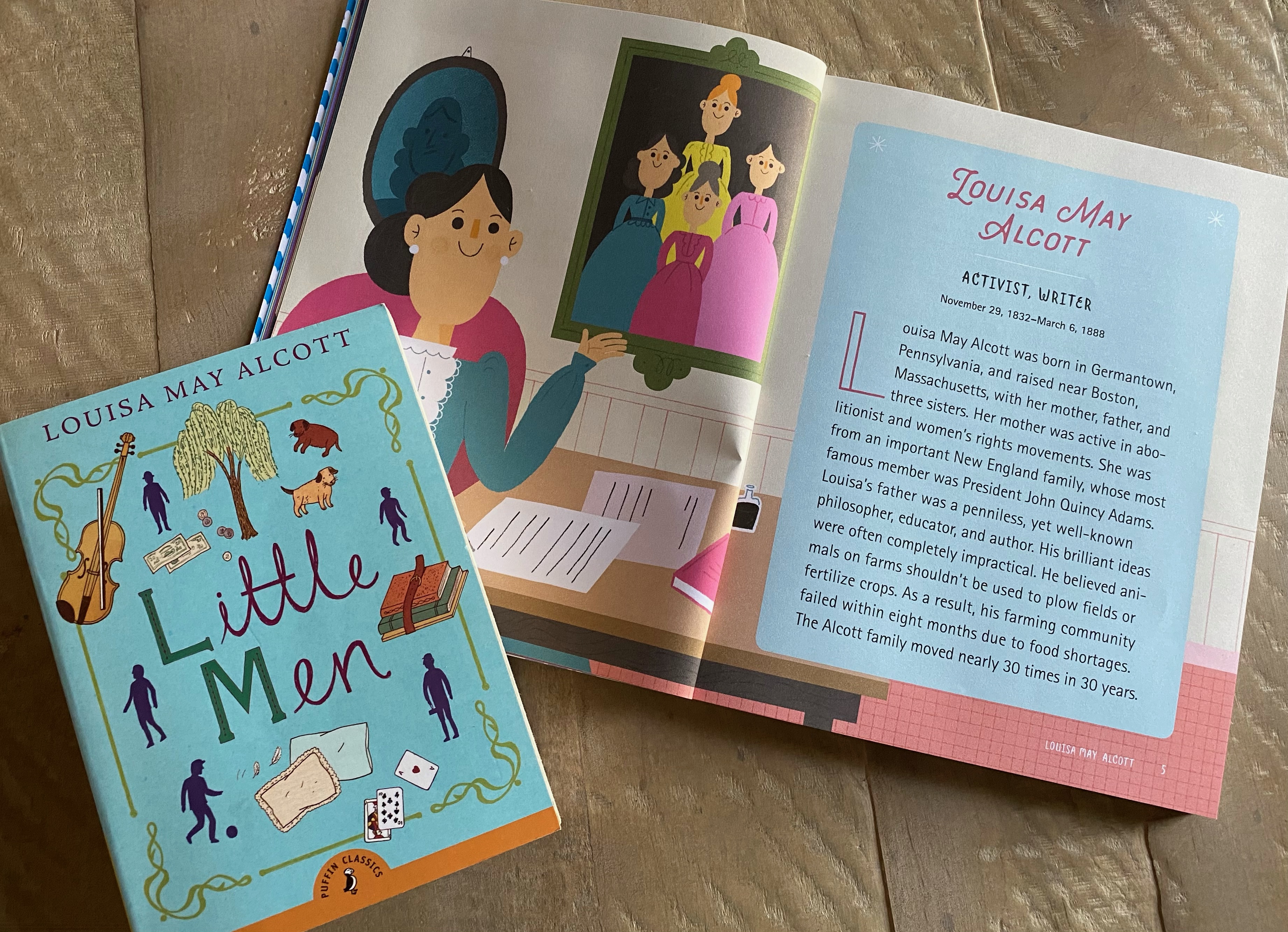
“Little Men”, by Louisa May Alcott – I have read “Little Women” several times and I was eager to share my first reading of “Little Men” with my son.  1)  Jeepers, this is relentlessly moral story.  2) This is a difficult read what with the vernacular of the 1870’s and the loads of characters, some with multiple nicknames. I read aloud one paragraph and then take the same amount of time to untangle what I’ve just read for my son.  Sigh.  We have augmented “Little Men” by reading a short bio of Louisa May Alcott from “American Trailblazers” by Lisa Trusiani.

Time for a change in tone!  Story Problem – Farmer Brown Runs for Town Mayor!  –  Yes, Farmer Brown is running for town mayor and his chances for winning look good!  His campaign manager has all sorts of campaign ideas to get Farmer Brown’s name before the public:

  • 50 big yard signs spread around town, with the slogan, “Farmer Brown can make our town grow!” ($4 for each sign and $25 each for Farmer Brown’s two nephews to place the signs)
  • 1000 campaign buttons (“Farmer Brown can make our town grow!”) for $250
  • A running ad (boldly proclaiming that “Farmer Brown can make our town grow!”) in the local newspaper for $75
  • A banner spanning the width of Main Street boldly proclaiming, “Farmer Brown can make our town grow!” for $75
  • 1,000 grocery sacks at Farmer Brown’s road-side stand with “Farmer Brown can make our town grow!” imprinted for $150

Farmer Brown has budgeted $750 for campaign PR.  Can he afford all the ideas ?  (answer at bottom of post)

Classical Music for Octopuses – we were still thinking about the brief lives of the octopuses.  If the current crop of octopuses is going to enjoy classical music, the pieces had better be short.  May we suggest – 

  • Violin virtuoso Fritz Kreisler’s “Schön Rosmarin” (Beautiful Rosmarin), composed in 1905.  Just under two minutes. We listened for iconic Kreisler embellishments while easily envisioning an octopus swaying with the tides –
  • “Solfeggietto”, by CPE Bach, composed in 1766. One minute sixteen seconds. This fast, frantic piece is certainly the “go to” background music for an octopus needing to escape predators –
  • “The Aquarium” from Carnival of the Animals (1886), by Camille Saint-Saëns.  Two minutes, four seconds. Reflective, yearning, chilling, mysterious; it seems as if the octopus was the muse for this piece –

Welcome to the best part of my day!
– Jane BH
(story problem answer:  NO!)

American Collage

Our focus, these past few weeks, has been directed toward several aspects of the American experience –

Part of the American Collage “The Smithsonian’s History of America in 101 Objects”, by Richard Kurin.  (We began by learning a bit about the Smithsonian Institution’s 19 museums and 9 research centers sites – mostly located in Washington DC).  So far, our favorite objects in the book’s collection:   

Columbus piombo    washington uniform

  • The well known portrait of Christopher Columbus that may not be a representation of the man at all – it was painted in 1519, more than 10 years after his death 
  • George Washington’s ultra elegant uniform (designed by George Washington!) 
  • The Bible that Thomas Jefferson edited for himself (leaving out parts he did not believe in)(discussion provoking)

It is going to take us months to work through this book.  We’re glad.

Part of the American Collage – “The Amish of Lancaster County” by Donald B. Kraybill.  Easy to read, up to date (published in 2019), with lovely, plentiful photographs.  Emphasized:  COMMUNITY and the hard working, self-sufficiency, graceful, modest, and religion-centered values of the Amish.  Of great fascination to us was the Amish education system:

amish school

  • all grades are taught in a one-room school 
  • science is not taught in school (we discussed)
  • there is no school after age 14 (we discussed)
  • teachers are not certified, college educated, or even high school graduates (we discussed)

Part of the American Collage – “The Blue Angels”, by Keillor and Wheeler.  Descriptive writing and heart-stopping photographs showcase the precision daredevil abilities of the Navy pilots demonstration team, thrilling everyone since 1946.  Most exciting chapter:  THE MANEUVERS! “The Delta Breakout”! “Loop Breaks”! “Six Plane Cross”!  “The Fleur-de-Lis”!  I asked my son if he would like to fly in a Blue Angel formation and the answer was a YES.  Count me out.  Also, you can count out any Amish community members from soaring with the  Blue Angels as they are (1) forbidden from joining the military and (2) forbidden from riding in airplanes of any sort.  CHANGE OF TOPIC: the first female Blue Angel joined the team in 2014 (we discussed).

Part of the American Collage – “The Incredible Band of John Philip Sousa”, by Paul Edmund Bierley.  We have never come across a book with its subject so thoroughly documented.  This book catalogs every tour, concert, concert program, musical instrument, and musician of the Sousa Band’s 40 year run.  Take aways, so far –

  • In 1889, Sousa sold the publishing rights to “The Washington Post March” for –  OH DEAR IT HURTS TO EVEN TYPE THIS – $35  
  • Sousa composed over 130 marches.  Most famous: “The Stars and Stripes Forever”, composed in 1896 and declared “Official National March of the USA” by an act of the US Congress in 1987
  • Between 1892 through 1931, the band presented just under 16,000 concerts, zigzagging all over the world.  SIXTEEN THOUSAND.
  • Sousa’s Band was a concert band, marching only eight times during the course of 40 years

Part of the American Collage – “Appleseed, The Life and Legacy of John Chapman”, by Joshua Blair.  We’ve learned:

  • Johnny Appleseed (John Chapman) was a real person (1774 – 1845), not a made up legend (although he did travel barefoot, wearing the darnedest clothes, just like the legends proclaim)
  • how he procured the apple seeds (from cider factories!)
  • how and where he set up apple nurseries and the importance of these nurseries
  • of his ability to trusted by westward moving pioneer settlers as well as native Americans
  • how he utterly embodied the spirit of the Swedenborgian religion; the apple tree planting being his ministry
  • in case you are still reading – I painted the “Johnny Appleseed Song” on our kitchen wall (pictured above) in 2003 to celebrate my father’s 82nd birthday because he loved this sung as grace before dinner

apple pie

“As American as Apple Pie” story problem – Of course, Le Fictitious Local Diner sponsors an apple pie baking contest each July 4th.  Last year 40 people entered the contest and there was a three-way tie for best pie:

  • Dr. Susan’s “Doctored-up Super Cinnamon Apple Pie”
  • Tennis Pro Tom’s “What’s Not To Love-Love Apple Lemon Tart”
  • Miss Maddy’s “I-Want-More Burnt Sugar Apple Extravaganza Pie”  

1)  If each pie used an average of 6 apples, how many apples were used to make up all the pies entered into the contest?

2)  If each pie maker practiced on 3 pies before baking their entry pie, how many apples were used to make up all pies (practice and entry pies)?

3)  If the pie bakers bought their apples from Farmer Brown’s fruit stand, did the stand sell more or less than 1,000 apples for the event? 

4)  If the three winning pies were placed on the diner menu for the month of July, and 10 of each were served over the course of the month, how many apples were used to make the menu pies?   (answers at bottom of post)

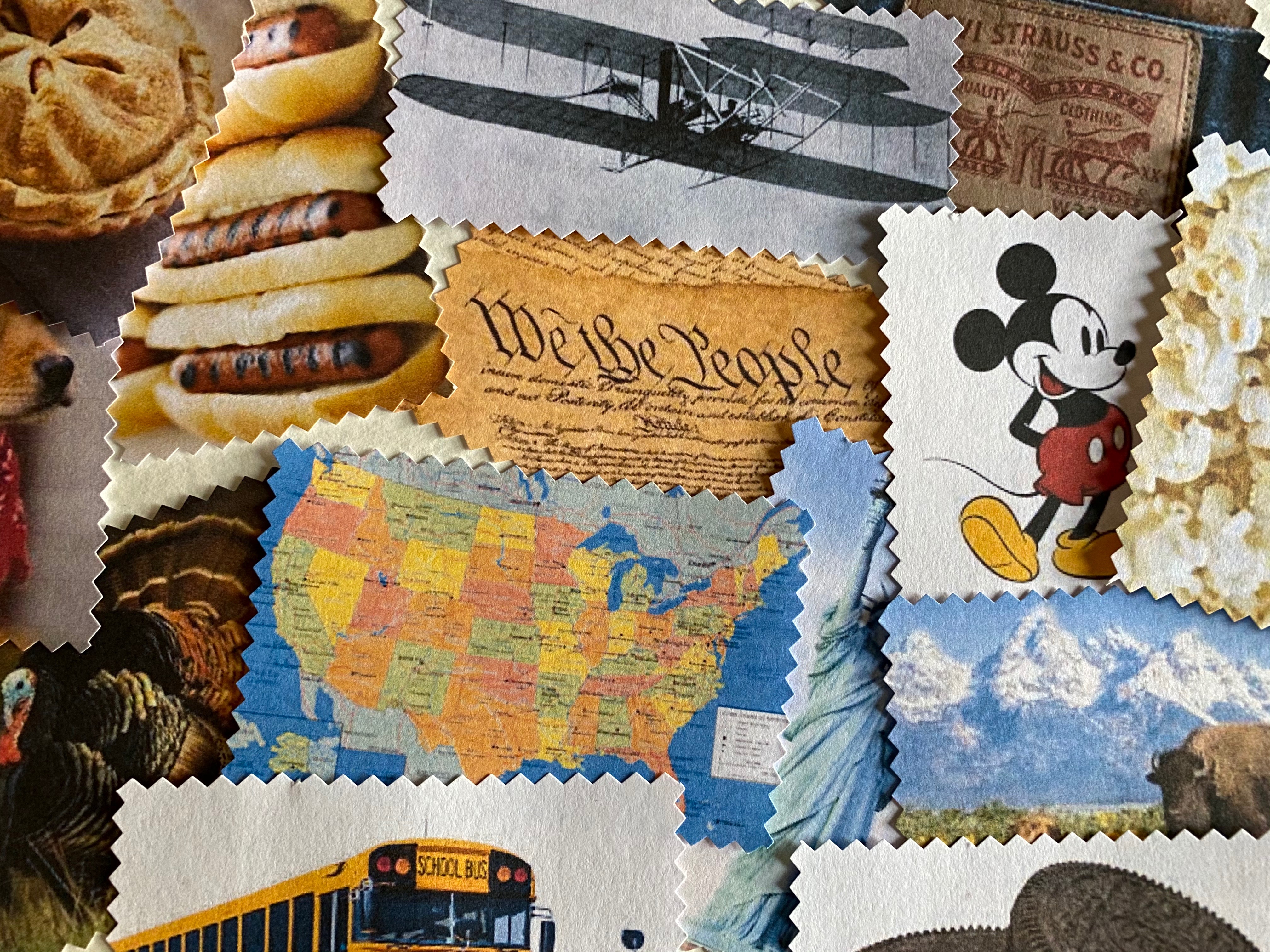
Look what we made:  our American experience collage (my son’s first collage)

Part of the American Collage – Classical Music:

Amy Beach’s “Fireflies” from “Four Sketches, opus 15”, 1892.  (Amy Beach is noted as being the first female American composer.)  “Fireflies” may just be our favorite summertime classical music selection.  We have probably listened to it 100 times, each time reminding us of firefly magic during sultry summer nights when we lived in Georgia.  The piece sparkles –

Florence Price’s “Silk Hat and Walking Cane” from her “Dances in the Canebrakes”, 1953.   (Florence Price is noted as being the first female African-American composer.)  This delightful short piece provided an opportunity to chat with my son about this well-structured composition’s thematic set-up:  We listened for themes  A – B – A (developed) – C – and finally back to A –  

Charles Ives’ “Country Band March”, composed in 1903.  This is a true musical collage in which Ives has jaggedly juxtaposed fragments from more than 12 recognizable American marches and folk melodies.  When we listen to this, my son and I pretend we are making our way through a crowded carnival midway with American music blaring at us from all sides – 

Welcome to the best part of my day!
– Jane BH
(story problem answers:  1)  240 apples,  2)  960 apples,  3)  less, 4) 180 apples)

From the Wanderlust Files

Wanderlust – 
“You don’t even know where I’m going.”
“I don’t care. I’d like to go anywhere.” 
― John Steinbeck, “Travels with Charley:  In Search of America”

Wanderlust –
“All that is gold does not glitter,
Not all those who wander are lost.” 
― J.R.R. Tolkien, “The Fellowship of the Ring”

Wanderlust – 
“The gene itself, which is identified as DRD4-7R, has been dubbed the “wanderlust gene,” because of its correlation with increased levels of curiosity and restlessness.”
― Dan Scotti, March 2015 edition of Elite Daily

and more Wanderlust – The Lewis and Clark Expedition – My son and I agree that there had to be a heaping helping of DRD4-7R present among the army volunteers assembled for President Thomas Jefferson’s “Corps of Discovery Expedition” (otherwise known as the “Lewis and Clark Expedition”).  We are reading Roland Smith’s “The Captain’s Dog”.  Each chapter begins with an entry from Captain Meriwether Lewis’s journal and the remainder of the chapter is told from the perspective of Lewis’s dog, Seaman.  We happily open this book up every night and use the included map to follow the arduous journey through the Louisiana Purchase territory and Oregon Country.  New vocab/concepts:  court marshal  –  desertion  –  forts  –  fur trappers  –  grizzly bears  –  keelboats  –  parley  –  pirogue  –  portage  –  privates  –  river currents

wanderlust books

and more Wanderlust – All things Hobo – Hello relentless traveler:  lots of DRD4-7R going on here.  My son and I have learned that a hobo is a continually traveling worker, and the traveling is done by means of a “free” ride on a train.  We are halfway into Barbara Hacha’s comprehensive resource, “Mulligan Stew”.  Just ask us about hobo signs, symbols, carved nickels, bindles, and the dangers of riding the rails.  We’ve read through “Tourist Union 63”, an (excellent) ethical code of behavior chartered by 63 hobos in 1889.  We’ve read about the National Hobo Convention, held annually in Britt, Iowa since 1900.  We’ve read about hobo funerals (sidebar: there is actually a marked gravesite in the hobo section of the Britt cemetery to honor “The Unknown Hobo”).  

and other stuff:

reading

Stop the presses – a few weeks back, someone asked me a question that stopped me in my tracks: Could my son read?  Whoa.  I thought so, but how could I have overlooked that?  So I have added something into our STORIES AND STUDIES routine:  a VERY SHORT story with a few follow up questions.  I remain silent, but I do help my son run his index finger under each line of text.  Then he answers the questions.  Is he reading?  YES!!!!! PHEW!!!!!  He has now read about:

  • Grandmother’s job at a potato chip factory
  • Aunt Susan’s blue ribbon for best pie in the state of California!
  • Peppy, Dog Obedience School Drop-out
  • The Shoes in the Ice Block Contest

carter jones book

Current fiction reading – Gary Schmidt’s “Pay attention Carter Jones”.  We pretty much always enjoy a Gary Schmidt book, but this one is a little daunting.  Premise is adorable – a family is bequeathed the services of a British butler.  But (here is the “but”):  the butler is intent upon teaching the family’s son the British game with the most bewildering set of rules and traditions:  CRICKET.  Every night when I pick up the book I think, oh my gosh, what did we learn last night and is my son picking up any of this?  Still, he is not pushing the book away, and if you look beyond the confusing cricket component, the dialog is fun reading.   

and who doesn’t love a Venn Diagram?  Sets, unions, intersections:  what’s not to like?  My son is FOCUSED! 

venn diagram

From our Venn Vault:
Set A – letters of first half of alphabet 
Set B – letters of last half of alphabet 
Intersection – letters that rhyme with “B”

Set A – people who like to wear red clothes
Set B – people who are jolly 
Intersection  Santa Claus

Set A – odd numbers 1-20
Set B – even numbers 1-20 
Intersection  numbers that can be divided by 3


marshmallow roast

A Farmer Brown story problem – Farmer Brown and his farm hands have invited just about everyone they know to a Labor Day campfire!  Farmer Brown has purchased loads of s’more fixings:  marshmallows, chocolate bars, and graham crackers, and the hands have prepared roasting skewers for the marshmallows. The ranch has 4 campfire pits, and each can accommodate 8 marshmallow roasters at a time.  It takes 5 minutes of careful tending to warm a marshmallow to a perfect golden brown.  If 60 friends show up to the s’more fest, how long will it take for everyone to roast a marshmallow for their first s’more of the evening? (answer at bottom of post)

Memorial Service Music to honor The Unknown Hobo – 

The Big Rock Candy Mountain – this song about a mythical hobo heaven (complete with “cigarette trees”, oh dear), was first recorded by Harry McClintock in 1928, and has been sung at hobo funerals.   My son and I listened to the original McClintock recording:

Ashokan Farewell – composed in 1982 by American folk musician, Jay Ungar.  From the very first bar, the piece captures the sense of loss, and yet, as each additional instrument joins in, we also feel surrounded by the warmth and camaraderie of more and more friends –

Song of the Riverman, from “The American Scene” – even though this is the song of the riverman, my son and I clearly hear the smooth rhythm of the rails.  Composed by William Grant Still in 1957, the melody conveys strength, wistfulness, loneliness and a bit of danger.  The somberness is so right for this memorial service –

Welcome to the best part of my day!
– Jane BH
(story problem answer:  10 minutes)

1809: What Went So Right

1809:  Brilliant Work, Moms! 

lincoln    darwin    mendelssohn    poe

Abraham Lincoln, born February 12, 1809
Charles Darwin, born February 12, 1809
Felix Mendelssohn, born February 3, 1809
Edgar Allan Poe, born January 19, 1809

We are currently studying:
Louis Braille, born January 4, 1809

braille bio

My son and I decided to learn about Louis Braille (1809 – 1852) and we struck gold with the extraordinarily well researched book, “Louis Braille – A Touch of Genius”, by C. Michael Mellor.  Almost scrapbook in style and continually captivating: 

  • photographs, vintage illustrations, postage stamps, transcribed letters, sidebars of historical significance, examples of reading systems for the visually impaired
  • Louis Braille’s family and the tragic mishap that left him blind at age 3
  • comprehensive information about the Institute for the Blind in Paris, France – the only school for the blind in all of Europe at the time – where Louis was enrolled at age 10  
    • innovations/controversies of each headmaster 
    • school curriculum – education, job training, and music.  We learned that in addition to being an outstanding student, Louis was a prize winning cello player and also earned a side income by playing the organ   
  • Louis Braille’s contributions:
    • the raised 6-dot cell code (at age 15)(!!!) that is now, worldwide, called “braille”
    • a device that allowed for written communication between the visually impaired and the sighted (the first dot-matrix printer) 
    • a raised dot system for reading music 

Louis Braille passed away at age 43 of tuberculosis.  We finished the book heartened and heartbroken.

More talk about Louis Braille – When I texted superb educator, Jill R.A., that my son and I were in the midst of a study unit on Louis Braille, she texted back:

Oh! I love that! Louis Braille is a hero of mine so I tell everybody about him!  My title is Teacher of the Visually Impaired (TVI).  I am an itinerant (good vocab word) teacher which means I travel to wherever blind and visually impaired students are, which may be at home, day care, or schools.  Some TVI’s teach in a classroom at a blind school,  but I see students that attend public schools and are attending general ed classes.  I also work with students from birth up to age 21. I generally consult with teachers and help them understand how to best teach the student who is visually Impaired.  However,  I have braille students who I meet with at least 3 times a week for braille lessons. I even have a few babies who will be braille readers and I meet with them and their parents for pre-braille activities to get their little fingers ready and sensitive to feel the dots.  We will play in rice and beans and pick out different things.   We also start “looking” at books really early so that they know to feel for the dots. It’s a fantastic job!”

Look at the variety of braille learning tools that  Jill R.A. sent to augment our unit (I told you she was superb):

braille tools

Poe Poems – my son and I explored two lengthy poems by 1809 birthday boy, Edgar Allan Poe:  his  happiness-to-misery blueprint in “The Bells” (1849) and the tortured loneliness pervasive in “The Raven” (1845).  So gorgeously composed, each word so fastidiously selected, but YIKES.

beatnik style

Poetry Night at Le Fictitious Local Diner – The diner recently hosted a 1950’s “Beatnik” style poetry reading night.  Patrons were encouraged to  dress beatnik style (cool, man, cool) and arrive ready to recite a poem.  There were prizes for the best and worst outfits, best and worst poems, and best and worst poem delivery.  Well!  The diner was overwhelmed by the turn out!  150 people showed up and 80% were in costume, and 20% were brave enough to recite a poem.

1- How many patrons arrived in costume?
a).  16     b).  80     c).  100     d).  120

2- How many patrons recited a poem?
a).  20     b).  30     c).  50     d).  75

3- What percentage of the entire attending crowd received a prize?
a).  4%     b).  6%     c).  20%     d).  50%

4- Should poetry night be an annual event at the diner? (answers at bottom of post)

Mendelssohn Music – we celebrated another 1809 birthday boy (this one with a brighter point of view than Poe) by listening to three of our favorite pieces by Felix Mendelssohn – 

  • Overture to Midsummer Night’s Dream, composed 1826.  So very clever.  An excellent performance by the Leipzig Gewandhaus Orchestra (where Mendelssohn served as a very beloved Music Director from 1835 – 1847):

  • Symphony No. 4 (“The Italian”), movement 1, composed in 1833.  Happy, breezy.  A glossy smooth performance under the baton of Metropolitan Orchestra (Sydney, Australia) conductor, Sarah-Grace Williams:

  • Violin Concerto in E minor, finale, composed 1844.  This is the movement that my son and I call “the cat and mouse movement”….lots of brisk “advance/retreat”.  This is an old recording, but we are mesmerized by the precision that Itzhak Perlman brings to this performance:

Welcome to the best part of my day!
– Jane BH
(story problem answers:  1) d.  120,  2) b. 30,  3)  a. 4%,  4)  Yes, of course!)

Looking North

Our Canadian Unit: the 49th parallel propels us into action – While reading about Canadian provinces, and we came across this:  British Colombia, Alberta, Saskatchewan, and Manitoba border the United States along the 49th parallel north. WHAT???????? It was like our alarm clock clanged!  It was obviously time to learn about parallels, longitude, latitude and the like.  So, two books to the rescue:  we’re reading through the scholarly and quite fascinating “Longitude” by Dava Sobel, and “Maphead” by Ken Jennings is on deck.  BTW, “Wow Canada!” by Vivien Bowers is proving to be an excellent resource.

olivia 3

Fiction Fun – We were sorry to finish two entertaining books this past week: our 10th Tom Gates book, “Top of the Class (nearly)” by the utterly imaginative Liz Pichon (gosh we love those Tom Gates books) and a revisit read of Gordon Korman’s insightful “Schooled” (important read).  We’ve just begun “Olivia Bean Trivia Queen”, written by Donna Gephart, a new author for us. So far: YAY!

Reporting in on our Buffalo Bill unit:
– We have just finished “Presenting Buffalo Bill” –  We’ve impressed ourselves by absorbing the material of Candace Fleming’s long, brilliantly researched book.  We probably learned EVERYTHING about this over-the-top man,  a LOT about the myth of the “wild west”, and a BIT about some unsettling American government policies of the late 18th century.
– A side note:  Buffalo Bill fits the profile –  My son and I have studied many “larger than life” individuals whose impact has been significant.  To a person, the greater the achievement, the more glaring the personal deficit(s) (vocab).  William Cody fits the profile.  Poor Bill – literally POOR BILL – had no concept of money management.  Although this is a comparatively benign (vocab) deficit, how could his friends and family not shudder in horror as he plunged unthinkable quantities of money into one ill-advised investment after another.  Oh Bill!

canadian geese

Farmer Brown and the Canadian Geese story problem – Farmer Brown loves the honking sound of Canadian Geese as they fly over his ranch, migrating south for the winter or back north for the summer.  He was interested to read that a town in Kansas counted 1,800 geese as year-round residents, their number increasing to 18,000 every winter.  A percentage increase of what?  A. 10%      B. 100%      C. 1,000%  (answer at bottom of post)

Back to our Canada studies:  WE DID NOT SEE THIS COMING – Here we are knee deep into our unit on the Canadian provinces, learning about the Royal Canadian Mounted Police, the Calgary Stampede, the Canadian Shield, poutine, puffins, prairie dogs – lovely, lovely, lovely and then, WHOA: smack in the middle of Canada, in the province of Manitoba: THE NARCISSE SNAKE DENS.  SNAKE DENS!!!!  We had to drop everything, find out more and look at GROSS WRIGGLING PHOTOS.  OK, here is the deal: every spring and fall, thousands and thousands of red-sided garter snakes congregate for a three week mating frenzy.

narcisse snake dens

Last night’s music:  A HISSY FIT – we pretended that the director of the Narcisse Snake Dens phoned and pleaded with us to plan a program of background music for the slithering sweethearts:

snakes

  • “Dance of the Seven Veils” from Richard Strauss’ one act opera, “Salome”, which premiered in 1905 (but was banned in London until 1907 for being WAY too steamy) (my son doesn’t need to know this).  This piece masterfully scores the out of control fever of the snake pits (thank you timpani) with the sinuous gliding of the snakes over and under each other (thank you snake charmy oboes).  This performance by the Philharmonic Orchestra of Santiago, conducted by Paolo Bortolameolli is SUPERB. TONS of energy:

  • “Blue Tango” by Leroy Anderson, composed in 1951.  We just laugh and laugh through this whole piece.  This is the go-to sassy music for a garter snake meet and greet:

  • We anthropomorphized (vocab) the snakes and imagined two snakes eyeing each other from opposite sides of the crowded and heaving den – and their hearts connect (we are laughing so hard) to “Some Enchanted Evening” from Rogers and Hammerstein’s 1949 “South Pacific” production:

Welcome to the best part of my day!
– Jane BH
(story problem answer: C. 1,000% increase)

Rootin’ Tootin’


Required Reading – We are nearly through “Presenting Buffalo Bill – The Man Who Invented the Wild West” (Candace Fleming).  Wow.  This should be adjunct reading for any history course that covers the late 19th century.

Quirky take-aways from this outstandingly researched book:

– William Cody did not like Lieutenant Colonel George A. Custer…and after “Custer’s Last Stand” at Little Big Horn, Cody hired Sitting Bull (inspirational leader of the victorious Lakota, Northern Cheyenne and Arapaho) to be part of his Wild West show.
– While the US Government sought to “Americanize” American Indians (passing laws forbidding traditional clothes, housing, religious practices, etc.), the Wild West show was partially responsible for keeping these customs alive – Buffalo Bill’s insistence upon authenticity meant his Pawnee, Cheyenne, and Lakota performers could wear their traditional clothing, speak their language, live in traditional dwellings, etc.
– When the Wild West performed in London, Queen Victoria broke a 26 year seclusion (lamenting the death of her husband, Prince Albert) to attend the show (and LOVED it).
– We are still marveling at William Cody’s energy and leadership skills:  managing 200+ performers (among which he was the central star OF COURSE), scores of horses, buffalo, elk, Texas steers, donkeys, deer, bears, full size wagons, a log cabin, a stagecoach, gigantic sets (vocab) and a brass band…not to mention food, accommodations, and travel arrangements.  We’re exhausted.
– William Cody was not a perfect person; he certainly had a handful of glaring deficits. But DARN IT, my son and I are fans!

canada

Map Happy – Our “find each USA state and color it in” map is complete.  My son looked forward to this activity every night; we would find the state in question, talk about its shape (Louisiana looks like a capital “L”, the Michigan “mitten”, etc.), and then ink in the state together.  We’ve now started on the Canadian map. Vivien Bowers’ most enjoyable book, “Wow Canada!” is providing background info as we color in each province and territory.

Funny, thought provoking, excellent read for us – we are in the midst of a fifth reading of our favorite Gordon Korman book, “Schooled”.  Such an original theme – a very centered, capable kid who has been raised in a defunct hippie commune is forced to matriculate into a public school.  A+.

doily

Fancy, Fancy, Fancy! Story Problem from Le Fictitious Local Diner – diner management has decided that a paper doily (vocab) under the condiments (vocab) on each table is a must.  There are 10 tables and 5 booths at the diner. Each table will get a fresh doily before both lunch and dinner services.  Will a case of 1,000 doilies be enough for one month?  If each case costs $7.00, how much should the diner budget for doilies for a year? (answers at bottom of post)

Rootin’ Tootin’ Music – we found rambunctious, fast paced, toe tappin’, hootin’ and hollerin’ music to help us imagine Buffalo Bill’s mightily successful Wild West extravaganza:

“Hoedown” from Aaron Copland’s “Rodeo” ballet, which premiered in 1942.  I think we feel intellectually elevated every time we listen to anything by Aaron Copland:

– The theme from the long-running TV show (1959-1973) “Bonanza”, orchestrated and arranged by David Rose and Billy May.  Voted by the Western Writers of America as one of the Top 100 Western Songs of All Time.  Is it THAT difficult to be in the top 100???  Why not TOP 10?  No matter – we love it:

– The theme from the 1960 American Western movie, “The Magnificent Seven”, composed by Elmer Bernstein.  We learned that Elmer Bernstein was NOT related to Leonard Bernstein (but they were friends), that he composed for loads and loads of movies, his scores were nominated for 14 Oscars (winning in 1967 for “Thoroughly Modern Millie”)…Back to “The Magnificent Seven” –  this classic was nominated for an academy award in 1961, but lost to “Exodus” (score composed by Ernest Gold).  Tough break.  BTW, this is a simply outstanding recording of the theme (but why the pineapple photo at the very beginning?):

Welcome to the best part of my day!
– Jane BH
(story problem answers: yes, and $84)

2016 – Gone, but not forgotten

2016-quiz

2016:  the year we learned more about –  the California Gold Rush, the insanely brilliant architecture of Gaudi, the work of bees, Eugene Bullard, homonyms, Hannibal, dwarf planets, George Washington Carver, patents, rodents, Rube Goldberg, computation involving triangles, etc, etc, etc.  Last night, my son took matching quiz that reviewed our academic studies from the past year, and earned an A+.  Good year.

macaulay-book

New book!  For Christmas, a special aunt and uncle sent my son David Macaulay’s classic, “The Way Things Work”.  This is obviously a mechanical engineering book lurking behind precise illustrations and hilarious examples.  This past week, we became experts on “the inclined plane” and “the lever”.  (In 2016, we learned a lot from Macauley’s books on “The Toilet” and “The Mill”, so we should emerge MENSA-worthy if we can absorb everything this comprehensive book offers.)

electricity

Story Problem from Le Fictitious Local Diner – The diner spent a lot of money on electricity in 2016; management is reviewing usage to see if they can cut back (perhaps a weekly “dining by candle-light” event might make a teeny dent in the diner’s electrical consumption).  To make decisions, management needs some facts:  if the diner was open 6 days a week, how many days in 2016 were they using electricity?  If the cooks were at the diner from 6 a.m. until 11 p.m., how many hours last year was the diner using electricity? (story problem answers at bottom of post)

2016

Music Listening in 2016 – My son and I welcomed an additional 85 classical (in the broadest sense) pieces into our iPod library this past year.  Last night, I presented a list of our fave 10 of these compositions and then my son picked his top three for listening.

10 pieces we first listened to in 2016 –

Ave Maria – Arcadelt
Banjoland Buffoonery – Kirkhope
Brandenberg Concerto No. 3 – Bach
Harp Concerto in A major – Dittersdorf
Organ Symphony, finale – Saint-Saens
Persian March – Strauss
Sailing By – Binge
String Quartet No. 2, scherzo – Borodin
The Anvil Chorus (Il Trovatore) – Verdi
Toccata in A major – Paradisi

music-faves-2016

My son’s selections for last night’s listening –

“Banjoland Buffoonery”, composed in 1998 by Grant Kirkhope for the Nintendo 64 video game, “Banjo-Kazooie”.  A short piece, packed with rollicking fun, AND an excellent (and accessible for the likes of my son and myself) example of theme and variation:

“Persian March”, composed by Johann Strauss II, in 1864.   My son cannot stop his toes from tapping to this marvelously exotic march (expertly played by a Polish youth orchestra) (SO heartening to witness excellence in youth):

“Sailing By”, written by Ronald Binge in 1963 and used by BBC Radio to introduce the late shipping forecast.  This sweet,  slumberous waltz gets our vote for most soothing lullaby.  When we just cannot deal with one more thing, THIS is our music:

Welcome to the best part of my day!
– Jane BH
(story problem answers: 1) 312 days 2) 5,304 hours)

Quandary

Here is the quandary (vocab):  I do not like reading to my son about man’s inhumanity to man; he has enough to deal with without trying to grasp the perplexing notion of cruelty.  HOWEVER, the “Wicked History” series books are so well written, organized, researched, and crazy fascinating – we can’t stay away.

leopold-book-cover

We just finished the book on BAD BAD King Leopold II of Belgium (1835-1909); and he was indefensibly bad – Hitler and Stalin BAD.  There were passages in the book describing atrocities under his leadership of the “Congo Free State” (his PERSONAL colony) so barbaric, that while reading aloud to my son, I had to skip over paragraph after paragraph.
On the plus side:
– we learned a LOT about what is now the Democratic Republic of the Congo and came away fascinated
– we added to our hero list:  George Washington Williams (a journalist), Edmund Morel (a most alert shipping clerk) and Roger Casement (a British consul). These men brought the brutal policies of Congo Free State administrators to world wide attention and censure (vocab)
– AND Leopold II died with just about everyone (well, maybe everyone) despising him. (ridiculously small consolation)

amazon-pic himalayan-pic

from “The Wonder Garden” book by Williams and Broom – stunning

The subject matter gets a LOT happier, but DRAT:  we just hate it when a good book ends. We loved EVERY page of “The Wonder Garden” by Kristjana S. Williams and Jenny Broom; luscious illustrations accompanied by solidly interesting facts.  This startlingly beautiful book showcases animals of five distinct habitats around the world. We were familiar with the Amazon Rainforest and the Great Barrier Reef, but we really hadn’t read anything about the Black Forest, the Chihuahuan Dessert or the Himalayan Mountains.  This delicious book is SO on our “read-it-again list”.

Last night my son took a simple matching location-to-fact quiz and then we paired up one piece of music with each habitat.

habitat-quiz

Music to remind us of five living wonders of our world:
– The Amazon Rain Forest – hosting around 1,500 species of birds, Camille Saint-Saens’ “The Aviary” (from his “Carnival of the Animals”, 1886) was an obvious selection.  The music is prefaced by an Ogden Nash poem read by Roger Moore.  Elegant:

– The Great Barrier Reef – again, from Saint-Saens’ “Carnival of the Animals”:  “The Aquarium”. Gloriously haunting music provides a backdrop for the world’s largest living structure (however, as beautiful as this linked video is, “The Aquarium” takes up only the first 2.5 minutes; the carnival’s donkey and the cuckoo movements follow, for some unknown reason):

– The Black Forest – the habitat for not only the world’s largest owls, but also the setting for several fairy tales from the brothers Grimm.  My son and I listened to “Evening Prayer” from the opera “Hansel and Gretel”, composed by Englebert Humperdinck in 1893.  We twiddled our fingers during the three minute LONG introduction; however once we got to the meat of the composition we enjoyed possibly the most comforting lullaby ever:

SIDEBAR:  another Englebert Humperdinck??? we followed Humperdinck’s “Evening Prayer” with a short discussion of British pop star (of the ’60’s and ’70’s) Englebert Humperdinck (but really Arnold George Dorsey) (obviously NO relation to the composer of the late 1800’s).  My UCLA college room-mate, J’nette, warbled a mocking version of  Humperdinck’s giant hit “Release Me” throughout our undergrad years, so I made my unappreciative son endure a trip down memory lane:

– The Chihuahuan Desert – Well, first of all, we had no idea where the Chihuahuan Desert was (southern parts of Arizona, New Mexico, Texas and northern parts of Mexico) and we are practically living in it!  We felt the second movement (the “Largo” movement) of Dvorak’s “New World Symphony” evoked the loneliness, uncertainty, and the grandeur of this habitat:

– and finally, The Himalayan Mountains – we paired “the rooftop of the world” with  “Approaching the Summit” composed by genius genius genius John Williams for the 1997 movie “Seven Years in Tibet”.  We could hear how this music captures themes – majestic and mysterious – from both sides of the Himalayan Mountains (India and China):

Welcome to the best part of my day!
– Jane BH
(The story problems from this week seemed painfully frivolous after reading about the human suffering provoked by King Leopold II.  I just couldn’t post any of them.)