Le Fictitious Local Diner

Dauntless

Fearless.  Pushing aside barriers.  Moving forward.  We found “dauntless” all over the place –

The Tuskegee Airmen – An Illustrated History:  1939 – 1949, by Carver, Ennels, Haulman.  If we were handing out grades:  
– A+ to this carefully documented scrapbook. 
– A+ to all Tuskegee Airmen – well trained military aviators and support personnel who worked together achieving an excellent combat record during WWII.  
– A+ to Dr. Roscoe Brown, one of the original airmen, who proudly wrote of, “these brave, persistent souls who successfully challenged stereotypes and overcame obstacles”.
We loved finding out:
– First Lady Eleanor Roosevelt inspected the flight program in 1941, flew with the chief  instructor, and found funding (to the tune of $175,000) for the building of Moton Field.
– Tuskegee Airmen were invited to attend the 2009 inauguration of Barack Obama.  More than 180 airmen were able to attend.
We now have a Tuskegee Airmen poster up on the wall.  

The Greatest Coast Guard Rescue Stories Ever Told, edited by Tom McCarthy.  Thirteen  gripping accounts of terrible predicaments involving an angry sea, raging storms, hoisting baskets, rescue swimmers, hypothermia, and – thank heavens – the very best of ship and helicopter maneuvering skills.  
Here is what would have improved this book: 
– a glossary (there are so many acronyms used in the reports, we had to guess meanings  by context) 
– photos:  we would have poured over them if this book had any  
Hello everybody:  one of the rescue swimmers said that over the course of 11 years of service, earning several Coast Guard awards, he received not a single “thank you” note from any of the stranded people he rescued.  Did my son and I think this was OK?  NEVER.

Home of the Brave, by Katherine Applegate.  This is such an important work of fiction.  We just finished our 2nd read through and we will read it again.  Kek (the protagonist), a child refugee from Sudan – brand new to Minnesota – is such a pure soul.  This beautifully written, quiet book has just enough humor to keep us captivated and just enough heartbreak to make us sensitive to an impossible situation.  After finishing the story, we read the author’s note, the reader’s guide, historical context, and discussion topics.  This was a gentle way for my son to begin to understand the plight of a refugee.  

….and other stuff…

Memorizing Poems – Cool School Style:

(really, this is hardly a groundbreaking teaching method)
Our current poems:
“Stopping by Woods on a Snowy Evening” – Robert Frost
“The Swing” – Robert Louis Stevenson
“Keep A-Goin’” – Frank L. Stanton* 
1).  I read the poem aloud
2).  I give my son the poem sheet, only this sheet SOMEHOW, MYSTERIOUSLY, has a few words blanked out and he has to fill them in.  With the Frost poem, we started with just 4 words blanked out.  We have worked up to 22 blanked out words.  And in case you haven’t noticed, my son’s handwriting is a challenge to read.

On the lighter side – Toys!  Amazing Stories Behind Some Great Inventions,  by Don Wulffson.  So far we have read about the origins of the slinky, the seesaw (oh dear, what those ancient Romans did with the seesaw involving a lion and 2 particularly unlucky individuals dressed up as clowns.  FOR SHAME), tops, silly putty, Raggedy Ann, toy trains, play doh (we did not know that play doh was originally formulated as a wallpaper cleaner).  Truly, a joy with every reading.  Except for the tragic clown business.

Story problem:  The Local Diner hosts “Weird Food Night”!  The local diner is sponsoring a scholarship fundraiser for high school seniors!  Here is what will happen:  a buffet of 20 weird (in the minds of high schoolers) foods will be set out for the students to identify (by appearance or sampling).  The student who identifies the most foods will be awarded the scholarship.

The following weird foods will be on the table:  

artichokes   capers   cauliflower   cloves   cornichons   cranberries   gooseberries   hominy   kiwi fruit   papaya   parsnips   persimmons   pickled beets   plantains   pomegranates   shallots   turnips   white asparagus   whole grain mustard   yams

150 high school seniors have signed up for the contest.  If each participant pays $10 to be in the contest, and the diner donates 80% of the fee to the scholarship prize, how much will the prize be worth for each winner if 2 of the participants can name all 20 foods? (answer at bottom of post)
a)  $150     b)  $600     c)  $750     d)  $1,500

Orchestral music for those who dare to be dauntless –

Mozart Symphony No. 40 in G minor, composed in 1788.  The adrenalin pumping pace in Movement I makes it choice background music for Coast Guard rescue missions and fighter pilot commissions.  This music is all about relentless focus.

(now for some fun)
Sister Suffragette, music and lyrics by Richard and Robert Sherman for the 1964 Mary Poppins movie.  In this song, Winifred Banks sings of being a “dauntless crusader for women’s votes”.  YOU GO GIRL.

Superman Theme, composed by John Williams for the 1978 “Superman” film.  This is music for the dauntless.  

Welcome to the best part of my day!
– Jane BH
(story problem answer:  b:  $600 each)
*  You are probably familiar with the Frost and Stevenson poems, but “Keep A-Goin’”?  Here’s  the story:  when my younger sister was in the 5th grade and had to memorize a poem to recite in class she picked Stanton’s poem and practiced it out loud so many times that everyone within earshot ended up memorizing the poem…and lo, decades later I can still recite the poem and pass a family tradition to my son.  We think “Keep A-Goin’” is the countrified way of saying “be dauntless”.

Chillin’ with the Ladies*

 My son and I have been spending time with the two most recognizable women in the world.

– Mother Teresa, by Navin Chawla  
This was a lengthy book (274 pages) for us, but every single page increased our awareness of Mother Teresa’s brilliant original thinking, her commitment to her calling, her powerful leadership skills.

We read in depth about the three endeavors of her Missionaries of Charity:
– a home for unwanted or orphaned children
– a home and medical facility for those with leprosy
– a home for the destitute and dying 

We have added a heart swelling quote from the book to our Sunday night spiritual moment:  while sitting with a dying patient, Mother Teresa was overheard to whisper, “You say a prayer in your religion, and I will say a prayer as I know it.  Together we will say this prayer and it will be something beautiful for God.   There is now a poster of St. Teresa of Calcutta on my son’s wall.

– The Mona Lisa Vanishes, by Nicholas Day
There is nothing concerning the theft of the Mona Lisa (from the Louvre Museum in 1911) that is not examined in this book: 

– we learned about Lisa Gherardini, who posed for the portrait 
– we learned about Leonardo da Vinci (it was thought provoking to read that Leonardo was most likely ADHD)(this would explain a lot)
– we learned about French police/detective work in the early 1900’s (just the very beginning of fingerprinting)
– we learned about security at the Louvre Museum (super lax)(then, not now)  
– and finally, a dazzling conclusion to the book:  the thief of the Mona Lisa is revealed, lies surrounding the theft are exposed, and we learned that the painting was returned with great ceremony to the Louvre just prior to the breakout of WWI.

This book is perhaps the most organized and well researched book we have ever read.  It is written in small readable chunks – perfect for us.  Inspired by this book, we now have a poster of the Mona Lisa up on my son’s wall. 

Fiction Fun –

– While Mrs. Coverlet was Away, by Mary Nash –  This classic from 1958 has been on our August reading list for several years.  I just love it…I sort of hope my son loves it too, cuz this was at least our 8th time through.   It is funny, it is clever, it champions self reliance.

Story Problem:  The Local Diner gets Fancy

The local diner has decided to add a refined touch:  from now on, all  breakfast rolls and desserts will be served atop a doily.  If the diner calculates that they serve 50 breakfast rolls daily (7 days a week) and 150 desserts daily (7 days a week), how many doilies will they need each week?
a)  70     b)  350     c)  700     d)  1,400

If the diner can purchase 1,000 doilies for $15 from “Doilies R Us”, will $100 be enough money in the diner budget to purchase a month’s worth of the needed doilies?  (answers at bottom of post)

(I am not defending the use of doilies, I am only writing a story problem)

Classical Music:  finally chillin’ with the ladies, virtuoso style –

– Setting the stage –
1913 – first woman EVER to be hired by a professional orchestra (the Queen’s Hall Orchestra in London)
1918 – first woman invited to join an American orchestra (the Detroit Symphony Orchestra)
2003 – at the very back of the pack:  the Vienna Philharmonic, under pressure from the Austrian government, finally welcomes the first female musician into the orchestra

Any orchestra should be so lucky to be chillin’ with these virtuosos:

Cello Virtuoso, Jacqueline du Pré – (1945 – 1987)  Ask anyone (who knows anything about this) to list 5 cello virtuosos, and Jacqueline du Pré’s name will be on that list.  My son and I sat rapt listening to her play “The Swan” from Camille Saint-Saëns’ 14 movement suite, “Carnival of the Animals” (composed in 1886) –

Flute Virtuoso, Jeanne Baxtresser (1947 –    ), former principal flutist for the NY Philharmonic (for 15 years!).  It was fun to listen to her almost haunting adaptation of Saint-Saëns’ “Swan” and we loved the spirited pace

Trumpet Virtuoso, Alison Balsom (1978 –    ).  Alas, we knew we weren’t going to find anyone on trumpet playing “The Swan”, but we were happy to find a recording of Handel’s  “Arrival of the Queen of Sheba” (from his 1748 oratorio, “Solomon”), showcasing Alison Balsom, whose performance is perfection.  Even though this has been one of our favorite compositions for years, we still can’t help but smirk thinking about Handel’s fussy piece portraying life in Jerusalem about 1,000 BC  –

Welcome to the best part of my day,
– Jane BH
(story problem answers:  d)  1,400 doilies a week, and “yes”, $100 is enough to pay for a month’s worth of doilies)
*The title of this page came from a “Get Fuzzy” (Darby Conley) cartoon from years and years ago.  The phrase is still making me and one of my other kids laugh every time we think about it.

Side Dishes

Regarding our Stories & Studies program  If books are the “main course”, we need side dishes to complete the nightly academic banquet.  This is the fun part for me – making up the story problems, word scrambles, iPad keyboard practice words, and most fun of all, creating the reading comprehension sheets.

Reading Comprehension –
Our reading comprehension efforts amount to this:  in complete silence, my son reads a few paragraphs dealing with the antics of two best friends, Clem and Clyde, and answers questions so I can assess if he understood what he read.  So far, it is a big smiles occasion when I present a new “Clem and Clyde”  and my son has worked through 25 reading comp sheets.  Did I hear someone inquire about the page titles?  OK:

Clem and Clyde get Jobs!
Clem and Clyde get New Shoes
Clem and Clyde and the Dandy Potato!*
Clem and Clyde Win an Award!
Clem and Clyde and the Pizza Poet
Clem and Clyde and the Purring Promenade
Clem and Clyde Learn to Juggle!
Clem and Clyde get New Backpacks
Clem and Clyde Paint their Bedrooms
Clem and Clyde Drive Tractors!*
Clem and Clyde and Honest Abe
Clem and Clyde and the Dream Destination
Clem and Clyde:  Trampoline Testers!
Clem and Clyde at Home on Candy Cane Lane
Clem and Clyde make New Years Resolutions
Clem and Clyde buy a Snowman
Clem and Clyde try Sugar Snap Peas
Clem and Clyde take Square Dancing Lessons!
Clem and Clyde get Haircuts
Clem and Clyde get Saturday Jobs
Clem and Clyde Paint Murals
Clem and Clyde and the Band-Aid Stand
Clem and Clyde Host a Spaghetti Dinner
Clem and Clyde Help Out at the Library
Clem and Clyde Make the Worst Lemonade

*samples:

iPad Keyboard Competence –
My son still needs to get comfortable with letter positions on a keyboard.   Repetition is obviously the key, but here is what would happen if I said “press the “a”, press the “a”, press the “a”, now press the “b”, press the “b”, press the “b””:  NOTHING.  So, I prepare groups of rhyming words (one group per night) (enough is enough) (this seems to be SLOWLY working:  without assistance, my son can now locate and press letters “A” through “I”).   Rhyming clusters like these:

wink – blink – sink – pink – rink – think (repeatedly pressing the “i-n-k” letters)
bark – park – hark – lark – shark – mark (repeatedly pressing the “a-r-k” letters)

Word Scrambles – 
My son LOVES (and is lightning fast at) unscrambling words.  If nothing else, this is good for  handwriting practice.  Not that anyone needs an example, but:

THARRSOCE (orchestra)
SLYMOPIC (Olympics)

Story Problems
I like story problems and I like writing them.  When I was a youngster, story problems were the only way that I could understand the point of math. Our story problems bring to life the Local Diner or Farmer Brown’s Ranch and Roadside Stand.

~The local diner has decided to bottle and sell their popular spicy buttermilk salad dressing.  Local high school art students are competing to design the bottle’s label.   The prize is three-pronged: 1) a case of 24 bottles of the spicy buttermilk salad dressing, 2) photo of winning designer in local newspaper, 3) the photo enlarged to poster size and displayed near the diner cash register (we are talking HOME TOWN FAME).  

– If each bottle will sell in the diner for $5.00, how much is the prize worth? 
a)  $24     b)  $120     c)  $500     d)  $524

– If the “sell by” date of each bottle is 6 months after bottling, and a family typically goes through 2 bottles of salad dressing a month, how many bottles from the case of 24 should the prize winner give away to neighbors?
a)  9     b)  12     c)  18     d)  20 (answers at bottom of post)

~Farmer Brown has recently purchased 5 new umbrellas for the outdoor picnic area adjacent to his roadside produce stand.  Good grief, each umbrella cost $500!  Farmer Brown is selling his popular “cinnamon stick apple pies” for $20 each to raise money to pay for the umbrellas.  If the profit from each pie sold is $15, will Farmer Brown have to sell more or less than 150 apple pies? (answer at bottom of post)

Parlez-vous de musique classique?  For the duration of the Paris Olympics, we have listened to the work of French composers (Saint-Saëns, Ravel, Faure, Satie, Offenbach, Delibes, Bizet, Debussy) every single night.   Getting us into the Parisian spirit – 

(BTW, this is how my son selects music every night)

Offenbach – The Can-Can from Jacque Offenbach’s comic opera of 1874, “Orpheus in the Underworld”.  This is the lively version my son and I have listened to many, many, many times –

Bizet – The Carillon (tower bells) from “L’Arlesienne, Suite No. 1”, composed in 1872.  Bizet composed 27 pieces  of incidental music for Alphonse Daudet’s drama (“L’Arlesienne”).  In this performance, we like how the conductor moves this piece right along.  The usual tempo is a bit slower.

Debussy – Clair de Lune, inspired by Paul Verlaine’s poem (1869),  Clair de Lune is the 3rd movement of Debussy’s “Suite Bergamasque” composition for piano of 1890.  This video footage complete with Lang Lang’s achingly slow, thought-filled performance, is filled with current scenes of Paris.  Perfect! 

Welcome to the best part of my day!
– Jane BH
(story problem answers:  b)  $120, b)  12 bottles to neighbors, and “more” (Farmer Brown needs to sell 167 apple pies)

Hot Summer, Cool School

Neither snow nor rain nor blistering Texas heat and screaming cicadas nor gloom of night nor Christmas nor somebody’s birthday prevents us Cool School scholars from stories and studies every single night.  This learning hour is so uplifting and when I sign off “Welcome to the best part of my day”, I mean it.  High points from the past few weeks – 

Reading Comprehension: Clem and Clyde style – Our current reading comprehension endeavor (a one page sheet, once a week) focuses upon two free-spirited lads, Clem and Clyde, who sneak aboard trains and crisscross the USA.  My son independently reads the few short paragraphs and answers follow-up questions about Clem and Clyde’s gripping escapades (involving the likes of a popcorn factory, a cement potato, clown shoes).  So far, A+:  this is the type of thing my son likes to read and this is the type of thing I like to write.

Keyboard Practicing –  Three times a week I give my son a list of 6 rhyming words (for the repetition of letters)(the list is different every session).  I support his wrist as he types out the words on the iPad.  Words like:  rain – main – drain – plain – train – brain

Then I release my son’s wrist and it is time for him to press alphabet letters without support.  This is so far out of his comfort zone, but he has nailed “a”, “b”,  and now, “c”.  This is huge progress!

Space Station Quiz – My son and I (BOTH) learned something crazy-interesting from every single page of the Smithsonian “Behind the Scenes at the Space Stations” book, published in 2022 (so quite up to date).  We concluded with a 10 question quiz for which my son scored 100% and my UCLA roomie (so ya know she’s smart) from way back, scored 20%.  Here are 5 of the questions: (answers at bottom of post)

1).  How many times does the International Space Station orbit Earth in a 24 hour period?

          a)  2 times     b)  5 times     c)  10 times     d)  16 times

2)  “Tiangong” (the Chinese Space Station) is translated:

          a)  celestial palace     b)  high in the sky     c)  beautiful view     d)  our future

3)  How much preparation goes into a space walk?

          a)  no preparation is needed     b)  24 hours     c)  4 days     d)  2 weeks

4)  How long does it take from lift-off for a rocket to reach space?

          a)   5 minutes     b)  9 minutes     c)  23 minutes     d)  2 hours

5)  Space agencies involved with the ISS are supporting the endeavor through:

          a)  2024     b)  2028     c)  2030     d)  2050

Kindness Lesson – My son just finished his 80th volunteer day at a local garden center and was gifted a sweet house plant, with all 9 employees signing the clay pot.  I am not sure this meant much to my son, but the gesture melted my heart.  This nursery is a haven of tolerance, accommodation, and kindness.

Recently completed books and topics – trees, Spain, countries that use the Euro as their currency (Spain being one), and “Prince Caspian” (a sequel to “The Lion, the Witch, and the Wardrobe”). 

Story Problem from the Local Diner – The local diner is celebrating the sweltering days of summer with a root beer float promotion.  For the month of August, the floats (showcasing the diner’s house-made vanilla ice cream) will sell for $2 each, instead of the regular price of $3 each. The cost of making a root beer float is $1.

If the diner sells 150 root beer floats in August and sold 90 floats in July, which month showed the larger profit?  Was this promotion a genius idea, from a financial point of view?  (answers at bottom of post)

Classical Music for Soothing Summer Sounds – 

Fireflies – a movement from Amy Beach’s suite for piano, “Four Sketches”, composed in 1892.  FYI, Ms. Beach is recognized as being the first successful American female composer.  My son and I reserve this sparkling piece for summer listening only.  Summer Soother Rating:  5 stars out of 5 stars – 

Suite Populaire Brésilienne, movement 1 (the Mazurka-Chôro), composed by Heitor Villa-Lobos in 1928.  This is a relatively new piece for us:  a tender melody that alternates between pensiveness and hopefulness, played by classical guitar virtuoso, Pepe Romero.  Summer Soother Rating:  5 stars out of 5 stars – 

Sailing By, Ronald Binge, 1963.  This relaxing piece is broadcast via BBC Radio 4 before the late shipping report.  I think we have listened to this at least 300 times over the past 10 years.  We want to be on this boat.  Summer Soother Rating:  5 stars out of 5 stars –

Welcome to the best part of my day!
– Jane BH

(Space Station Quiz answers:  1)  d.  16 times, 2)  a.  celestial palace,  3) d.  2 weeks,  4)  b.  9 minutes,  5)  a.  2024)
(Local Diner story problem answers:  July showed the larger profit.  This was not a super smart promotion from a financial point of view)

Looking Upward

My son and I are “Looking Upward”, zeroing in on a favorite topic:  OUTER SPACE.

(“Looking Upward” is also the title of a 3-movement suite composed by America’s “March King”, John Philip Sousa, in the early 1900’s.  Suite movements: “By the Light of the Polar Star”, “Beneath the Southern Cross”, and the piece we listened to several times (because we couldn’t believe our ears), “Mars and Venus”.  I am afraid this movement found us engaging in some Sousa smack talk. Sousa’s “Mars and Venus” is one of our “classical” music postings on this page.)

Here’s what helped us look upward – 

“Professor Astro Cat’s Frontiers of Space” – We learned so much from the Dr. Dominic Walliman/Ben Newman book of 2013, and we are loving every page of their revised edition (2022): the brighter color palette, the seriously cool, clever, sharp graphics (I am not sure if you can tell, but we are mesmerized by the design work in this book), the latest information on space travel, space apparel, SPACE JUNK (OMG), ridiculously frightening black holes, telescope findings, and captivating imaginings about the future.  A+ all over the place. 

DK’s Smithsonian “Behind the Scenes at the Space Stations” –  Great companion resource to the Professor Astro Cat book.  We’ve learned about the International Space Station’s giant robotic arm (Canadarm 2, almost 58’ long, designed/built by the Canadian Space Agency), the Chinese space station (Tiangong – translates to “Heavenly Palace”), NASA astronaut pins (!), gravity training (my son gave this a “yes”, it is a vehement “NO” from me), and launch rituals.

NASA’s “Spot the Station” web page – something fun!  NASA provides a global map and pinpoints the up-to-the-minute location of the ISS.  We have been logging onto “Spot the Station” twice nightly:  first, before we start our studies and then right before we listen to music (so, about a 45 minute time gap).  Every single night, it is a magical shock to see how far the Space Station has traveled in such a short amount of time. (spotthestation.nasa.gov)

Internet Search #1:  Question of the evening:  How long does it take for an astronaut to journey from Earth to the International Space Station? (answer at bottom of post)

Internet Search #2:  Question of the evening:  With astronauts from several countries crewing the ISS, what language is used to communicate with each other?  (answer at bottom of post)

Story Problem:  Local Diner Plans Dinner Dance –  The local diner is making plans for their first ever “Dancing Under the Stars” event, scheduled for mid-summer’s eve (Saturday, June 24, mark your calendars).  The diner’s back deck, which can accommodate 200 seated guests, will be festooned with thousands of twinkly lights and simply everyone in town is making reservations.  $25 per person will include star shaped hors d’oeuvres, dinner, desert (star shaped cookies), and dancing to the rhythms of local band, “Keyboard Dave and the Star Tones”.  

  1. If the diner budgets $10.00 per person for appetizer/meal/dessert, $300 for the twinkly lights, $500 for the band, and $200 for the clean-up team, and if all 200 tickets have been sold, will the diner make a profit?
  2. If “Keyboard Dave and the Star Tones” play so well that they deserve a hefty tip, can the diner make a profit if they pay the band an extra $200?  (answers at bottom of post)

We’ve also been reading – 

Crossing in Time” –  Here is a topic new to us:  ship building.  Gifted writer/story teller/superb technical illustrator, David Macaulay, takes us from the invention of the steam engine to the construction of the grand passenger ship, SS United States (which won the Blue Riband – “riband”:  archaic form of the word, “ribbon” – for crossing the Atlantic with highest average speed).  This is the ship that would bring the author and family from London to New York in the late 1950’s.  The book ends with a heart breaker:  whereas the good ship RMS Queen Mary has enjoyed glamorous retirement as a destination event venue, docked in Long Beach, California, the equally luxurious SS United States has found itself docked in obscurity, on the Delaware River, basically unloved since it was withdrawn from service in 1969.  It was purchased by a conservancy dedicated to its renovation but alas, nothing so far.  So wrong.

“Maizy Chen’s Last Chance” – Lisa Yee’s engaging and important read is filled with layers of themes that provoked conversations (meaning me yammering on and my son resignedly listening):  racism, poker, friendship, independent thinking, the interplay of multiple generations, and fortune cookies.  We would read anything Lisa Yee writes.

“The Lion, The Witch, and the Wardrobe” – C.S. Lewis’s classic, published in 1950.  Ooooooh, good vs evil all over the place.  And since reading this, we cannot believe how many times we have overheard somebody referencing Narnia.  My son gave a definite yes to reading the next in the series.

Matilda” – After finishing “The Lion, the Witch, and the Wardrobe” we started reading Roald Dahl’s “Matilda”.  About half way through, Matilda tells her teacher that her favorite book is  “The Lion, the Witch, and the Wardrobe”.  Serendipity!  This was a terrifyingly delightful read as we watched our sweet protagonist outsmart stupidity and triumph over tyranny.  Role model.

Classical Music for our Solar System – 

Mars, The Bringer of War – movement 1 from Gustav Holst’s orchestral suite, “The Planets”, composed between 1914 and 1917.  (Performance note:  we love the precision of the tapping violin bows.)  Holst was fascinated by astrology, so his suite musically depicts the Roman Gods for whom each planet was named.  Holst’s Mars is aggressive, relentless, intimidating.  Get out of his way – 

Venus, The Bringer of Peace – movement 2 from Holst’s “The Planets”.  Nearly 9 minutes of etherial mystery and dreaminess.  As in each movement, Holst successfully transports us to the destination that has captured his focus – 

And now, oh dear, Sousa’s take on Mars and Venus:

Mars and Venus, from John Philip Sousa’s 1902 “Looking Upward”.  Sousa jams a jumble of themes into this 7 minute movement, but we didn’t hear anything that would convey us to Mars and Venus.  Mr. Sousa!  Please!  What were you thinking?  All we can hear is CIRCUS MUSIC –

    • the jolliest circus parade music
    • a few fanfares
    • tightrope walker music
    • the bittersweetness of dismantling the circus when the show is over
    • train-on-the-tracks rhythms (maybe the circus ensemble is packed up and heading toward the next town?) – 

Welcome to the best part of my day!
– Jane BH

Astronaut travel question:  An astronaut is able to travel from Earth to the ISS (approximately 250 miles) in as little as 4 hours.
Astronaut language question:  All crew members need to have a working knowledge of English, but the two main languages in use aboard the ISS are English and Russian.
(Story Problem answers:   1).  yes and 2).  yes)

Study Break

Such an unfun set-up:  first the studies, then the study break.

The Greenland Focus – My son and I have proclaimed 2023 as the year we are going to learn about Greenland (the one large land mass we hadn’t “visited” during 2022).  We started with the Wikipedia entry (Greenland: largest island in the world, part of the Kingdom of Denmark, 70% of its energy comes from water power (renewable).  YAY!),  and then read, “Escape Greenland” by Ellen Prager.  This is not our usual type of fiction reading (it is a bit on the high tension/good guys vs. bad guys side)(we are more on the low tension-looking to be enchanted side).  Nonetheless, it successfully brought the location, terrain and climate of Greenland to our attention.

“Icebergs & Glaciers” by Seymour Simon.  A good accompaniment to “Escape Greenland”.  We needed to see photographs of glaciers and icebergs.  We needed grasp their definitions.  (This is hardly the end of our Greenland focus.)

Next Stop, Australia, via “The Great Barrier Reef” by Helen Scales and Lisk Feng.  You can now ask us about:

  • coral bleaching, John “Charlie” Vernon (Godfather of Coral), and the wicked, wicked Crown-of-Thorns Starfish  
  • the future of Green Sea Turtles (this is a species, not a description).  The facts: 
        • the temperature in the nest of baby sea turtle eggs determines the sex of the turtle.  WHAT???? My son and I took a few moments to puzzle over this.  
        • if the nest temperature is lower than 81 degrees, the turtles will be males.  If the temp is above 87 degrees, the turtles will be female.  In-between temps produce a mix.
        • at present, only 1% of green turtles hatching in the Great Barrier Reef are male.    My son and I discussed whether this is optimal.  

  • we read a bit about the world-famous whale, Migaloo (an albino humpback whale), who makes an annual appearance in the reef area (actually, scientists think Migaloo might have perished in the recent past)(RIP Migaloo).  We wanted to know more about Migaloo, so we read “Migaloo, The White Whale”, by Mark Wilson, which provoked us to take a listen to recorded humpback whale sounds. V soothing –

}}-}}}}}}}}}}{{{{{{{{{-{{

Bugs leading the way – how did scientists come up with the idea for:


  • the changing color (green to gold) of the “10” on the 10 dollar bill?  The Blue Morpho Butterfly
  • efficient use of electricity in light bulbs?  Fireflies
  • better solar panels?  The Isabella Tiger Moth
  • more comfortable medical needles?  Mosquitos (whoa: something nice about mosquitoes)

How do we know all this stuff?  “FANDEX Kids “Bugs”.  Anyone following our strict regimen, focusing upon 2 bugs a night would also know:

  • that the queen of some species of termites can live up to 50 years.  Yeeks.
  • the oldest known spider in the world was a female trapdoor spider.  She lived for 43 years!  We can only assume she was studied in a science lab, because she was heartlessly named, “Number 16”.

Yes, we are still on the bird thing we are half way through “What It’s Like to Be a Bird”, written/stunningly illustrated by David Allen Sibley.  We thank Ann P. (influential master teacher who mentored me through my student teaching days decades and decades ago) for suggesting this elegant book.  So far, our favorite 2-page spread:  Wild Turkeys 

  • turkeys were domesticated in Mexico over 2,000 years ago
  • in the 1500’s, they were brought from Mexico to Spain with returning explorers (conquistadors most likely, who are on our permanent bad list)
  • within 20 years, turkeys were the rage throughout Europe (the Pilgrims even brought them back to the Americas onboard the Mayflower)  
  • and TA-DA!!!  Somehow, some Europeans did not get the memo that these birds were from Mexico; it was widely believed they originated from the middle east, specifically, TURKEY.  Thus the name!  File this away for a Thanksgiving Day conversation starter.  We loved this entire segment and read it aloud 3 times.  Thank you again, Ann P.!

And BTW, we now have Sibley’s “Birds of Texas” poster up on the wall.  Very cool.

FINALLY, the study break!  Snack Time Story Problem   The local diner has purchased a popcorn cart with the intention of renting it out for birthday parties and local youth sporting events.  The festive cart was purchased for $300 and will be available for rental at $75 per day.  The diner can supply popcorn and popcorn bags (200 portions for $50).  For fancy affairs, clients may wish to hire Chef Iris to serve up the popcorn at an additional cost of $100 per day.

– How many times will the popcorn cart need to be rented to recover the $300? 
A.  4 rentals     B. 14 rentals     C.  24 rentals  D.  1,000 rentals 

– How much will a client spend if they require the cart for two days, 600 popcorn servings, and Chef Iris to tend cart?
A.  $300     B.  $400     C.  $500     D.  $1,000  (answers at bottom of post)

Classical Music Time – let us suppose that the popcorn cart client would love some carefree, cheerful background music.  Maybe Chef Iris would suggest –

  • Leroy Anderson’s very first work, “Jazz Pizzicato”, 1938.  We can almost hear the popcorn popping –
  • Beethoven’s “Five Pieces for a Mechanical Clock”, Number 3, composed around 1799.  Sweet carnival-type music that could provoke twirling around the closest popcorn cart.  (from what I’ve read, I’m thinking this may have appalled Beethoven)  –  
  • Shostakovich, “Ballet Suite No. 4”, movement 2  (“The Song of Great Rivers”), composed in 1953.  Fresh, lighthearted, an almost merry-go-round feel.  Signature popcorn cart music –

Welcome to the best part of my day!
– Jane BH
(story problem answers:  A. 4 rentals, and C. $500)

Be like Sarah

A Citizen of the World – 

Among other things, last week found my son and I exploring the depth and breadth of The Royal Society of London and continuing our 2022 quest to match academic and non-academic topics with places-of-origin on the globe.  But something came up that caused us to put aside our stack of books for a bit.  We had the opportunity to cheer for up-to-the-minute SUPERB GLOBAL CITIZENSHIP IN ACTION.  

May I present long time family friend, international educator Sarah LC, who currently resides in Germany.  Here is what she posted a few days ago:

I volunteered to meet Ukrainian refugees at the Berlin Central Train Station today.  Wearing an identifying yellow vest, along with about 30 other people, I met incoming trains of refugees, some of which were carrying as many as 750 people.  I roamed, or I stood still, and people knew they could ask me a question, and I would do my best to help.

– “Are you traveling on to another German city? Stand here, and you will get a ticket “
– “Do you need food? Follow me, here is the area where you can get food and sit for a bit.”
– “You do not have any place to go beyond this? You are here in Berlin and you don’t know anyone, or you don’t have a plan beyond this? Then come here…a bus will take you to an apartment or hotel room here, or in Dresden, or Hamburg…we will put you up.”
– “Are you traveling on to Portugal? Then let me show you where you can get your next train ticket.”
– “Do you need a SIM Card? Here is where you can get one.”
– “You need a COVID test? Follow me.”
And on and on.

Signing up to volunteer was the easiest thing in the world. Read a few few rules, register, and show up. I don’t speak a word of Ukrainian, Russian or Polish. It didn’t matter. We made things work.
I was quite impressed with the ad hoc consortium that set up this spontaneous structure in the midst of the greatest migration of people since WWII.

We think Sarah is a superb citizen of the world.  We want to be like Sarah.  (Of course we located Germany and Ukraine on the map and marked each with a gold dot.)(We are cyber-sending a bouquet of gold dots to Sarah LC.)

That settled, our current studies – 

The Royal Society – two books have caught our attention:  Adrien Tinniswood’s “The Royal Society and the Invention of Modern Science” and Bill Bryson’s masterwork anthology, “Seeing Further – The Story of Science, Discovery, and the Genius of the Royal Society” (which is WAY too intellectual for the likes of us…nonetheless, we are charting key points).  Before this study, here is what we knew about The Royal Society:  nothing.  Now we know – 

  • Founded in 1660, to assist and promote the accumulation of useful (scientific) knowledge
  • Members (“Fellows”) have included:  Isaac Newton, Benjamin Franklin, Charles Darwin, and Antoni van Leeuwenhoek (all of whom we have studied).  So far there have been over 8,000 members (women are included in the number).
  • In the official name, “The Royal Society of London”, “London” refers only to the location of the society’s headquarters.  It is not “pro-Britain”, but is rather “pro-scientists of the world” (example:  Benjamin Franklin was a welcomed member even during the Revolutionary War).

Owls –  Currently we are reading about 40 species of owl in Jack Byard’s “Know Your Owls” and marking a dot on the map where each is found (and BTW, there are no owls in Antarctica).  Every species’ particular hoot is notated, so in order to make this a 3-dimensional learning experience I give each hoot a try.  “A” for effort, “B-” for execution.  OK, here are two owl relationships we were not aware of:

  • Owls and Woodpeckers:  many of the smaller owl species set up their nests in trees where gaps have been drilled by woodpeckers
  • Owls and Mice:  owls eat a lot of mice

“Daily Bread – What Kids Eat Around the World”, an original artistic endeavor by Gregg Segal documenting over 50 children from around the world (another opportunity to dot up our map) and what they eat.   A full page, gorgeous photograph of each child, surrounded by food they consume during the course of a week is accompanied by a few enthusiastic and respectful paragraphs, but there is an implied message about each kid’s nutritional intake (the junkier the foods, the chunkier the kids).  BTW, interesting fact in the author’s introduction: a 2015 Cambridge University study ranking diets around the world placed Chad and Sierra Leone at the top of the list for healthiest diets.  Author concludes that these countries have such poor infrastructures that food conglomerates haven’t figured out how to set up shop there.  Maybe Chad and Sierra Leone are luckier than they know.

Make us laugh – After all this heavy duty reading and analyzing we really needed to conclude our evenings with something funny.  Something like the latest book by Liz Pichon,  “Tom Gates – Ten Tremendous Tales”.  Layers of fun with an always amusing ensemble cast (we are not sure who we like reading about most – Tom’s impossible sister, his annoying uncle, his overworked teacher, the out-of-touch principal, the ridiculously upbeat music teacher?).  We are sort of fans of Ms. Pichon.

Story problem from the local diner – (oh, this is such an easy one) Every April 1st, the local diner hosts the premier social event of the season:   Stand-Up Comedy Night!  10 super hilarious members of the community have signed up to tell jokes on a hastily erected stage and tickets have been sold out for months.  The ticket price includes not only the outstanding entertainment, but also a slice of pie and a beverage.  If 150 tickets have been sold and each of the comedian wannabes gets a slice of pie, and each pie serves 8, how may pies should be prepared for the event?

a)  16 pies     b)  20 pies     c)  40 pies     d)  75 pies (answer at bottom of post)

Classical Music:  Fanfares for Global Citizens – We wondered if the type of person (like Sarah) who volunteers to make the world a kinder place, is the type of person who would relish being announced with a fanfare (we sort of think not), but that doesn’t mean that a fanfare is not deserved – 

  • First, we listened to “Call to Post”, a classic fanfare familiar to anyone who has ever seen the Kentucky Derby.  This 34 note fanfare has been used at horse races since the 1860’s and alerts everyone of the next race commencing in a mere 10 minutes –  

  • Handel, “Music for the Royal Fireworks”, movement 4 (La Rejouissance) (1749).  A regal, no funny business, 3 minute piece.  What we hear is essentially 2 robust fanfare themes played over and over –   

  • Gilbert and Sullivan, Iolanthe, “Loudly Let the Trumpet Bray” (1882).  The intent of this piece in the operetta is a satirical jab at the powers that be.  Regardless, it is still great fanfare music, worthy of our inspirational volunteers –

Welcome to the best part of my day!
– Jane BH
(story problem answer:  b)  20 pies)

December Template

December Staples –

If it is December we are smiling our way through Mary Nash’s “Mrs. Coverlet’s Magicians”.  What about this book makes us eager to read it for the 15th time?

funny ✓  original plot   champions self-reliance   holiday spirit  ✓

Or we might be enjoying “The Life and Adventures of Santa Claus”, by Julie Lane.  This is our third time through this old fashioned December read. The author has skillfully woven plausible reasons for Santa’s sled, Christmas stockings, Santa’s red suit, etc into the story. 

The best book we’ve read in 2020 – Katherine Applegate’s award-winning “Home of the Brave”:  Kek, a refugee (we discussed differences between immigrant and refugee) from The Sudan (found it on globe, briefly read of its inner turmoil/armed conflict and despaired) has a new home with his aunt and cousin in America.  Every word in this book has been so carefully selected; it is easy to read, calmly poetic, heart-wrenchingly deep, and even funny.  It is about kindness and appreciation.  I was pretty much choked up by the end of every single short chapter.  This is a book that makes us be better people. 

Walruses for the win – We have just finished a unit on pinnipeds (fin footed), using “Scary Creatures:  Pinnipeds” by John Malam as a resource.  We now have the basics on seals, sea lions, and walruses, but seriously, there wasn’t too much that was tremendously interesting except this:

Guess how many clams an adult male walrus can eat at one meal?  6,000.  As in SIX THOUSAND.  How is it that there are any clams left?  My son and I decided that from now on when we see somebody gobbling up way more than their share we are not going to refer to them as a pig or hog, but rather as a walrus.

“American Trailblazers” by Lisa Trusiani – This book presents compelling introductions to 50 Americans who have shaped US history.  Some, my son was familiar with –  Example:  Paul Robeson.  My son loves Robeson’s recording of “Old Man River” from the musical “Showboat”, but we had no idea that Robeson was majorly intellectually gifted with a first-rate education (Rutgers University valedictorian in 1919, Columbia Law School graduate in 1923).

Some were new names to my son – Example:  Alexander Calder.  We learned that Sandy Calder (of the fabulous ultra modern mobiles) came from a line of professional sculptors.  His grandfather, Alexander Milne Calder constructed the bronze statue of William Penn that stands atop the Philadelphia City Hall.  His father,  Alexander Stirling Calder created a sculpture of George Washington that is part of the Washington Square Arch in New York City.  We had to see photos:

Story Problem Time – Jingling all the way at the Local Diner – Somebody, probably the diner cashier, Miss Fran, decided it would add a lot of holiday cheer if 5 large jingle bells were attached to every chair in the diner.  Chairs pushed in, chairs pulled out:  jingle, jingle, jingle.  

  • If there are usually 32 chairs in the diner, but due to the pandemic, 3/4 of the chairs had to be placed into storage, how many chairs would be adorned with bells?
  • If each bell costs 50 cents, how much would it cost to jingle up the chairs remaining in the diner? (answers at bottom of post)

December Listening – Handbell Choirs! What says HOLIDAYS ARE IN THE AIR more than the ting ting tinging of a handbell choir? –

First, a very cute performance of “Up on the Housetop” by the Raleigh Ringers –  

Next, LeRoy Anderson’s “Sleigh Ride” – a perfect match with a handbell choir (all that jingling), and the usual shenanigans provided by the Raleigh Ringers – 

And finally, “Patapan” – a superb performance by the Hong Kong Youth Handbell Ensemble.  Adorable ending –  

Welcome to the best part of my day!
– Jane BH
(story problem answers:  8 chairs, $20)


Brownie Points

smithsonian left

Brownie points for us!  It was LENGTHY, but we have finished The Smithsonian’s History of America in 101 Objects, compiled by Richard Kurin (currently Acting Provost and Under Secretary for Museums and Research at the Smithsonian Institution).  And brownie points for this first-rate endeavor, a superior textbook choice for a full semester of American History.  My son’s favorite chapters:

  • Lewis and Clark’s Pocket Compass – we loved our unit on the Lewis and Clark expedition (see “From the Wanderlust Files”, August 27, 2019), and couldn’t believe we were actually viewing an artifact from the journey.
  • Helen Keller’s Watch – first of all, this is a VERY INTERESTING WATCH. Secondly, here is something that cheered us – totally unrelated to the watch – Helen Keller’s tuition to Radcliffe was arranged by Mark Twain!!!
  • The Tsimshian Totem Pole – an utterly elegant piece of art that became more enchanting after we understood the story this totem pole reveals.
  • Marian Anderson’s Mink Coat – a well balanced account of events that prompted an ice cold outdoor concert (Easter Sunday, 1939) given by American treasure, contralto Marian Anderson.  We have now added Ms. Anderson’s  recording of “He’s Got the Whole World in His Hands” to our Sunday night listening –
  • The Brownie Camera – the most captivating chapter! We learned about George Eastman and his concept for the Brownie camera (provoking us to read The Brownie Book, Palmer Cox’s mini stories of mini spirits, which inspired Eastman to name his little camera, “The Brownie”) and we were riveted reading the report of the teenage girl, traveling in 1912 aboard the RMS Carpathia, using her Brownie camera to record the rescuing of survivors from the sinking Titanic.

The Photo Ark, by Joel Sartore – a coffee table book with a noble purpose:  to create awareness of extinction possibilities threatening Earth’s current animal kingdom.  Each of the 399 photographs touched our heart.

  • Our favorite chapter – the success stories of species that have been brought back from the brink of extinction.
  • My son’s selection for most beautiful animal photographed in the book –  a three-way tie:  the California Sea Lion, the Pink-Tipped Anemone, and the Bali Mynah.  I would include photos, but the new format options on this blog site have me perplexed.
  • What we learned – most of the monkey-type animals (OK, this is an outrageously incorrect generalization, but this is the easiest way for my son to grasp the idea of the primates-minus-humans group) are in danger of becoming extinct.
  • What we learned – most insects are not in danger of becoming extinct.   (hmmm, drat)
  • What we learned – The International Union for Conservation of Nature’s list of threatened species codes:

EX= Extinct EW= Extinct in the Wild CR= Critically Endangered
EN= Endangered VU= Vulnerable NT= Near Threatened
LC= Least Concern DD= Data Deficient NE= Not Evaluated

Story Problem – Brownies are served! – The local diner is offering adorable after-school snack boxes for $5.  Each box includes 2 of their town-famous peppermint frosted brownies and a small bottle of apple cider.   If there are 500 students in town and every single student purchases a snack box once a week, and each box costs the diner $3, how much will the diner net after a month of after-school treat sales? (answer at bottom of post)

A)  $1,000     B)  $2,500     C)  $4,000     D)  $10,000

Classical Music Listening – we were smiling over the detailed engravings in Palmer Cox’s The Brownie Book, so we put together a program of background music for his merry mischievous brownies – 

  • Badinerie, from JS Bach’s “Orchestral Suite No. 2 in B minor” (1738). This piece makes us imagine brownies dashing all over the place doing good works for the nice people and tripping things up for the mean people – 
  • Banjoland Buffoonery, by Grant Kirkhope for the 2008 video game, “Banjo-Kazooie:  Nuts & Bolts”.  The brownies are up to no good and having a good laugh at the same time.  You do not want to get on the bad side of the brownies – 
  • The Wild Bears, by Sir Edward Elgar, from his “The Wand of Youth, Suite No. 2” of 1908.  This superb short composition has got everything – speed, originality, hold-your-breath moments, a smashing ending – the brownies are sneaking around and this is easily their theme music –

Welcome to the best part of my day!
– Jane BH
(story problem answers:  Farmer Brown’s question: “Yes”. Diner question: C). $4,000).

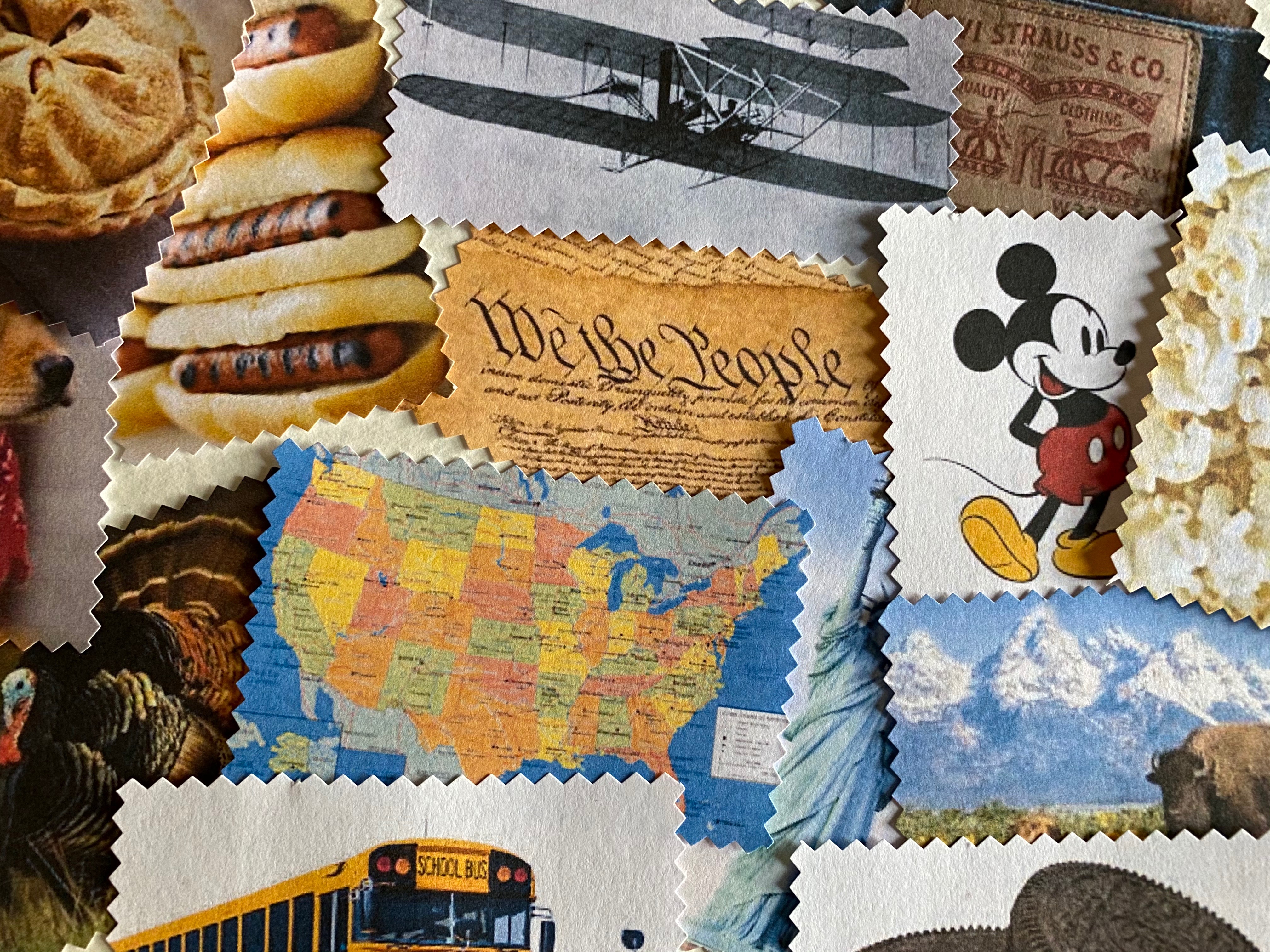
American Collage

Our focus, these past few weeks, has been directed toward several aspects of the American experience –

Part of the American Collage “The Smithsonian’s History of America in 101 Objects”, by Richard Kurin.  (We began by learning a bit about the Smithsonian Institution’s 19 museums and 9 research centers sites – mostly located in Washington DC).  So far, our favorite objects in the book’s collection:   

Columbus piombo    washington uniform

  • The well known portrait of Christopher Columbus that may not be a representation of the man at all – it was painted in 1519, more than 10 years after his death 
  • George Washington’s ultra elegant uniform (designed by George Washington!) 
  • The Bible that Thomas Jefferson edited for himself (leaving out parts he did not believe in)(discussion provoking)

It is going to take us months to work through this book.  We’re glad.

Part of the American Collage – “The Amish of Lancaster County” by Donald B. Kraybill.  Easy to read, up to date (published in 2019), with lovely, plentiful photographs.  Emphasized:  COMMUNITY and the hard working, self-sufficiency, graceful, modest, and religion-centered values of the Amish.  Of great fascination to us was the Amish education system:

amish school

  • all grades are taught in a one-room school 
  • science is not taught in school (we discussed)
  • there is no school after age 14 (we discussed)
  • teachers are not certified, college educated, or even high school graduates (we discussed)

Part of the American Collage – “The Blue Angels”, by Keillor and Wheeler.  Descriptive writing and heart-stopping photographs showcase the precision daredevil abilities of the Navy pilots demonstration team, thrilling everyone since 1946.  Most exciting chapter:  THE MANEUVERS! “The Delta Breakout”! “Loop Breaks”! “Six Plane Cross”!  “The Fleur-de-Lis”!  I asked my son if he would like to fly in a Blue Angel formation and the answer was a YES.  Count me out.  Also, you can count out any Amish community members from soaring with the  Blue Angels as they are (1) forbidden from joining the military and (2) forbidden from riding in airplanes of any sort.  CHANGE OF TOPIC: the first female Blue Angel joined the team in 2014 (we discussed).

Part of the American Collage – “The Incredible Band of John Philip Sousa”, by Paul Edmund Bierley.  We have never come across a book with its subject so thoroughly documented.  This book catalogs every tour, concert, concert program, musical instrument, and musician of the Sousa Band’s 40 year run.  Take aways, so far –

  • In 1889, Sousa sold the publishing rights to “The Washington Post March” for –  OH DEAR IT HURTS TO EVEN TYPE THIS – $35  
  • Sousa composed over 130 marches.  Most famous: “The Stars and Stripes Forever”, composed in 1896 and declared “Official National March of the USA” by an act of the US Congress in 1987
  • Between 1892 through 1931, the band presented just under 16,000 concerts, zigzagging all over the world.  SIXTEEN THOUSAND.
  • Sousa’s Band was a concert band, marching only eight times during the course of 40 years

Part of the American Collage – “Appleseed, The Life and Legacy of John Chapman”, by Joshua Blair.  We’ve learned:

  • Johnny Appleseed (John Chapman) was a real person (1774 – 1845), not a made up legend (although he did travel barefoot, wearing the darnedest clothes, just like the legends proclaim)
  • how he procured the apple seeds (from cider factories!)
  • how and where he set up apple nurseries and the importance of these nurseries
  • of his ability to trusted by westward moving pioneer settlers as well as native Americans
  • how he utterly embodied the spirit of the Swedenborgian religion; the apple tree planting being his ministry
  • in case you are still reading – I painted the “Johnny Appleseed Song” on our kitchen wall (pictured above) in 2003 to celebrate my father’s 82nd birthday because he loved this sung as grace before dinner

apple pie

“As American as Apple Pie” story problem – Of course, Le Fictitious Local Diner sponsors an apple pie baking contest each July 4th.  Last year 40 people entered the contest and there was a three-way tie for best pie:

  • Dr. Susan’s “Doctored-up Super Cinnamon Apple Pie”
  • Tennis Pro Tom’s “What’s Not To Love-Love Apple Lemon Tart”
  • Miss Maddy’s “I-Want-More Burnt Sugar Apple Extravaganza Pie”  

1)  If each pie used an average of 6 apples, how many apples were used to make up all the pies entered into the contest?

2)  If each pie maker practiced on 3 pies before baking their entry pie, how many apples were used to make up all pies (practice and entry pies)?

3)  If the pie bakers bought their apples from Farmer Brown’s fruit stand, did the stand sell more or less than 1,000 apples for the event? 

4)  If the three winning pies were placed on the diner menu for the month of July, and 10 of each were served over the course of the month, how many apples were used to make the menu pies?   (answers at bottom of post)

Look what we made:  our American experience collage (my son’s first collage)

Part of the American Collage – Classical Music:

Amy Beach’s “Fireflies” from “Four Sketches, opus 15”, 1892.  (Amy Beach is noted as being the first female American composer.)  “Fireflies” may just be our favorite summertime classical music selection.  We have probably listened to it 100 times, each time reminding us of firefly magic during sultry summer nights when we lived in Georgia.  The piece sparkles –

Florence Price’s “Silk Hat and Walking Cane” from her “Dances in the Canebrakes”, 1953.   (Florence Price is noted as being the first female African-American composer.)  This delightful short piece provided an opportunity to chat with my son about this well-structured composition’s thematic set-up:  We listened for themes  A – B – A (developed) – C – and finally back to A –  

Charles Ives’ “Country Band March”, composed in 1903.  This is a true musical collage in which Ives has jaggedly juxtaposed fragments from more than 12 recognizable American marches and folk melodies.  When we listen to this, my son and I pretend we are making our way through a crowded carnival midway with American music blaring at us from all sides – 

Welcome to the best part of my day!
– Jane BH
(story problem answers:  1)  240 apples,  2)  960 apples,  3)  less, 4) 180 apples)