Young Adult Novels

Travelogue

Last night, we were all over the map during STORIES AND STUDIES.

globe alaska

Alaska: A few months ago we finished a unit on totem poles, and last night we revisited the frozen north to take a look at the making of igloos. Completely fascinating. The snow blocks are not nearly as thick as I had imagined.   What will we learn tonight?  I hope there are pictures of people inside the igloos. What can a person do in there?  Just sleep and eat?  Can you stand up in an igloo? For us Texans, just looking at photographs of igloos offers a degree of relief from the summer heat.

India: To enhance the reading of our current novel, “All My Noble Dreams and Then What Happens”, which takes place in India during the 1920’s, we have started a unit on Mohandas Gandhi. I got ahold of a DK Eyewitness book focused on Gandhi and we are reading through it thoughtfully.  There is wall space in my son’s room dedicated to original thinkers who stood up for their beliefs and observations (think Charles Darwin and Galileo).  Obviously, we will order a poster of Gandhi when we conclude this unit.

The American Mid-West: Last night’s Farmer Brown story problem involved calculating the amount of paint necessary to perk up Farmer Brown’s red barn. We also worked on another type of story problem: “Diner Math”!  My son had to compute the total of each table’s orders at the “Le Fictitious Local Diner”, and add on a generous 20% tip.  Yay Diner Math! Yay Farmer Brown story problems! Yay any sort of math that we can look forward to!

And finally, Hungary: our classical music time was spent listening to three different versions of the Hungarian March (AKA the Rakoczi March). BTW, our chosen composers, Berlioz, Liszt, and Brahms knew each other. (BTW, do not take this to mean that they were BFFs.)

  • First, Hector Berlioz’ “Hungarian March”.  This was used in his gigantic musical work, “The Damnation of Faust”.  A great, great march.
  • Next, Franz Liszt’s “Hungarian Rhapsody Number 15”.  A real kitchen sink arrangement – what didn’t Liszt put into this composition? You can hear the Hungarian March PLUS everything from delicate trills to a locomotive gaining momentum, chilling winds, and scary horror-movie background music. So weird.
  • Finally, Brahms’ “Hungarian Dance Number 19”.  Elegant.

Welcome to the best part of my day!

– Jane BH
Novel Ideas

Today’s topic:  finding the perfect novel to read aloud to my son – what I am seeking (yay!) and what I am avoiding (yikes!).

books

Yay: we like advanced vocabulary and young adult protagonists.  Yikes: the typical young adult “coming of age” novel is not appropriate for my son. Yikes, yikes, yikes:  themes of alcoholism, drug use, rash behavior, abuse, incest, death, disconnected parenting, suicide, sex, and people being outright mean to one another.  I preview loads of books so we don’t have to head down these dark roads.

Also, because I am the one reading aloud, I have some say in the book genre.  I have tried ’em, but I usually don’t care for sci-fi, fantasy, stories with recurring villains, or time travel.  Here is what I am looking for:  humor, adventure, mystery, self-reliance, team efforts, friendship. I am looking for the good read with storylines complex enough to warrant rereading.

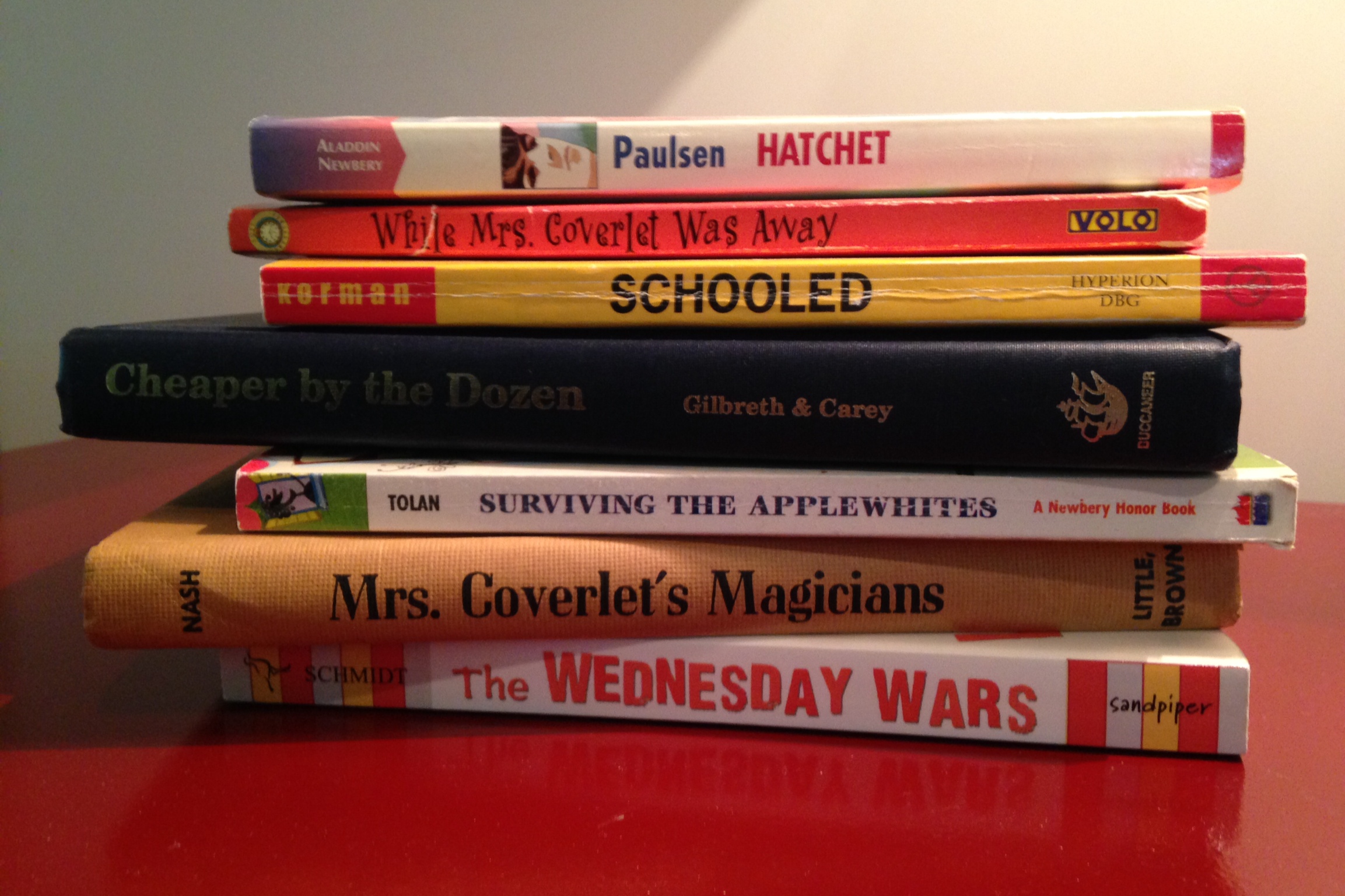
We probably read 50 novels annually. Here are the books we cannot get enough of, so they get reread about once a year:

  • Hatchet – Gary Paulsen
  • Cheaper By The Dozen – Frank B. Gilbreth
  • Schooled – Gordon Korman
  • Surviving the Applewhites – Stephanie S. Tolan
  • While Mrs. Coverlet Was Away – Mary Nash
  • Mrs. Coverlet’s Magicians – Mary Nash
  • The Wednesday Wars – Gary D. Schmidt

Here is what we worked on last night:

My son was presented with a long list of locations; his job was to divide them into city, state, or country categories. We finished the amphibian unit (yay!) and we started the lizard unit (yay!). We finished the pirate book (which was a disappointment to the end, although we did learn one teeny fact: Black Bart was the most successful pirate ever) (but we don’t know why) (sigh). Our Farmer Brown story problem dealt with the purchase of new water troughs for the pigs.  Oink.

Classical music theme: it was VIRTUOSO NIGHT showcasing trumpeter Wynton Marsalis.

  • Franz Joseph Haydn’s “Concerto in E-flat Major for Trumpet, movement 3”.  Aw, such a lackluster title for such a lively, commanding piece.
  • Niccolo Paganini’s “Moto Perpetuo” (perpetual motion).  The goal for the listener is to determine where the trumpeter is taking a breath in this piece, which is essentially a four-and-a-half-minute endurance-test.  And note:  this performance is a small testament to the skills of Mr. Marsalis.
  • Jeremiah Clarke’s “Prince of Denmark’s March”.  Often referred to as “Trumpet Voluntary”, Clarke’s composition is used for many a glorious wedding processional.

Welcome to the best part of my day!

– Jane BH


Hendecasyllable!

A few nights ago, while reading “All My Noble Dreams and Then What Happens”, we came across an unfamiliar word, “hendecasyllable”.   Hendecasyllable?  Over to the dictionary immediately to find out that this word refers to poetic phrases that contain 11 syllables, very popular in ancient Greek and Latin verse. Well, live and learn (four syllables, not a hendecasyllable).

“Hendecasyllable” got me wondering if my son understood what a syllable was. So last night’s STORIES AND STUDIES began with a focus upon THE SYLLABLE. After an introductory explanation, my son went through a list of 20 words and divided them into syllables. Piece o’ cake (three syllables, not a hendecasyllable).

A new nature study unit! Amphibians! So far, they are more repugnant than snakes. If you are prepared to look at something so gag-reflex ugly, may I present the mudpuppy and the siren amphibian.

Our Farmer Brown story problem:

– Farmer Brown wants to create a festive atmosphere for his outdoor summer barbeque. His plan includes decorating 15 olive trees with strings of sparkly lights. He will need 5 strings of lights for each tree. Each string of lights costs $5.00, and he also needs to buy 15 long extension cords, at a cost of $8.00 each. How much money will Farmer Brown spend to decorate his trees?

Back to “All My Nobel Dreams and Then What Happens”, of the hendecasyllable reference: even though I don’t foresee reading this book again, it is a well-written, engaging novel, with important historical information. It captures the struggle of the Indians, in the 1920s, to recapture control of their country from the British. Worthy reading.

Classical music time:   “Minuet in G to the Power of Three”:

  • “Minuet in G” by Mozart – probably composed by the young genius when he was 6.  Most engaging.
  • “Minuet in G” by Beethoven – this is the “Minuet in G” used by Professor Harold Hill for his “think system” in Meredith Willson’s “The Music Man”.  Whoa.  Blurry eyes from too many quotation marks.
  • “Minuet in G” by Bach – so wistful. I just love this piece.

Welcome to the very best part of my day!  (Bingo! Eleven syllables! Hendecasyllable!)

 – Jane BH

In which we explain our “Stories and Studies” nightly agenda

We Write – this takes so many different forms. Sometimes I ask my son about something we learned the night before. Sometimes I set up math problems. Sometimes I ask him about somebody in the family. Sometimes I ask him how he is feeling. Sometimes he selects our classical music program for the evening. Sometimes we practice handwriting. We work with pen and paper and we also use a wonderful app on our iPad.  This is the time slot where I have taught him how to take a true/false test, a multiple-choice test, a matching test.

We Learn New Things – we set aside the desk top and open the books.  We usually have two academic subjects going on. Each academic unit lasts about two weeks.  We supplement the books with our iPad and a big globe

We Read Novels – we usually have two novels going. I read aloud. If the book doesn’t hold our attention, we stop reading it.   If we love the book, we may let a year go by and then we enjoy it again.

We Read Poems –  well, this is pretty self explanatory.

We Listen to Music – most of our study units last about 2 weeks, and this is what I thought would happen with our classical music unit. But this subject has proved so interesting that we have been on it for almost 3 years.

Background story – I had purchased a booklet that included posters of 16 classical composers. By day two, it occurred to me that it was ridiculous to read about composers without listening to their music, so I learned how to research music, purchase it, download it into an iTunes file, and then transfer it to my iPod. We have now listened to just under 500 compositions.

We listen to three compositions every night, and every night of the week has a music theme: composer spotlight, dance and march music, virtuoso night, etc. We might have a theme night, like “clocks” and then listen to music of different classical periods that have titles that refer to clocks (Haydn’s “The Clock” Symphony, Bizet’s “Carillon” from L’Arlesienne, LeRoy Anderson’s “Syncopated Clock”).  Here is what we don’t do:  listen to music in chronological order.  What is the fun in that?

Welcome to the best part of my day!

– Jane BH

In which we introduce ourselves

I am a mom. My son is 23 and he has autism. He is non-verbal. This blog is about our learning-at-home program.

 About 8 years ago, while working with an experienced educational consultant, I was asked, “what facts does your son know?” Seriously? I couldn’t think of any facts that he might know. Every night I read little Disney books to him and nursery rhymes, but facts? I didn’t think my son was either interested in facts or capable of understanding facts. The stunned look on my face provoked the consultant to say, “Your son wants to know facts!  Here, read aloud the first two paragraphs of this!”.  She handed me an old science textbook, and turned to a page on dinosaurs. I took a look, gulped, and thought, “well now she will see – here comes an epic fail”.

 Here is what happened: My son and I sat next to each other as I began to read the dry material.  Within seconds, my son was glued to my side, pouring over the page, drinking in the information.  Two paragraphs were not enough for him, I had to read more and more, and the implication was sobering – I had been depriving a curious mind. My son wanted to learn facts!  This was our start.

 What this had evolved into:  every night, my son and I set up our STORIES AND STUDIES center on his big bed. We have comfortable back supporting pillows and we place a sleek, portable desktop over his legs and we get to work. The first thing that happens is that he squeals with delight for about 3 minutes, and then we are off!

 Our nightly plan –

  • we write
  • we learn new things
  • we read novels
  • we read poems
  • we listen to music (mostly classical)

 Welcome to the best part of my day!

– Jane BH