Lonely Planet Kids

Stat Chat

The Statistics:  How many books did we read in 2024?

Number of books started:  53
Number finished:  46
46 might seem commendable, but my friend Shannon made it a goal to read 1,000 books to her toddler grandson in 2024.  On December 24th they shared book number 1,000.  Whoa.  Shannon!  You are making us look like slackers!
Number abandoned:  5
We do not believe that we would be better people if we continued to read books that did not entice. 
Number still being read:  2
Number of fiction books:  19
Number of non-fiction books:  34

Books to be re-read because they rank high on the awesome scale:
The Labors of Hercules Beal, Gary D. Schmidt
Footnotes from the Most Fascinating Museums, Bob Eckstein
The Mona Lisa Vanishes, Nicholas Day
While Mrs. Coverlet was Away, Mary Nash
Mrs. Coverlet’s Magicians, Mary Nash
Schooled, Gordon Korman
Home of the Brave, Katherine Applegate

Our very very favorite reads of 2024:
Fiction:  The Labors of Hercules Beal, Gary D. Schmidt
Non-fiction:  The Mona Lisa Vanishes, Nicholas Day

Currently reading:

Marine One, by Colonel Ray “Frenchy” L’Heureux.  Compellingly written.  We are learning what it takes to be in charge of the US presidential helicopter (always referred to as “Marine One”, as presidential helicopter transport falls under the management of the US Marines).   These helicopters are so well maintained and the pilots are so well trained that since its first commission (1947) there have been NO accidents or mishaps.  New concepts for my son:  Marine boot camp – hovering – a squadron – a lift package. 

The Travel Book, a Journey through Every Country in the World, a Lonely Planet Kids book.  So, first question:  as of January 1, 2025, how many countries are there in the world?  Sorry, trick question:  an internet search has totals ranging form 195 to 257.  (sigh)  In The Travel Book, 204 countries are showcased  (each gets a single page of facts and quirky points of interest), so we are going with 204.  We are learning about one country a night and finding its location on our globe.  We should be reporting back in a little less than 7 months.

Reading Comprehension:  Since last report, my son is still smiling over our Clem and Clyde stories.  Latest antics involve:

sports fans – treasure hunting – whittling – Halloween socks – Thanksgiving napkins   
orchestra membership – creating a dazzling Christmas tree

The Poetry Project:  memorization is coming along for the three poems we began with (“Stopping by Woods on a Snowy Evening”, “Keep a Goin’”, and “The Swing”).  Newest addition to the unit is “Sea Fever” by John Masefield.

New new new!  We are starting to do VERY EASY crossword puzzles!  Santa brought a book that looks youngster-ish, but I am guessing that whomever put it together had some sort of teaching background.  It advances from the simplistic to mid-level difficulty crossword puzzles at a thoughtful pace.  My son is experiencing success and likes delving into this book.

A Long and Complicated Farmer Brown Story Problem:  

Weather is chilly in January on the ranch, so Farmer Brown decided to purchase 4 pair of thick wool socks for each of his 5 farm hands.  The socks cost $30 per pair, but the “Sock Hop Sock Shop” was having a special deal for the month of January:  2 pair of socks for $50!  
– So, Farmer Brown purchased how many pair of socks?
a)  4 pair     b)  5 pair     c)  20 pair     d)  30 pair
– And how much did Farmer Brown pay (not including tax) for his farm hands’ socks?
a)  $120     b)  $150     c)  $200     d)  $500
– And how much more would he have paid if he had bought the socks in February?
a)  $100     b)  $50     c)  $30     d)  $20

But here is the thing:  Farmer Brown was so busy chatting with his old friend Hank (you know, of Hank’s Harmonica Orchestra), that instead of buying MEN’S sized socks, he purchased WOMEN’S sized socks and there was a “no return” policy on the “special deal” merchandise.  So Farmer Brown decided to donate the socks to the town’s silent auction fundraiser (to repair the roof on the town’s bingo parlor) and had to return to the “Sock Hop Sock Shop” and buy the right sized socks for his farm hands.
– How many pair of socks did Farmer Brown purchase when all was said and done?
a)  8 pair     b)  20 pair     c)  30 pair     d)  40 pair
– How much did Farmer Brown spend (not including tax) buying all the socks (good thing it was January!)?
a)  $1,200     b)  $1,000    c)  $350     d)  $80  
(answers at bottom of post)

Classical Music to Welcome 2025 – 

La Réjouissance, movement IV, from Handel’s “Music for the Royal Fireworks”, composed in 1749.  This is a robust fanfare worthy of welcoming 2025.  Should the occasion arise where we require a fanfare, this piece would be the one –

Pines of the Appian Way, movement IV, from Ottorino Respighi’s “Pines of Rome”, composed in 1924.  We join the composer trudging through discord, sorrow, darkness in the first half of this movement, but the back half of the movement – OH!  An overwhelming and lengthy crescendo gives reason for turning from sadness and welcoming the glories a new year can bring –

Sunrise, movement I, from Ferde Grofé’s “Grand Canyon Suite”, composed in 1930. This  music reminds us of the sheer privilege of welcoming a new day (and why not a new year?).  Bird song at the beginning of the piece is the first hint that all is going as it should be going – and it is NONE of OUR doing.  Sunrise in the hands of a higher power.  We have added “Sunrise” onto our Sunday night classical music list –

Welcome to the best part of my day.
– Jane BH
(story problem answers:  c)  20 pair, d)  $500,  a)  $100, d)  40 pair,  b)  $100.  Inspiration for this story problem:  my husband gifted me with 4 pair of MEN’S SIZED wool socks for Christmas.  Ooops.)

P.S.  My biggest news!  I was part of a BBC Radio 4 program that was broadcast on New Year’s Day!  The program series (“Soul Music”) presents superbly constructed half-hour episodes that focus on a single piece of music.  “Sailing By”, composed by Ronald Binge in 1963, was chosen for the New Year’s Day show.  It is a composition that is well recognized by British citizens as it is played every night before the late shipping report broadcast.  I have written short thoughts about this sweet slumberous waltz in 3 different blog posts.  Anyway, if you have a spare half hour, here is the link.  My raspy/twangy voice is positioned about 2/3rds into the program.

https://www.bbc.co.uk/sounds/play/m0026999

and here is the entire piece –


January Jabber

Here is something we didn’t know: the number of books we read a year.  So, the plan for 2024: TRACKING OUR READING –  How many books will my son and I read this year?  How many will we start?  How many will we finish?  How many are good enough to make it into the re-read basket? 

Speaking of reading (from our Farmer Brown story problem collection) – Farmer Brown has a library in his farmhands’ bunkhouse.  The library has 200 books, some on ranch animal care, some on tending crops, some are rip-roaring tales of the old west.  Farmer Brown noticed that 20 of the books have never been read (mostly books on personal hygiene and healthy snacks).  

– What percentage of books have been read by the farmhands?
a)    10%     b)     20%     c)     75%     d)     90%

– There are 60 wild west fiction books that have been read over and over by the farmhands.  These books comprise what percentage of the bunkhouse library? (answers at bottom of post)
a)  15%     b)  30%     c)  45%     d)  60%

Our Current Sy Montgomery Books – Sy Montgomery is an author whose writing appeals to us.  Her journal-style books take us around the world as we join her in following the work of dedicated animal researchers (and we especially love her “researcher bios”) –

 – The Hyena Scientist”:   For this study, Sy Montgomery journeys to Kenya to join a team of scientists focused on and fascinated by hyenas.  For us, the most intriguing takeaway:  hyenas gather in tightly knit clans (and there are CLAN WARS) with an extremely structured hierarchy, and the females RULE.  Do not mess with the matriarch.

Amazon Adventure – How Tiny Fish are Saving the World’s Largest Rain Forest”:  Cardinal Tetras, bitty sized fish from the Rio Negro (a tributary of the Amazon River, near Barcelos, Brazil) are sought after by home aquarium owners all over the world, and Montgomery spells out why this fish gathering/transporting industry is ecologically important.  OK, OK, but here is the best part of this book:  learning about Barcelos’ FESTIVAL OF ORNAMENTAL FISH!  Oh my gosh, THE FESTIVAL!  Citizens of this teeny town spend months preparing parade floats, stitching flamboyant costumes, and rehearsing for grand “cast-of-a-thousand” performances in the town stadium.  The festival is also a competition:  town citizens are either on the Cardinal team or the Discus (another small aquarium fish) team.  Teams are judged on costumes and performance AND how politely team members watch their rival’s performance! Yes!  Etiquette always!  The Festival of Ornamental Fish is so on the bucket list.

January Jeopardy – We are quiz show ready!  A sampling  of quirky info from our latest batch of books –

1.  The hippo is the most dangerous animal in Africa.  (from “The Hyena Scientist”,  Sy Montgomery)
2. The didgeridoo is the oldest musical instrument in the world.  (from “A Time to Celebrate”, a Lonely Planet Kids book)
3.  Some of the Olympic swimming medalists from the 1948, 1952 and 1956 games started their aquatic training in Maui’s sugar plantation irrigation ditches.  (from “Sakamoto’s Swim Club”, Julie Abery)
4.  Omaha, Nebraska was the home town of dancing sensations Fred Astaire and sister Adele. (from “Footwork – The Story of Freed and Adele Astaire”, Roxane Orvill)
5.  Crescent-shaped, sword-shaped, and star-shaped are three different types of sand dunes found in Algeria’s Sahara Desert.  (from “Algeria, Enchantment of the World”, Martin Hintz)
6.  According to botanists, there are 8 different types of vegetables (leaf, bulb, flower bud, root, tuber, stem, fruit, and seed veggiesit grieves me that my son does not acknowledge 7 types of vegetables). (from “The Vegetables We Eat”, by Gail Gibbons) (answers at bottom of post)

Music + Academics = A+

  • Philip Glass’s “Negro River”, from his 9 movement “Aquas da Amazonia” (composed for a ballet in the late 1990’s), transports us to the site of our “Amazon Adventure” reading experience.   We hear rhythms and echoes of the river – birds, bugs, frogs, water bubbles, an intruder (a snake?) –   

  • Who wouldn’t want to hear the music of the didgeridoo, the oldest instrument in the world!  The didgeridoo (traditionally made of eucalyptus) in this video clip is certainly elegant.  For us, the drone sound it produces takes us by surprise every single time – 

  • And how about some background music for Farmer Brown’s farmhands as they read through the novels of the American west?  We are really liking Virgil Thomson’s “Cattle” movement from his suite that accompanied the 1936 documentary, “The Plow that Broke the Plains”. This short piece is a comforting patchwork of old west melodies –  

Welcome to the best part of my day,
– Jane BH
(story problem answers:  d)  90% have been read, b)  wild west fiction comprises 30% of the library)
Left over from last post:  our San Francisco family member finally sent us a photo from aboard a cable car: 

The Octopus Shocker

He writes!  He illustrates! – For the past few weeks my son and I have become entranced with  Owen Davey books.   Informative, clever, teamed with sophisticated graphics in a perfection of colors.  Our type of book.  We’ve just finished – 

  • “Mad about Monkeys” – We needed to get a better grip on our knowledge of primates (as in the fact that chimpanzees, gorillas, orangutans, gibbons are NOT types of monkeys) (we had sort of thought they were)(we were wrong).  Also, we now have a passing knowledge of “old world” and “new world” monkeys.  
  • “Obsessive about Octopuses” – 1)  this book is so A+, 2) the correct plural of octopus is octopuses, NOT octopi, 3) we stopped short when we read about the common blanket octopus: the female stretches to 6 feet in length and the male (ARE YOU REALLY READY FOR THIS?) measures in at 1 inch. A live male blanket octopus was sighted for the first time in 2002 (Wikipedia) OH MY GOSH and 4)  THE SHOCKER!!!!!  Most of the 300 species of octopus live ONLY A FEW MONTHS!  I have been asking all my friends how long a typical octopus lives and guesses have ranged from 16 years to 50 years.  Dear dear magical, nimble, problem-solving octopuses –  taken at so young an age.
  • Next on the reading list, “Fanatical about Frogs”.

Deforestation – My son and I read a lot of books about endangered animals, so we know that loss of habitat is a primary cause.  We have come across the term, “deforestation”  many times, so deforestation was on our minds when we read from the excellent “How Ships Work” (a Lonely Planet Kids book) that – 

  • around 2,000 trees were used to build a Spanish galleon in the 1500’s (and we know there was more than one galleon).
  • 6,000 trees were needed to construct British flagship HMS Victory in 1765. 

 Deforestation is not a new trend.

“Everest” by Sangma Francis and Lisk Feng – all topics Everest are covered in this well written, well designed book:  Sherpas, the sacredness of the mountain, climbing clothes, the development of oxygen masks, trash on the mountain, routes to the summit, inspirational climbers AND my son and I are still musing over the fact that Mount Everest grows 1/3 inch a year.

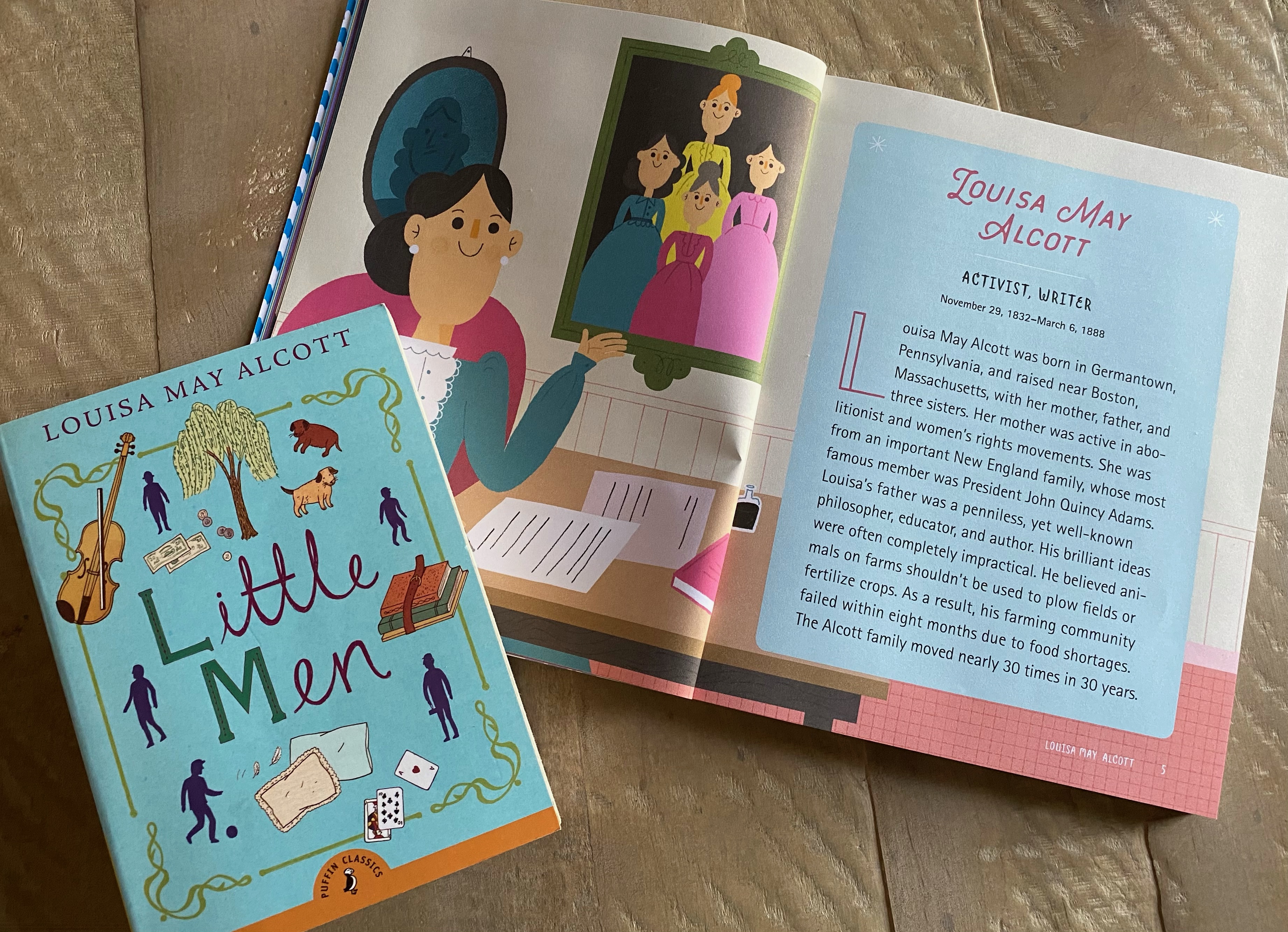
“Little Men”, by Louisa May Alcott – I have read “Little Women” several times and I was eager to share my first reading of “Little Men” with my son.  1)  Jeepers, this is relentlessly moral story.  2) This is a difficult read what with the vernacular of the 1870’s and the loads of characters, some with multiple nicknames. I read aloud one paragraph and then take the same amount of time to untangle what I’ve just read for my son.  Sigh.  We have augmented “Little Men” by reading a short bio of Louisa May Alcott from “American Trailblazers” by Lisa Trusiani.

Time for a change in tone!  Story Problem – Farmer Brown Runs for Town Mayor!  –  Yes, Farmer Brown is running for town mayor and his chances for winning look good!  His campaign manager has all sorts of campaign ideas to get Farmer Brown’s name before the public:

  • 50 big yard signs spread around town, with the slogan, “Farmer Brown can make our town grow!” ($4 for each sign and $25 each for Farmer Brown’s two nephews to place the signs)
  • 1000 campaign buttons (“Farmer Brown can make our town grow!”) for $250
  • A running ad (boldly proclaiming that “Farmer Brown can make our town grow!”) in the local newspaper for $75
  • A banner spanning the width of Main Street boldly proclaiming, “Farmer Brown can make our town grow!” for $75
  • 1,000 grocery sacks at Farmer Brown’s road-side stand with “Farmer Brown can make our town grow!” imprinted for $150

Farmer Brown has budgeted $750 for campaign PR.  Can he afford all the ideas ?  (answer at bottom of post)

Classical Music for Octopuses – we were still thinking about the brief lives of the octopuses.  If the current crop of octopuses is going to enjoy classical music, the pieces had better be short.  May we suggest – 

  • Violin virtuoso Fritz Kreisler’s “Schön Rosmarin” (Beautiful Rosmarin), composed in 1905.  Just under two minutes. We listened for iconic Kreisler embellishments while easily envisioning an octopus swaying with the tides –
  • “Solfeggietto”, by CPE Bach, composed in 1766. One minute sixteen seconds. This fast, frantic piece is certainly the “go to” background music for an octopus needing to escape predators –
  • “The Aquarium” from Carnival of the Animals (1886), by Camille Saint-Saëns.  Two minutes, four seconds. Reflective, yearning, chilling, mysterious; it seems as if the octopus was the muse for this piece –

Welcome to the best part of my day!
– Jane BH
(story problem answer:  NO!)

Too much gushing?

We plow through so many poorly edited books (case in point: the North American Birds book that had a chapter entitled “Finches” in which there was no mention of finches in said chapter), or stupefyingly boring books (case in point: the recent purchase of a most disappointing volume on the history of yodeling), so when we come across books such as we’ve been reading these past weeks, I gush.  Sorry.  Not sorry. 

Paddle-to-the-Sea – this book is so A++++.  Written and illustrated in 1941 by Holling Clancy Holling, and selected as a Caldecott Honor Book in 1942.  This soothing reading is: 

  • a geography lesson in the Great Lakes (which provoked us to order a rather large Great Lakes map poster for my son’s room):

lakes map

  • a lesson in “sticking to the plan”
  • a lesson in “letting go”
  • a lesson in observation
  • a lesson about the kindness of strangers

For us, “Paddle-to-the-Sea” was one almost poetic page per night, accompanied by detailed illustrations, to help us follow the journey of a small hand-carved wooden canoe, complete with hand-carved wooden passenger, as it traveled from a river in Canada through the Great Lakes and eventually on to the Atlantic Ocean.  The 4 year voyage concludes in a most satisfying manner (I was sort of weeping).  Excellent, excellent night-time reading.

Dinosaur Atlas  a spectacular, though slightly unwieldy effort (it is a large book whose large pages unfold making an even larger book) from Lonely Planet Kids.  This book is FILLED with late-breaking dinosaur findings, photos, and deliciously bold graphics.

News to us:

  • 80% of identified dinosaurs have been named since 1990. Those among us who learned everything they know about dinosaurs from “The Flintstones” should take note
  • dinosaur fossils have been found in abundance in every continent INCLUDING Antarctica
  • there is a strong possibility that all theropods (meat eaters that marched around on the 2 hind legs (think T-Rex)) – HAD FEATHERS! (not for flying, perhaps for warmth)

The Flag Book – another keeper resource from Lonely Planet Kids.  All world flags displayed and analyzed, PLUS flag topics that drew an intrigued look from my son: 

  • Car race flags
  • Why the flag on the right side tail of a national airplane is displayed backwards
  • Jamaican flag – only flag in the world that does not contain red or white or blue
  • Bermuda flag – only flag in the world that showcases a disaster (a shipwreck)
  • Why the state flag of Hawaii features the British “Union Jack” flag in its design
  • Hey!  We couldn’t help but notice – the flag of Chile is so similar to our Texas flag

The Smithsonian’s History of America in 101 Objects – this is the type of book that makes us more appreciative citizens.  Each short chapter provides background information on a treasured item from the Smithsonian collection, then explains how the Smithsonian came in possession of the object.  First-rate writing.  Since the last post, the items that provoked extensive side conversations between my son and I:

  • A compass from the Lewis and Clark expedition
  • Harriet Tubman’s shawl from THE QUEEN OF ENGLAND!!!
  • The Brownie camera that shot pictures of the RMS Carpathia rescue of Titanic passengers

pickles

Story Problem:  gushing about Farmer Brown’s newest product – Farmer Brown had such luck with his cucumber crop this year that he has gone into pickle production.  Using his grandmother’s recipe, he has made jars and jars and jars of dill pickles.  He is not only selling them at his road-side stand, but a national food catalog has made a substantial purchase.  

– If Farmer Brown slices 2 cloves of garlic into each jar of his extremely popular dill pickles, and there are approximately 10 cloves in a head of garlic, and he has filled 12 dozen jars, how many heads of garlic were needed?

A).  10     B).  18     C).  25     D).  29  (answer at bottom of post)

Speaking of story problems!  Coming semi-soon! –  A booklet that will include 100 story problems from this blog.  Illustrations are finished!  This will be available from this website  before Christmas.  STAY TUNED. 

Classical Music we gush over –

pick 3

About 4 times a week, I make a list of 10 classical music pieces and have my son select the three we are going to listen to that evening.  If one of the following is on the list, it ALWAYS gets picked. I would estimate that we have listened to each of these no less than 400 times –

  • The Moldau, the second movement from Bedrich Smetana’s symphonic poem, “Ma Vlast”, which premiered in 1882.  The piece follows a river’s path, passing woodlands, meadows, a wedding, mermaids, castles and ruins.  An abrupt and fabulous ending: 

  • The Wild Bears, the sixth movement from Sir Edward Elgar’s “The Wand of Youth” (second suite), premiering in 1908.  A rollicking 3 minutes, full of sophisticated orchestration,  surprises, and a smashing ending.  We also really like Mariss Jansons, the conductor in this video:

  • Guitar Quintet No. 4 in D major, movement III (AKA “Fandango”), composed by Luigi Boccherini in 1798.  Soothing, warm, intriguing.  Not much to look at in this video, but this is the recording we love:

Welcome to the best part of my day!
– Jane BH
(story problem answer:  D).  29 cloves of garlic)

Not on my watch

Last Tuesday, I was lunching at a neighborhood cafe and felt a magnetic pull to eavesdrop on the two teenagers a few tables down who had obviously cut class.  The theme of their distressing conversation was “I hate school”.  Oh my.  Who or what stomped the life out of their learning adventure?  

grandma watch

Not on my watch.  Every single night it is my pleasure to make sure that the learning adventure for my son (AND myself) is set on FULL BLAST.  One goal is to read something so startling that we stop, reread, and marvel.  A few items that had us marveling this past week:

national parks better

  • From “The Wondrous Workings of Planet Earth”, by Rachel Ignotofsky:
    • the one place on earth, that by 1959 international treaty, can only be used for peace and science (with all discoveries shared freely).  Nice.  (Antarctica)
    • while many ecosystems are under threat from unsustainable farming techniques, deforestation, and global warming, the Mongolian Steppe has quite another problem:  GOATS.  One of Mongolia’s successful exports is the fiber from cashmere goats,  so there are a LOT of goats grazing with a vengeance, munching roots as well as the grass,  destroying entire landscapes.
    • the Gouldian finch of the Australian savanna.  Crazy GORGEOUS (see photo below in the music listening section).
  • From the Lonely Planet Kids book, “America’s National Parks”:
    • which state, after California and Alaska, boasts the greatest number of national parks?  (Utah).  We never would have guessed that.
    • there are national parks that exist primarily underwater:  American Samoa National Park, Biscayne National Park, Channel Islands National Park, Dry Tortugas National Park, Kenai Fjords National Park, and Everglades National Park.

tide pool 3 tries

More interesting information on the horizon  We have just started the terribly elegant little “Pacific Coast Tide Pools” by Marni Fylling.  So far we have become knowledgeable about low tides, high tides, the splash zone, the challenges of being permanently attached to a rock, and the toxic beauty of sea anemones.  Sponges are on deck.

trivia sign

Story problem:  Trivia Night at Le Fictitious Local Diner – Tuesday nights are slow at the diner, so the new manager, Miss Jeanette, is hosting “Tuesday Twilight Trivia” to bring in more customers.  Admission is the purchase of the “Tuesday Twilight Trivia Dinner Special” for $7.50.  If the first Tuesday there were 20 players and the second Tuesday there were 40 players, by what percentage did the the attendance rise?  
A)   20%      B)  40%       C)    50%     D)  100%

If the diner awards a cash prize of $25 to each evening’s winner, how much did the diner gross on night number two?
A)  $150     B)  $275     C)  $400     D)  $1,000
(answers at bottom of post)

finches

Music to celebrate that ridiculous-yet-gorgeous Gouldian finch –

  • Vivaldi’s “Flute Concerto in D major” (known as “The Goldfinch”), movement 3, published in 1728.  Yay, James Galway –

  • “Dawn” from Ravel’s ballet, “Daphnis and Chloe”, which premiered in 1912.  A superb, compact performance by the Berlin Phil, complete with chorus.  We put our full attention to listening for the subtle birdsong theme that runs in the background throughout the piece –

and finally:

tie dyed hippie    finch singular

  • “Green Tambourine” by the Lemon Pipers.  The psychedelic colorwork that is the Gouldian finch simply begged for a vintage song from the psychedelic 1960’s.  How can we not smile when we listen to this?  GREAT rhythm.  Peace out –

(for more ’60’s vibe:  the April 29, 2015 post, “Peace, Love, and Tambourines”)

Welcome to the best part of my day!
– Jane BH
(story problem answers:  D)  100%  and  B)  $275)