
They glide through the air with the greatest of ease – We are reading “Catching Air”, a book focused on GLIDING ANIMALS (non-bird animals that seemingly fly from tree to tree). This is our third book by Sneed B. Collard III, whose writings on lizards and bird beaks (for heavens sakes) have made us enthusiastic observers. As usual, the material he presents in “Catching Air” makes us feel super scholarly:
- we now know that large eyes on animals are suggestive of a nocturnal nature
- we now know the difference between flying, gliding, and parachuting animals
- we now know what a patagium (vocab) is and we know how to pronounce it
- we discussed the difference between a carnivore, herbivore, and omnivore
- we are now among those who know where the largest, second largest, and third largest islands in the world are (the largest, of course, is Greenland – where there are no gliding animals, but there are gliding animals aplenty in Papua New Guinea, the second largest island and Borneo, third largest island)
- last night we read about the creepiest creepiest creepiest thing: the air gliding snakes of Borneo

Editing Triumph: Hans Christian Anderson – I wanted my son to understand references that originated from Anderson’s writings, like “The Emperor’s New Clothes” and “The Ugly Duckling”, so we read from a most elegant edition of his fairy tales, compiled by Noel Daniel (published in 2013). This book is thoughtfully organized and filled with sumptuous surprises. There is a lot of gold ink, short informative sidebars, and each fairy tale is teamed up with its own illustrator (the likes of Maurice Sendak and Arthur Rackham). THIS is the edition that anybody interested in Hans Christian Anderson should own.
Quick Notes –
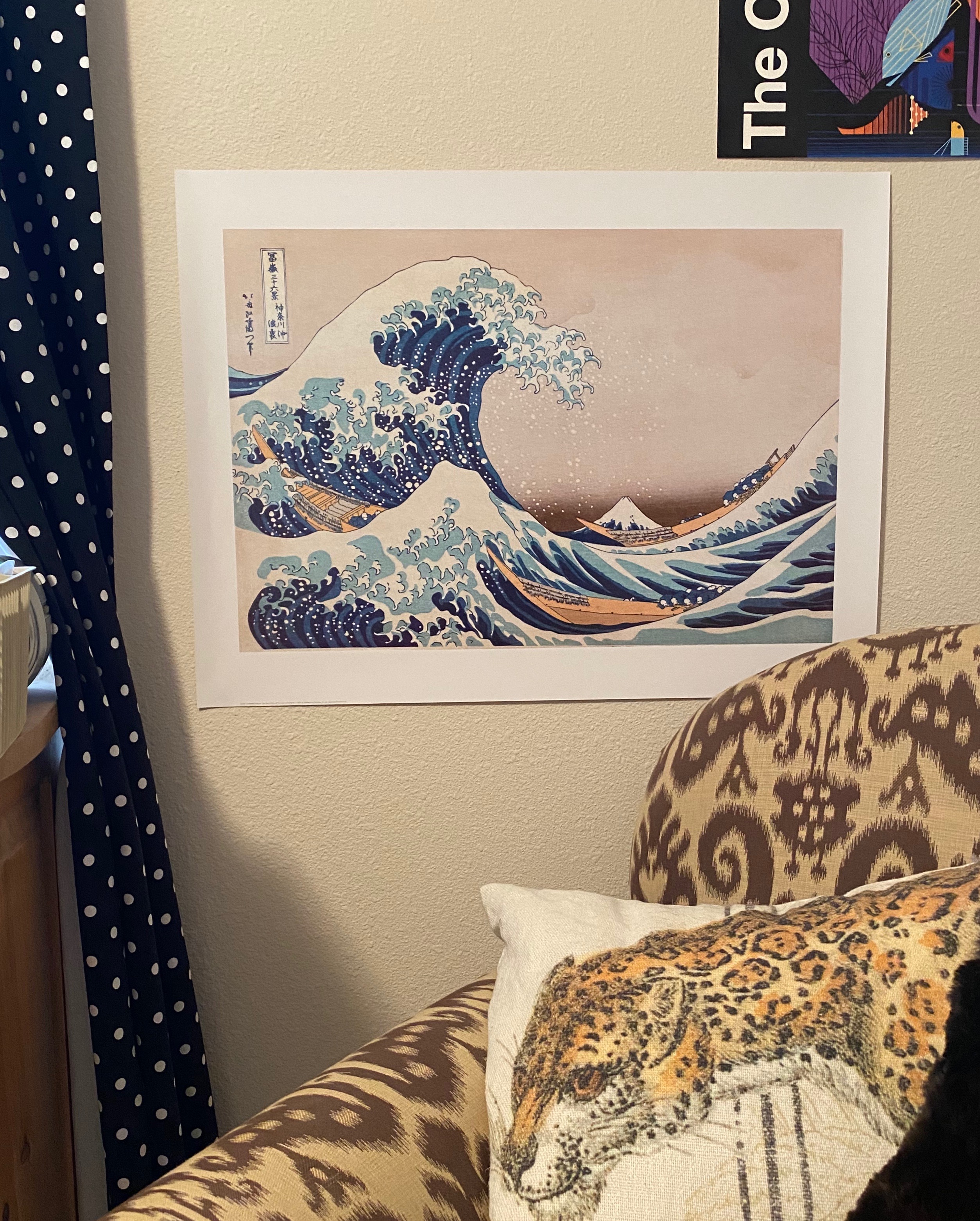
- Hokusai: After finishing “The Old Man Mad about Drawing” (Francois Place), learning more about Katsushika Hokusai, woodcut print master of the late 1700’s, I presented my son with 4 Hokusai poster possibilities for his room. He selected the classic, “The Great Wave”. Even in poster form, it is more spectacular than I had imagined.
- Marsupials: First of all, “marsupial” is a fun word to say. Marsupial, marsupial, marsupial. We finished a unit on marsupials – those mammals that nurture their newborns in mom’s front pocket – except for those marsupials whose mom’s don’t have a front pocket (which our book should have expanded upon)(editing disappointment)(sigh).
- Compass directions: I did a compass check with my son. Did he know north, south, east, and west? YES.
- Hank the Cow Dog: It has been years since we have read through the John R. Erickson series. This is the ridiculousness we need to conclude each day. We pretty much love Hank.
Complaint Department: My son and I are studying architectural landmarks. I am not mentioning our resource because this book could have been so much better. I would not be giving this editor a raise anytime soon:
- Our book provides only vague references to each landmark’s location, as if the exact whereabouts were a secret. Seriously? No nearby city mention? No COUNTRY mention? How can there not be a little map accompanying each entry?
- Whereas all entries are interesting, are they all really landmarks? Are the Roman Baths of England a landmark? Are the the buried terra-cotta army figures in China a landmark?
- Often the book waxes on about a particular object of fascination (fabulous mosaics, a special stone, etc) associated with a particular landmark, and then does not include a photo of the object. AAAAACK.
Nevertheless, we do have our favorite landmarks:

- First place honors go to the hundred foot tall Christ the Redeemer of Rio de Janeiro. Monumental simplicity. Of interest: funding ran low during construction, so the Vatican stepped in to assist. Nice.
- Second place, measuring in at 185 feet (on one side) is the relentless engineering fiasco and utterly charming Leaning Tower of Pisa.

Story problem – a landmark at Farmer Brown’s roadside produce stand! In the hopes of making his produce stand a tour-bus destination, Farmer Brown has commissioned a sculptor to create a 10 foot high bronze ear of corn, to be positioned near the stand. That should get everyone’s attention! The “artwork” will be true to actual corn proportions. If there are 50 kernels of corn in a typical row on a corncob, each kernel must be approximately how wide in the sculpture? (answer at bottom of post)
A) 2.5 inches B) 5 inches C) 7.5 inches D) 2.5 feet

Classical Music Time – earlier in this month (MARCH), a local radio station hosted a “vote for your favorite march” opportunity. We listen to marches every Friday night throughout the year, so my son definitely knew the three he was voting for:
- Marche Militaire No. 1 in D major, composed as a piano four-hands piece by Franz Schubert and first published in 1826. Perhaps best described as a ballroom march, Marche Militaire is also effectively used in the cute-as-anything Disney cartoon of 1932, “Santa’s Workshop” (my son LOVES this cartoon – frankly, I love this cartoon). Note: the extremely competent pianists in this clip do take quite a bit of time to get started:
- March of the Prague Student Legion, by Bedrich Smetana, composed in 1848. This is a march that fills you with nationalistic pride, makes you throw your shoulders back and stand up straight. We love the snappy pace of this particular recording. As an added listening bonus, tucked into the middle of the march, my son and I listen for a few bars of “The Farmer in the Dell”:
- The Imperial March (Darth Vader’s theme), John Williams’ genius nod to aggression and menace. In this film clip, John Williams conducts the LA Philharmonic Orchestra (complete with Jedi and Mr. Vader):
Welcome to the best part of my day!
– Jane BH
(story problem answer: A) 2.5”)


