Greenland

Study Break

Such an unfun set-up:  first the studies, then the study break.

The Greenland Focus – My son and I have proclaimed 2023 as the year we are going to learn about Greenland (the one large land mass we hadn’t “visited” during 2022).  We started with the Wikipedia entry (Greenland: largest island in the world, part of the Kingdom of Denmark, 70% of its energy comes from water power (renewable).  YAY!),  and then read, “Escape Greenland” by Ellen Prager.  This is not our usual type of fiction reading (it is a bit on the high tension/good guys vs. bad guys side)(we are more on the low tension-looking to be enchanted side).  Nonetheless, it successfully brought the location, terrain and climate of Greenland to our attention.

“Icebergs & Glaciers” by Seymour Simon.  A good accompaniment to “Escape Greenland”.  We needed to see photographs of glaciers and icebergs.  We needed grasp their definitions.  (This is hardly the end of our Greenland focus.)

Next Stop, Australia, via “The Great Barrier Reef” by Helen Scales and Lisk Feng.  You can now ask us about:

  • coral bleaching, John “Charlie” Vernon (Godfather of Coral), and the wicked, wicked Crown-of-Thorns Starfish  
  • the future of Green Sea Turtles (this is a species, not a description).  The facts: 
        • the temperature in the nest of baby sea turtle eggs determines the sex of the turtle.  WHAT???? My son and I took a few moments to puzzle over this.  
        • if the nest temperature is lower than 81 degrees, the turtles will be males.  If the temp is above 87 degrees, the turtles will be female.  In-between temps produce a mix.
        • at present, only 1% of green turtles hatching in the Great Barrier Reef are male.    My son and I discussed whether this is optimal.  

  • we read a bit about the world-famous whale, Migaloo (an albino humpback whale), who makes an annual appearance in the reef area (actually, scientists think Migaloo might have perished in the recent past)(RIP Migaloo).  We wanted to know more about Migaloo, so we read “Migaloo, The White Whale”, by Mark Wilson, which provoked us to take a listen to recorded humpback whale sounds. V soothing –

}}-}}}}}}}}}}{{{{{{{{{-{{

Bugs leading the way – how did scientists come up with the idea for:


  • the changing color (green to gold) of the “10” on the 10 dollar bill?  The Blue Morpho Butterfly
  • efficient use of electricity in light bulbs?  Fireflies
  • better solar panels?  The Isabella Tiger Moth
  • more comfortable medical needles?  Mosquitos (whoa: something nice about mosquitoes)

How do we know all this stuff?  “FANDEX Kids “Bugs”.  Anyone following our strict regimen, focusing upon 2 bugs a night would also know:

  • that the queen of some species of termites can live up to 50 years.  Yeeks.
  • the oldest known spider in the world was a female trapdoor spider.  She lived for 43 years!  We can only assume she was studied in a science lab, because she was heartlessly named, “Number 16”.

Yes, we are still on the bird thing we are half way through “What It’s Like to Be a Bird”, written/stunningly illustrated by David Allen Sibley.  We thank Ann P. (influential master teacher who mentored me through my student teaching days decades and decades ago) for suggesting this elegant book.  So far, our favorite 2-page spread:  Wild Turkeys 

  • turkeys were domesticated in Mexico over 2,000 years ago
  • in the 1500’s, they were brought from Mexico to Spain with returning explorers (conquistadors most likely, who are on our permanent bad list)
  • within 20 years, turkeys were the rage throughout Europe (the Pilgrims even brought them back to the Americas onboard the Mayflower)  
  • and TA-DA!!!  Somehow, some Europeans did not get the memo that these birds were from Mexico; it was widely believed they originated from the middle east, specifically, TURKEY.  Thus the name!  File this away for a Thanksgiving Day conversation starter.  We loved this entire segment and read it aloud 3 times.  Thank you again, Ann P.!

And BTW, we now have Sibley’s “Birds of Texas” poster up on the wall.  Very cool.

FINALLY, the study break!  Snack Time Story Problem   The local diner has purchased a popcorn cart with the intention of renting it out for birthday parties and local youth sporting events.  The festive cart was purchased for $300 and will be available for rental at $75 per day.  The diner can supply popcorn and popcorn bags (200 portions for $50).  For fancy affairs, clients may wish to hire Chef Iris to serve up the popcorn at an additional cost of $100 per day.

– How many times will the popcorn cart need to be rented to recover the $300? 
A.  4 rentals     B. 14 rentals     C.  24 rentals  D.  1,000 rentals 

– How much will a client spend if they require the cart for two days, 600 popcorn servings, and Chef Iris to tend cart?
A.  $300     B.  $400     C.  $500     D.  $1,000  (answers at bottom of post)

Classical Music Time – let us suppose that the popcorn cart client would love some carefree, cheerful background music.  Maybe Chef Iris would suggest –

  • Leroy Anderson’s very first work, “Jazz Pizzicato”, 1938.  We can almost hear the popcorn popping –

  • Beethoven’s “Five Pieces for a Mechanical Clock”, Number 3, composed around 1799.  Sweet carnival-type music that could provoke twirling around the closest popcorn cart.  (from what I’ve read, I’m thinking this may have appalled Beethoven)  –  

  • Shostakovich, “Ballet Suite No. 4”, movement 2  (“The Song of Great Rivers”), composed in 1953.  Fresh, lighthearted, an almost merry-go-round feel.  Signature popcorn cart music –

Welcome to the best part of my day!
– Jane BH
(story problem answers:  A. 4 rentals, and C. $500)

Mid-March Roundup

They glide through the air with the greatest of ease – We are reading “Catching Air”, a book focused on GLIDING ANIMALS (non-bird animals that seemingly fly from tree to tree).  This is our third book by Sneed B. Collard III, whose writings on lizards and bird beaks (for heavens sakes) have made us enthusiastic observers.   As usual, the material he presents in “Catching Air” makes us feel super scholarly:

  • we now know that large eyes on animals are suggestive of a nocturnal nature
  • we now know the difference between flying, gliding, and parachuting animals
  • we now know what a patagium (vocab) is and we know how to pronounce it
  • we discussed the difference between a carnivore, herbivore, and omnivore
  • we are now among those who know where the largest, second largest, and third largest islands in the world are (the largest, of course, is Greenland – where there are no gliding animals, but there are gliding animals aplenty in Papua New Guinea, the second largest island and Borneo, third largest island) 
  • last night we read about the creepiest creepiest creepiest thing:  the air gliding snakes of Borneo     

Editing Triumph:  Hans Christian Anderson – I wanted my son to understand references that originated from Anderson’s writings, like “The Emperor’s New Clothes” and “The Ugly Duckling”, so we read from a most elegant edition of his fairy tales, compiled by Noel Daniel (published in 2013).  This book is thoughtfully organized and filled with sumptuous surprises.  There is a lot of gold ink, short informative sidebars, and each fairy tale is teamed up with its own illustrator  (the likes of Maurice Sendak and Arthur Rackham).  THIS is the edition that anybody interested in Hans Christian Anderson should own. 

Quick Notes –

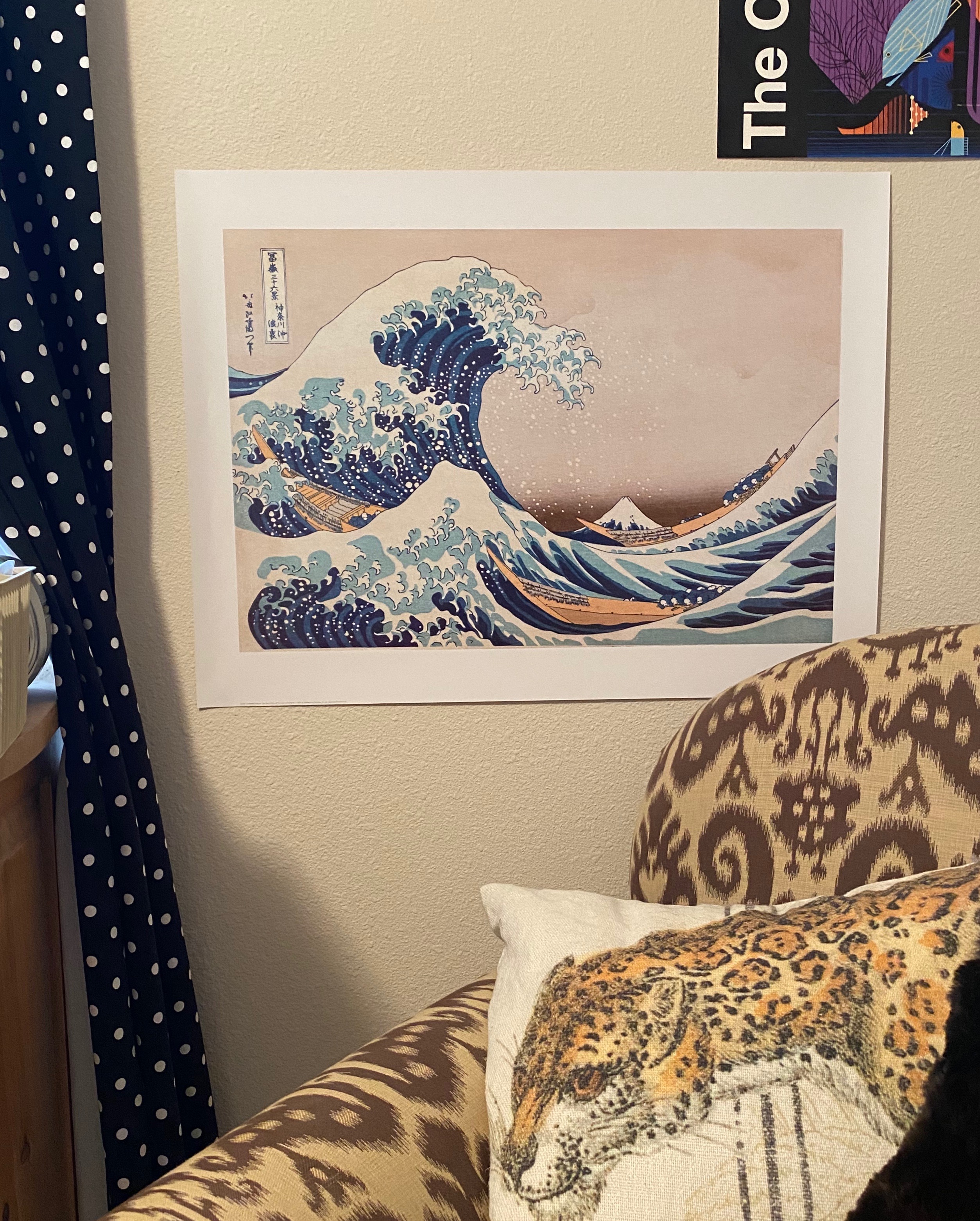
  • Hokusai:  After finishing “The Old Man Mad about Drawing” (Francois Place), learning more about Katsushika Hokusai, woodcut print master of the late 1700’s, I presented my son with 4 Hokusai poster possibilities for his room.  He selected the classic, “The Great Wave”.  Even in poster form, it is more spectacular than I had imagined.
  • Marsupials:  First of all, “marsupial” is a fun word to say.  Marsupial, marsupial, marsupial.  We finished a unit on marsupials – those mammals that nurture their newborns in mom’s front pocket – except for those marsupials whose mom’s don’t have a front pocket (which our book should have expanded upon)(editing disappointment)(sigh).
  • Compass directions:  I did a compass check with my son.  Did he know north, south, east, and west?  YES.
  • Hank the Cow Dog:  It has been years since we have read through the John R. Erickson series.  This is the ridiculousness we need to conclude each day.  We pretty much love Hank.

Complaint Department:  My son and I are studying architectural landmarks.  I am not mentioning our resource because this book could have been so much better.  I would not be giving this editor a raise anytime soon:

  • Our book provides only vague references to each landmark’s location, as if the exact whereabouts were a secret.  Seriously?  No nearby city mention?  No COUNTRY mention?  How can there not be a little map accompanying each entry?   
  • Whereas all entries are interesting, are they all really landmarks?  Are the Roman Baths of England a landmark?  Are the the buried terra-cotta army figures in China a landmark?
  • Often the book waxes on about a particular object of fascination (fabulous mosaics, a special stone, etc) associated with a particular landmark, and then does not include a photo of the object.  AAAAACK.

Nevertheless, we do have our favorite landmarks:

  • First place honors go to the hundred foot tall Christ the Redeemer of Rio de Janeiro.  Monumental simplicity.  Of interest:  funding ran low during construction, so the Vatican stepped in to assist.  Nice.
  • Second place, measuring in at 185 feet (on one side) is the relentless engineering fiasco and utterly charming Leaning Tower of Pisa.  

Story problem – a landmark at Farmer Brown’s roadside produce stand!  In the hopes of making his produce stand a tour-bus destination, Farmer Brown has commissioned a sculptor to create a 10 foot high bronze ear of corn, to be positioned near the stand.  That should get everyone’s attention!  The “artwork” will be true to actual corn proportions.  If there are 50 kernels of corn in a typical row on a corncob, each kernel must be approximately how wide in the sculpture?  (answer at bottom of post)

A)  2.5 inches     B)  5 inches     C)  7.5 inches     D)  2.5 feet

Classical Music Time – earlier in this month (MARCH), a local radio station hosted a “vote for your favorite march” opportunity.  We listen to marches every Friday night throughout the year, so my son definitely knew the three he was voting for:

  • Marche Militaire No. 1 in D major, composed as a piano four-hands piece by  Franz Schubert and first published in 1826.   Perhaps best described as a ballroom march, Marche Militaire is also effectively used in the cute-as-anything Disney cartoon of 1932, “Santa’s Workshop” (my son LOVES this cartoon – frankly, I love this cartoon).  Note:  the extremely competent pianists in this clip do take quite a bit of time to get started:

  • March of the Prague Student Legion, by Bedrich Smetana, composed in 1848.  This is a march that fills you with nationalistic pride, makes you throw your shoulders back and stand up straight.  We love the snappy pace of this particular recording.  As an added listening bonus, tucked into the middle of the march, my son and I listen for a few bars of “The Farmer in the Dell”:

  • The Imperial March (Darth Vader’s theme),  John Williams’ genius nod to aggression and menace.  In this film clip, John Williams conducts the LA Philharmonic Orchestra (complete with Jedi and Mr. Vader):

Welcome to the best part of my day!
– Jane BH
(story problem answer:  A)  2.5”)

Sea Hunt

Sea Hunt – Do you know about the Sargasso Sea?  Located in the Atlantic Ocean, to the east of Bermuda, it is about 2/3 as wide as the continental USA (so it is HUGE), yet there is a glaring shortage of non-fiction books focused upon this important ecosystem.  Surely my son and I are not the only people who want to know more about the turtles and eels of the Sargasso Sea.  We learned a bit by reading through Ruth Heller’s, “A Sea Within a Sea”, a lovely book with information set to rhyme, but we want more.  Attention people who are looking for something to write about: big opportunity here.

Great Beginnings – We are hopeful about two books we began last night: “Ocean” by Ricardo Henriques and Andre Letria (in just the first four pages we enjoyed a richness of information woven into sparse, eye-catching graphics) AND, we started an abridged version of Homer’s “The Odyssey”, by Gillian Cross and Neil Packer (oh my, the illustrations! and of course, oh my, the story!)

What else are we reading?
“Boats Fast & Slow” by Iris Volant and Jarom Vogel (almost a bit too elementary for us. Nonetheless, there are things to learn from this well organized book).
“The War I Finally Won”, by Kimberly Brubaker Bradley (a sequel to the excellent “The War that Saved My Life”).
“While Mrs. Coverlet Was Away” by Mary Nash (only our 6th time through) (a plot line that makes us smile through every single re-read) (this book needs to be read during the summer).

Willy Nilly Time Zones – My son and I love opening up a Ken Jennings book – his writing is clever, funny, and informative.  This week, we are in the middle of his “Junior Genius Guide to Maps and Geography” and have spent time twirling our globe while we read about the International Date Line, the Prime Meridian, and time zones.
WE DID NOT KNOW THIS: countries can determine whether they want to follow international time zone designations.  China, which spans 5 time zones, and Greenland, which spans 4 time zones both make do on a single time zone.  We spent a few minutes thinking about what this would mean if you lived at the far east or far west of either country.  Interesting.
When we are feeling rebellious we say THROW AWAY the state approved text books and replace them with anything written by Ken Jennings.

A Farmer Brown Story Problem – Over Labor Day weekend, there is to be a kayak race in the local river and Farmer Brown is anxious for his ranch team to win the competition (good publicity for his farm stand).  He is purchasing 6 kayaks at $250 each for his employees to practice with, and super competitive Farmer Brown has promised to captain the team! (the ranch team will be so glad when the race is over)
After the race, Farmer Brown is going to offer kayak rentals to be used on his ranch pond. If he charges $15 to rent a kayak for an afternoon of paddling fun, and assuming that 6 people want to kayak every single day, how many afternoons will pass before he makes a profit (which will probably go into kayak maintenance)?
A) 17     B) 27     C) 37     D) 47 (answer at bottom of post)
For discussion: Is this a fast way to make money?

Water Water All Around – a classical music theme to compliment all the reading about oceans, seas, and boats:

  • “The Aquarium”, from Camille Saint-Saens’ “The Carnival of the Animals”, composed in 1886.  Saint-Saens congers up an atmosphere of creepy deep sea mystery in this short short two minute piece –

  • “Jeux de Vagues” (“Play of the Waves”), from Debussy’s “La Mer”, composed in 1904.  We haven’t braved listening to this intellectual masterpiece until this very week; a bit too sophisticated for us, I thought.  But this week, my son and I sat back and let Debussy bring us the sounds of waves being pushed around by the wind, currents, and other waves.  Terribly elegant –

  • “Over the Waves”, composed by Juventino Rosas in 1888.  This waltz rhythm is definitely happier listening than the Aquarium or Jeux de Vagues.  However (semi-interesting side-note), we keep getting this confused with Emile Waldteufel’s “The Skaters Waltz” of 1882 (could Rosas have been “more than” inspired by Waldteufel’s piece?) –

Welcome to the best part of my day!
– Jane BH
(story problem answer:  A)  17 afternoons)(and our discussion topic:  we decided that this actually was a semi-fast way of making money, faster than we thought)