Month: August 2014

FINISH THE POEM

Test Taking.  I am still laughing about last night’s multiple-choice quiz, FINISH THE POEM.  Really, it was a silly test to take, and yet it did provide information regarding my son’s retentive abilities, so it was a worthy use of time.  My son was presented with lines from 15 familiar poems, with the last word missing. He scored 100% and I am pleased with the grasp he has on poems that we have read over the years.

Examples:

“Will you walk into my parlor?”, said the spider to the __________”

(A)  bee       (B)  fly       (C)  ladybug

“The woods are lovely, dark, and deep, But I have promises to __________”

(A)  keep       (B)  fulfill       (C)  reap

Reasons for giving my son a multiple-choice or true/false quiz:

  • I want him to be comfortable with all types of tests
  • I want to see if have I taught a subject adequately
  • both types of tests are potentially handy as communication devices

New Words.  From our novels and academic readings, we came across two unfamiliar words: ASHRAM and BANDICOOT. Cool words. We looked them up immediately.

Last night’s Farmer Brown story problem:  Farmer Brown has a apple orchard, so he was understandably excited when he scooped up an apple-cider press at the county auction. We 1) took a look at cider presses via Google images, 2) discussed the concept of an “auction”, and 3) sat rapt as we watched an auctioneer on YouTube. Then we calculated how many jugs of cider Farmer Brown will have to sell before he breaks even on his new contraption.

Music Time:  Our selections exemplified “wistfulness”:

  • Tchaikovsky’s “Romeo and Juliet Fantasy Overture – Love Theme” – This is the “go-to” background music for movie scenes where two people in love – separated by a meadow or the like – run toward each other. If you can get the slapstick possibilities out of your mind, this is the heart wrencher of heart wrenchers.
  • Jay Ungar’s “Ashokan Farewell” – You can just feel the yearning in this stunning piece for fiddle, guitar, and bass. Well chosen as the theme for the Ken Burns’ PBS series, The Civil War.
  • Irving Berlin’s “What’ll I Do” – The simplest of words masterfully arranged.  Wistful, wistful, wistful.

Welcome to the best part of my day!

– Jane BH
Taking Classical Music for a Test Spin

My daughter’s friend brought up an interesting question: “what if you sort of want to try out classical music, but you don’t know where to begin?”  This is where I was three years ago when I started the classical music unit with my son.  These were my guidelines:

  • Go for short compositions
  • Look for lively pieces; funny, quick-paced, thematic

Specific Suggestions –bumblebee

  • 1 minute – The Nutcracker, Russian Dance (Tchaikovsky)
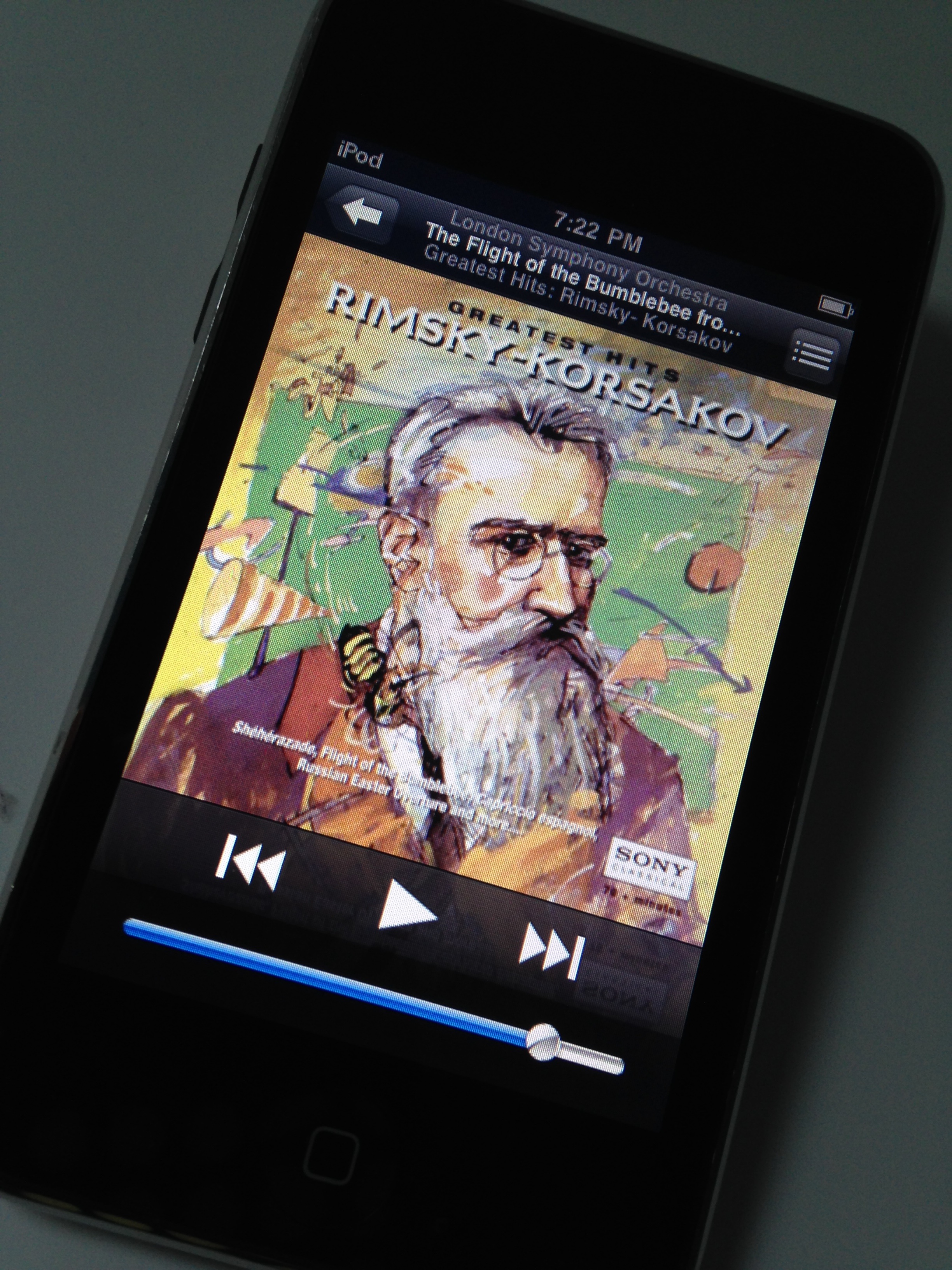
  • 1.5 minutes – Flight of the Bumblebee (Rimsky-Korsakov)
  • 1.5 minutes – The Typewriter (Anderson)
  • 2 minutes – In the Hall of the Mountain King (Grieg)
  • 2 minutes – Orpheus in the Underworld, The Can-Can (Delibes)
  • 2.5 minutes – Feuerfest Polka (Josef Strauss, bro of the Waltz King)
  • 2.5 minutes – Sabre Dance (Khachaturian)
  • 2.5 minutes – March of the Toreadors (Bizet)
  • 3 minutes – William Tell Overture (Rossini) (the entire overture is 12 minutes long, but it is easy to find a recording of the popular 3 minute segment)
  • 3 minutes – Hungarian Dance No. 5 (Brahms)
  • ONE LAST THING.  Double the listening interest level by finding out something quirky about the composer. Luckily, all of the great composers rank really high on the quirk scale.

Welcome to the best part of my day!

– Jane BH

Case in Point: Ibn Battuta

STORIES AND STUDIES.  Hey!  This learning business is supposed to be for the benefit of my son, but I cannot believe how often I am learning things, too.  The latest case in point: Ibn Battuta.  We began a unit on explorers last night and first down the shoot, deserving of his very own chapter, was Ibn Battuta.  Ibn Battuta???  Just in case the name isn’t ringing a bell, Ibn Battuta, who hailed from Morocco, set out on a journey in 1325, and by the time his enthusiastic explorations (Africa, Asia, the Far East) concluded thirty years later, he had traveled 75,000 miles.

Our Mohandas Gandhi unit – We read about philosophers and activists who inspired Gandhi. One was Emmeline Pankhurst, a suffragette from London. My son was familiar with her name from the Mary Poppins movie! In the song, “Sister Suffragette” (adorable song BTW), Mrs. Banks sings, “…Take heart! For Mrs. Pankhurst has been clapped in irons again!”.  Then we had to talk about what “irons” were.  I love this incidental learning part.

Our Farmer Brown story question focused upon his barn cat, Mrs. Ridiculous, and her new brood of 7 kittens, and the costs involved with their first visit to the vet’s office.  Farmer Brown is so responsible.

Music Time – the theme was “Let’s Waltz with Tchaikovsky”:

  • Serenade for Strings, movement 2 (waltz). Tchaikovsky wrote that he was quite pleased with this composition (and it is known that he wasn’t quite pleased with some of his works) (so this is really saying something).
  • Swan Lake, the waltz from Act II. Every piece, EVERY PIECE, from this ballet is A+++.
  • Eugene Onegin (a lyric opera), the polonaise from Act III. (A polonaise is a three-quarter time dance, livelier than a typical waltz.) This grand piece has an infectious melody that you find yourself humming over and over. Interesting factoid: according to Wikipedia, a polonaise is always the first dance at the Polish equivalent of a high school or college senior prom.

Welcome to the best part of my day!

– Jane BH
Travelogue

Last night, we were all over the map during STORIES AND STUDIES.

globe alaska

Alaska: A few months ago we finished a unit on totem poles, and last night we revisited the frozen north to take a look at the making of igloos. Completely fascinating. The snow blocks are not nearly as thick as I had imagined.   What will we learn tonight?  I hope there are pictures of people inside the igloos. What can a person do in there?  Just sleep and eat?  Can you stand up in an igloo? For us Texans, just looking at photographs of igloos offers a degree of relief from the summer heat.

India: To enhance the reading of our current novel, “All My Noble Dreams and Then What Happens”, which takes place in India during the 1920’s, we have started a unit on Mohandas Gandhi. I got ahold of a DK Eyewitness book focused on Gandhi and we are reading through it thoughtfully.  There is wall space in my son’s room dedicated to original thinkers who stood up for their beliefs and observations (think Charles Darwin and Galileo).  Obviously, we will order a poster of Gandhi when we conclude this unit.

The American Mid-West: Last night’s Farmer Brown story problem involved calculating the amount of paint necessary to perk up Farmer Brown’s red barn. We also worked on another type of story problem: “Diner Math”!  My son had to compute the total of each table’s orders at the “Le Fictitious Local Diner”, and add on a generous 20% tip.  Yay Diner Math! Yay Farmer Brown story problems! Yay any sort of math that we can look forward to!

And finally, Hungary: our classical music time was spent listening to three different versions of the Hungarian March (AKA the Rakoczi March). BTW, our chosen composers, Berlioz, Liszt, and Brahms knew each other. (BTW, do not take this to mean that they were BFFs.)

  • First, Hector Berlioz’ “Hungarian March”.  This was used in his gigantic musical work, “The Damnation of Faust”.  A great, great march.
  • Next, Franz Liszt’s “Hungarian Rhapsody Number 15”.  A real kitchen sink arrangement – what didn’t Liszt put into this composition? You can hear the Hungarian March PLUS everything from delicate trills to a locomotive gaining momentum, chilling winds, and scary horror-movie background music. So weird.
  • Finally, Brahms’ “Hungarian Dance Number 19”.  Elegant.

Welcome to the best part of my day!

– Jane BH

Novel Ideas

Today’s topic:  finding the perfect novel to read aloud to my son – what I am seeking (yay!) and what I am avoiding (yikes!).

books

Yay: we like advanced vocabulary and young adult protagonists.  Yikes: the typical young adult “coming of age” novel is not appropriate for my son. Yikes, yikes, yikes:  themes of alcoholism, drug use, rash behavior, abuse, incest, death, disconnected parenting, suicide, sex, and people being outright mean to one another.  I preview loads of books so we don’t have to head down these dark roads.

Also, because I am the one reading aloud, I have some say in the book genre.  I have tried ’em, but I usually don’t care for sci-fi, fantasy, stories with recurring villains, or time travel.  Here is what I am looking for:  humor, adventure, mystery, self-reliance, team efforts, friendship. I am looking for the good read with storylines complex enough to warrant rereading.

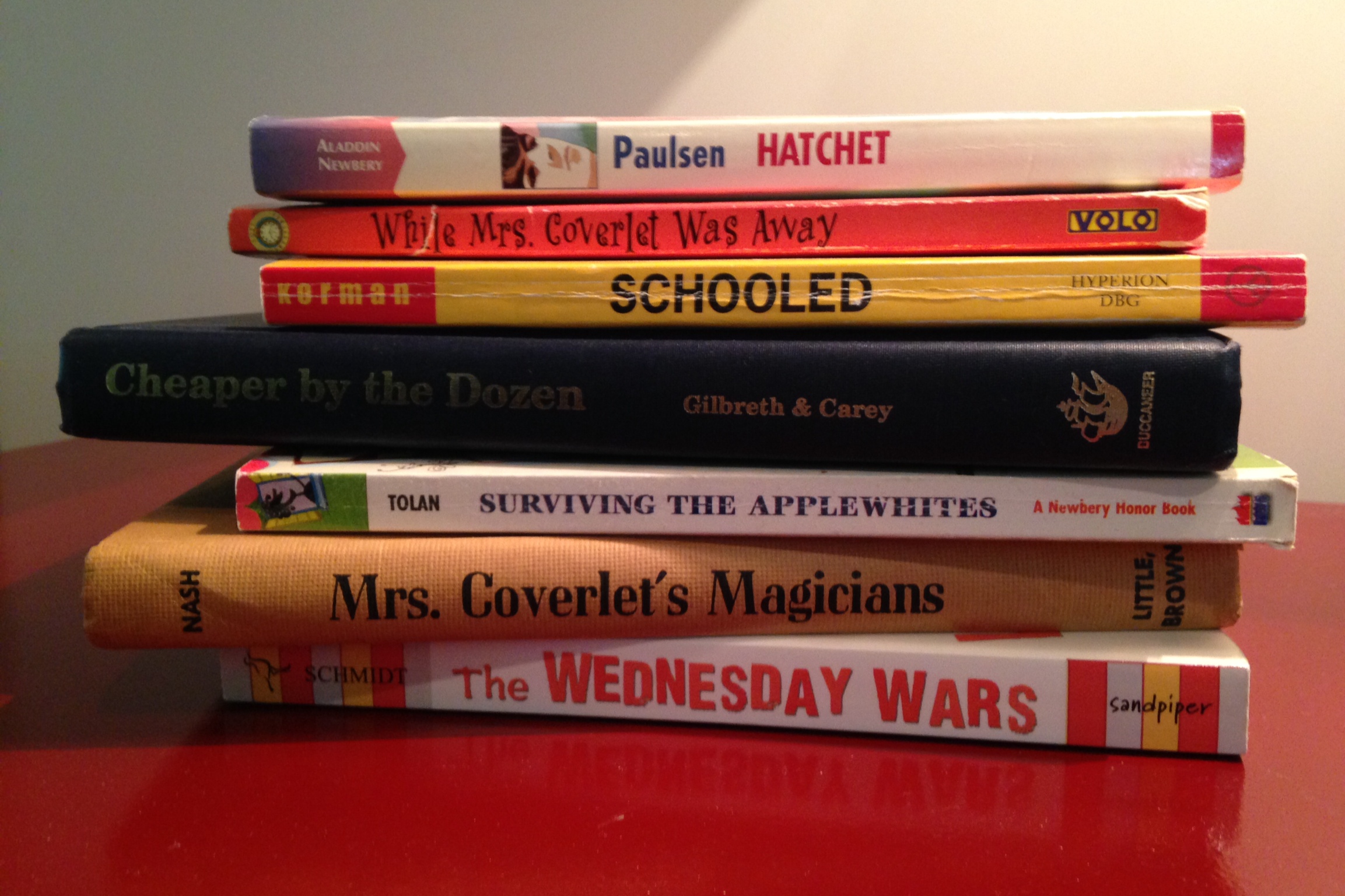
We probably read 50 novels annually. Here are the books we cannot get enough of, so they get reread about once a year:

  • Hatchet – Gary Paulsen
  • Cheaper By The Dozen – Frank B. Gilbreth
  • Schooled – Gordon Korman
  • Surviving the Applewhites – Stephanie S. Tolan
  • While Mrs. Coverlet Was Away – Mary Nash
  • Mrs. Coverlet’s Magicians – Mary Nash
  • The Wednesday Wars – Gary D. Schmidt

Here is what we worked on last night:

My son was presented with a long list of locations; his job was to divide them into city, state, or country categories. We finished the amphibian unit (yay!) and we started the lizard unit (yay!). We finished the pirate book (which was a disappointment to the end, although we did learn one teeny fact: Black Bart was the most successful pirate ever) (but we don’t know why) (sigh). Our Farmer Brown story problem dealt with the purchase of new water troughs for the pigs.  Oink.

Classical music theme: it was VIRTUOSO NIGHT showcasing trumpeter Wynton Marsalis.

  • Franz Joseph Haydn’s “Concerto in E-flat Major for Trumpet, movement 3”.  Aw, such a lackluster title for such a lively, commanding piece.
  • Niccolo Paganini’s “Moto Perpetuo” (perpetual motion).  The goal for the listener is to determine where the trumpeter is taking a breath in this piece, which is essentially a four-and-a-half-minute endurance-test.  And note:  this performance is a small testament to the skills of Mr. Marsalis.
  • Jeremiah Clarke’s “Prince of Denmark’s March”.  Often referred to as “Trumpet Voluntary”, Clarke’s composition is used for many a glorious wedding processional.

Welcome to the best part of my day!

– Jane BH


Bringing Handwriting Up to Scratch

Our STORIES AND STUDIES session from last night – same novels, same amphibian unit. Not much new to report, but I have been meaning to mention something cool we have been using for handwriting practice:

Rainbow Mini Scratch Art Notes!

rainbow cards

If you had a decent elementary school art experience, you must have spent some time with “scratch art”.  Remember crayoning colors with a vengeance onto paper and then covering the color-filled page with India ink?   After everything dried, you used a pin to scratch into the ink any sort of design, and lo and behold, there was your drawing in a random rainbow of colors, too splendid for words.

Well, hey!  There is now a company that makes scratch art cards!  We get all the fun of scratching into the cards without any of the India ink mess.  I’ve found the product in upscale toy stores, and I’ve found it on Amazon.  Each card is about the size of sticky note, and a box includes 125 cards and wooden scratching tool. We have been using rainbow scratch cards for lettering practice, and now handwriting drills have been taken to an entirely new level. No matter what you write, or how you write, you want to keep writing, because watching each color reveal itself is curiously fascinating.

Last night’s classical music theme: Surprise Endings!

  • “The Wild Bears” from Sir Edward Elgar’s nursery suite, “The Wand of Youth”.  This is one of our top ten favorite pieces and we listen to it often. A rollicking three minutes, it makes us think of a great family game of hide and seek.  Smashing ending.
  • “The Moldau” by Bedrich Smetana. This exquisite piece brings to life a river in Smetana’s native Bohemia.  The final minute is so beautiful and descriptive, and the abrupt ending is perfection.
  • “The Imperial March” by John Williams…you know, the Darth Vader theme.  Seriously imaginative composition with an in-your-face ending.

Welcome to the best part of my day!

– Jane BH

Hendecasyllable!

A few nights ago, while reading “All My Noble Dreams and Then What Happens”, we came across an unfamiliar word, “hendecasyllable”.   Hendecasyllable?  Over to the dictionary immediately to find out that this word refers to poetic phrases that contain 11 syllables, very popular in ancient Greek and Latin verse. Well, live and learn (four syllables, not a hendecasyllable).

“Hendecasyllable” got me wondering if my son understood what a syllable was. So last night’s STORIES AND STUDIES began with a focus upon THE SYLLABLE. After an introductory explanation, my son went through a list of 20 words and divided them into syllables. Piece o’ cake (three syllables, not a hendecasyllable).

A new nature study unit! Amphibians! So far, they are more repugnant than snakes. If you are prepared to look at something so gag-reflex ugly, may I present the mudpuppy and the siren amphibian.

Our Farmer Brown story problem:

– Farmer Brown wants to create a festive atmosphere for his outdoor summer barbeque. His plan includes decorating 15 olive trees with strings of sparkly lights. He will need 5 strings of lights for each tree. Each string of lights costs $5.00, and he also needs to buy 15 long extension cords, at a cost of $8.00 each. How much money will Farmer Brown spend to decorate his trees?

Back to “All My Nobel Dreams and Then What Happens”, of the hendecasyllable reference: even though I don’t foresee reading this book again, it is a well-written, engaging novel, with important historical information. It captures the struggle of the Indians, in the 1920s, to recapture control of their country from the British. Worthy reading.

Classical music time:   “Minuet in G to the Power of Three”:

  • “Minuet in G” by Mozart – probably composed by the young genius when he was 6.  Most engaging.
  • “Minuet in G” by Beethoven – this is the “Minuet in G” used by Professor Harold Hill for his “think system” in Meredith Willson’s “The Music Man”.  Whoa.  Blurry eyes from too many quotation marks.
  • “Minuet in G” by Bach – so wistful. I just love this piece.

Welcome to the very best part of my day!  (Bingo! Eleven syllables! Hendecasyllable!)

 – Jane BH

Music to Soothe

Studies weren’t the best last night.

The Snake Unit – I am trying to be enthusiastic about our snakes study, as I want my son to learn about nature with an open-mindedness I may not feel. Of course, my son is finding all of the revolting facts fascinating, but I wish I didn’t have to read about rodents and little birds meeting their maker via le snake du jour. Shedding skin, venom, billions of babies. Ewwwwww. I know, I know, CIRCLE OF LIFE. Last night we read about bull snakes (called bull snakes because of the bull-like grunt they make) (lovely) and corn snakes (called so because they have been found in corn fields) (note to self: wear boots in corn fields). Tonight it is going to be some sort of snake that has its stripes running length-wise instead of ring-wise, which is yet again, so gross.

And then,

The Pirate Unit – I am starting to question the scholarship of our pirate-facts book author. Last night’s focus, “The Gang Plank”, should have been AWESOME. Who doesn’t yearn for every chilling detail about THE GANG PLANK?  But ever so regrettably, the only information our author provided was that she was unsure whether gang planks actually existed. WELL REALLY. How about somebody get to the bottom of this before somebody dangles such a  tantalizing chapter title before the reader?

We needed soothing music to conclude our evening. Our Sunday night music agenda calls for ecclesiastical music. We chose the most peaceful church music to erase the distress caused by general snake grossness and the gang plank disappointment.

  • A motet by Anton Bruckner. Honestly, the title is so long, and it is in Latin and I have no idea what they are singing, but it is in 8-part harmony and it is gorgeous and it easily earns a 10 on the soothing scale. (I can think of a lot of people who have no idea what a “motet” is – seriously, that would be everybody I know (except Ed I. and Bob E.  They know.).  So:  a motet is a choral piece with several parts – meaning sopranos, altos, tenors, baritones, bases – singing in lush harmony.  The motet was a significant musical genre of the Renaissance).
  • By Johann Sebastian Bach, “Sheep May Safely Graze”. Comfort music.
  • Joseph Brackett’s Shaker song, “Simple Gifts”. We listened to YoYo Ma’s thoughtful rendition.

Welcome to the best part of my day!

– Jane BH

Posting about Posters

My son’s room has turned into an art gallery of sorts.  Every time we finish a unit on an artist or illustrator, we select a representative work (in poster form) and find a place for it on the wall (see sidebar).  This room surprises everyone who visits.

boo room

It is pretty easy to figure out how to select a poster, purchase it, and install it, but on the off chance somebody is freaked out about the procedure, here is what we do:

  • I look for posters at museum websites that are dedicated to the particular artist – the selection is wider and prices are significantly lower than art & poster websites.  I have also been satisfied with Amazon’s poster selection.
  • I select six potential posters.  I do a cut and paste from the museum website, presenting all six paintings on one page, and let my son pick the piece he likes best.  I place the order.
  • When poster arrives, we let it unfurl for a week or so, then I adhere it to the wall with removable poster tape squares.
  • If we decide that we really like a particular poster, a local framer mounts it on foam core board, attaches wood stretcher bars in the back, and affixes a hanging wire.  Very inexpensive compared to traditional framing and the look is cool.

An abrupt switch of topics – last night’s music theme was “trains”:

  • Heitor Villa-Lobos’ “The Little Train”.  Controlled, soothing, endearing.
  • Patrick Doyle’s “The Steam Engine”, from Emma Thompson’s movie, “Sense and Sensibility”.  A very short piece that brims with sweet optimism.
  • Duke Ellington’s, “Take the A Train”.  Awesome every single listening.

Welcome to the best part of my day!

– Jane BH