Richard Kurin

Brownie Points

smithsonian left

Brownie points for us!  It was LENGTHY, but we have finished The Smithsonian’s History of America in 101 Objects, compiled by Richard Kurin (currently Acting Provost and Under Secretary for Museums and Research at the Smithsonian Institution).  And brownie points for this first-rate endeavor, a superior textbook choice for a full semester of American History.  My son’s favorite chapters:

  • Lewis and Clark’s Pocket Compass – we loved our unit on the Lewis and Clark expedition (see “From the Wanderlust Files”, August 27, 2019), and couldn’t believe we were actually viewing an artifact from the journey.
  • Helen Keller’s Watch – first of all, this is a VERY INTERESTING WATCH. Secondly, here is something that cheered us – totally unrelated to the watch – Helen Keller’s tuition to Radcliffe was arranged by Mark Twain!!!
  • The Tsimshian Totem Pole – an utterly elegant piece of art that became more enchanting after we understood the story this totem pole reveals.
  • Marian Anderson’s Mink Coat – a well balanced account of events that prompted an ice cold outdoor concert (Easter Sunday, 1939) given by American treasure, contralto Marian Anderson.  We have now added Ms. Anderson’s  recording of “He’s Got the Whole World in His Hands” to our Sunday night listening –
  • The Brownie Camera – the most captivating chapter! We learned about George Eastman and his concept for the Brownie camera (provoking us to read The Brownie Book, Palmer Cox’s mini stories of mini spirits, which inspired Eastman to name his little camera, “The Brownie”) and we were riveted reading the report of the teenage girl, traveling in 1912 aboard the RMS Carpathia, using her Brownie camera to record the rescuing of survivors from the sinking Titanic.

The Photo Ark, by Joel Sartore – a coffee table book with a noble purpose:  to create awareness of extinction possibilities threatening Earth’s current animal kingdom.  Each of the 399 photographs touched our heart.

  • Our favorite chapter – the success stories of species that have been brought back from the brink of extinction.
  • My son’s selection for most beautiful animal photographed in the book –  a three-way tie:  the California Sea Lion, the Pink-Tipped Anemone, and the Bali Mynah.  I would include photos, but the new format options on this blog site have me perplexed.
  • What we learned – most of the monkey-type animals (OK, this is an outrageously incorrect generalization, but this is the easiest way for my son to grasp the idea of the primates-minus-humans group) are in danger of becoming extinct.
  • What we learned – most insects are not in danger of becoming extinct.   (hmmm, drat)
  • What we learned – The International Union for Conservation of Nature’s list of threatened species codes:

EX= Extinct EW= Extinct in the Wild CR= Critically Endangered
EN= Endangered VU= Vulnerable NT= Near Threatened
LC= Least Concern DD= Data Deficient NE= Not Evaluated

Story Problem – Brownies are served! – The local diner is offering adorable after-school snack boxes for $5.  Each box includes 2 of their town-famous peppermint frosted brownies and a small bottle of apple cider.   If there are 500 students in town and every single student purchases a snack box once a week, and each box costs the diner $3, how much will the diner net after a month of after-school treat sales? (answer at bottom of post)

A)  $1,000     B)  $2,500     C)  $4,000     D)  $10,000

Classical Music Listening – we were smiling over the detailed engravings in Palmer Cox’s The Brownie Book, so we put together a program of background music for his merry mischievous brownies – 

  • Badinerie, from JS Bach’s “Orchestral Suite No. 2 in B minor” (1738). This piece makes us imagine brownies dashing all over the place doing good works for the nice people and tripping things up for the mean people – 
  • Banjoland Buffoonery, by Grant Kirkhope for the 2008 video game, “Banjo-Kazooie:  Nuts & Bolts”.  The brownies are up to no good and having a good laugh at the same time.  You do not want to get on the bad side of the brownies – 
  • The Wild Bears, by Sir Edward Elgar, from his “The Wand of Youth, Suite No. 2” of 1908.  This superb short composition has got everything – speed, originality, hold-your-breath moments, a smashing ending – the brownies are sneaking around and this is easily their theme music –

Welcome to the best part of my day!
– Jane BH
(story problem answers:  Farmer Brown’s question: “Yes”. Diner question: C). $4,000).

American Collage

Our focus, these past few weeks, has been directed toward several aspects of the American experience –

Part of the American Collage “The Smithsonian’s History of America in 101 Objects”, by Richard Kurin.  (We began by learning a bit about the Smithsonian Institution’s 19 museums and 9 research centers sites – mostly located in Washington DC).  So far, our favorite objects in the book’s collection:   

Columbus piombo    washington uniform

  • The well known portrait of Christopher Columbus that may not be a representation of the man at all – it was painted in 1519, more than 10 years after his death 
  • George Washington’s ultra elegant uniform (designed by George Washington!) 
  • The Bible that Thomas Jefferson edited for himself (leaving out parts he did not believe in)(discussion provoking)

It is going to take us months to work through this book.  We’re glad.

Part of the American Collage – “The Amish of Lancaster County” by Donald B. Kraybill.  Easy to read, up to date (published in 2019), with lovely, plentiful photographs.  Emphasized:  COMMUNITY and the hard working, self-sufficiency, graceful, modest, and religion-centered values of the Amish.  Of great fascination to us was the Amish education system:

amish school

  • all grades are taught in a one-room school 
  • science is not taught in school (we discussed)
  • there is no school after age 14 (we discussed)
  • teachers are not certified, college educated, or even high school graduates (we discussed)

Part of the American Collage – “The Blue Angels”, by Keillor and Wheeler.  Descriptive writing and heart-stopping photographs showcase the precision daredevil abilities of the Navy pilots demonstration team, thrilling everyone since 1946.  Most exciting chapter:  THE MANEUVERS! “The Delta Breakout”! “Loop Breaks”! “Six Plane Cross”!  “The Fleur-de-Lis”!  I asked my son if he would like to fly in a Blue Angel formation and the answer was a YES.  Count me out.  Also, you can count out any Amish community members from soaring with the  Blue Angels as they are (1) forbidden from joining the military and (2) forbidden from riding in airplanes of any sort.  CHANGE OF TOPIC: the first female Blue Angel joined the team in 2014 (we discussed).

Part of the American Collage – “The Incredible Band of John Philip Sousa”, by Paul Edmund Bierley.  We have never come across a book with its subject so thoroughly documented.  This book catalogs every tour, concert, concert program, musical instrument, and musician of the Sousa Band’s 40 year run.  Take aways, so far –

  • In 1889, Sousa sold the publishing rights to “The Washington Post March” for –  OH DEAR IT HURTS TO EVEN TYPE THIS – $35  
  • Sousa composed over 130 marches.  Most famous: “The Stars and Stripes Forever”, composed in 1896 and declared “Official National March of the USA” by an act of the US Congress in 1987
  • Between 1892 through 1931, the band presented just under 16,000 concerts, zigzagging all over the world.  SIXTEEN THOUSAND.
  • Sousa’s Band was a concert band, marching only eight times during the course of 40 years

Part of the American Collage – “Appleseed, The Life and Legacy of John Chapman”, by Joshua Blair.  We’ve learned:

  • Johnny Appleseed (John Chapman) was a real person (1774 – 1845), not a made up legend (although he did travel barefoot, wearing the darnedest clothes, just like the legends proclaim)
  • how he procured the apple seeds (from cider factories!)
  • how and where he set up apple nurseries and the importance of these nurseries
  • of his ability to trusted by westward moving pioneer settlers as well as native Americans
  • how he utterly embodied the spirit of the Swedenborgian religion; the apple tree planting being his ministry
  • in case you are still reading – I painted the “Johnny Appleseed Song” on our kitchen wall (pictured above) in 2003 to celebrate my father’s 82nd birthday because he loved this sung as grace before dinner

apple pie

“As American as Apple Pie” story problem – Of course, Le Fictitious Local Diner sponsors an apple pie baking contest each July 4th.  Last year 40 people entered the contest and there was a three-way tie for best pie:

  • Dr. Susan’s “Doctored-up Super Cinnamon Apple Pie”
  • Tennis Pro Tom’s “What’s Not To Love-Love Apple Lemon Tart”
  • Miss Maddy’s “I-Want-More Burnt Sugar Apple Extravaganza Pie”  

1)  If each pie used an average of 6 apples, how many apples were used to make up all the pies entered into the contest?

2)  If each pie maker practiced on 3 pies before baking their entry pie, how many apples were used to make up all pies (practice and entry pies)?

3)  If the pie bakers bought their apples from Farmer Brown’s fruit stand, did the stand sell more or less than 1,000 apples for the event? 

4)  If the three winning pies were placed on the diner menu for the month of July, and 10 of each were served over the course of the month, how many apples were used to make the menu pies?   (answers at bottom of post)

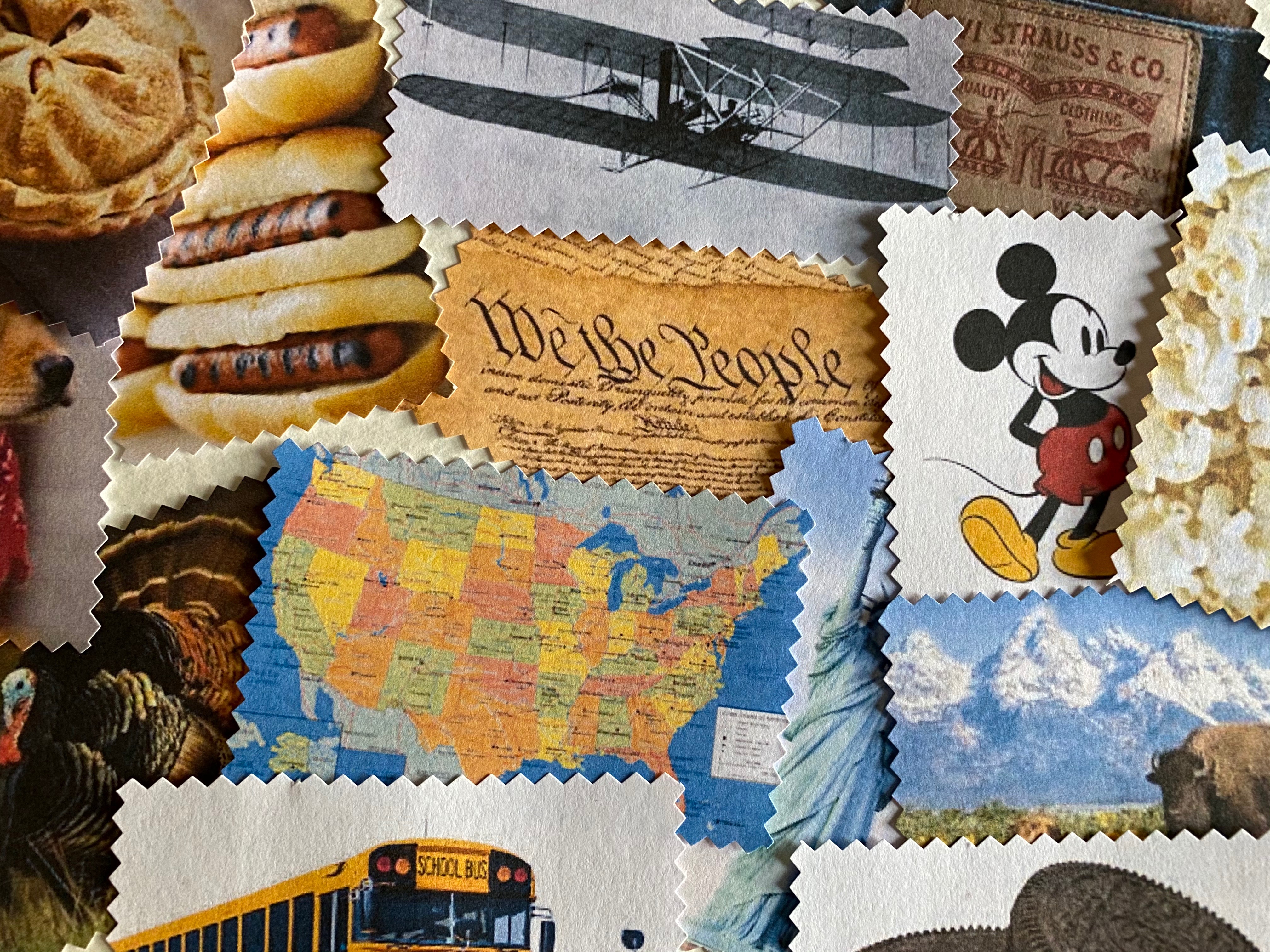
Look what we made:  our American experience collage (my son’s first collage)

Part of the American Collage – Classical Music:

Amy Beach’s “Fireflies” from “Four Sketches, opus 15”, 1892.  (Amy Beach is noted as being the first female American composer.)  “Fireflies” may just be our favorite summertime classical music selection.  We have probably listened to it 100 times, each time reminding us of firefly magic during sultry summer nights when we lived in Georgia.  The piece sparkles –

Florence Price’s “Silk Hat and Walking Cane” from her “Dances in the Canebrakes”, 1953.   (Florence Price is noted as being the first female African-American composer.)  This delightful short piece provided an opportunity to chat with my son about this well-structured composition’s thematic set-up:  We listened for themes  A – B – A (developed) – C – and finally back to A –  

Charles Ives’ “Country Band March”, composed in 1903.  This is a true musical collage in which Ives has jaggedly juxtaposed fragments from more than 12 recognizable American marches and folk melodies.  When we listen to this, my son and I pretend we are making our way through a crowded carnival midway with American music blaring at us from all sides – 

Welcome to the best part of my day!
– Jane BH
(story problem answers:  1)  240 apples,  2)  960 apples,  3)  less, 4) 180 apples)